
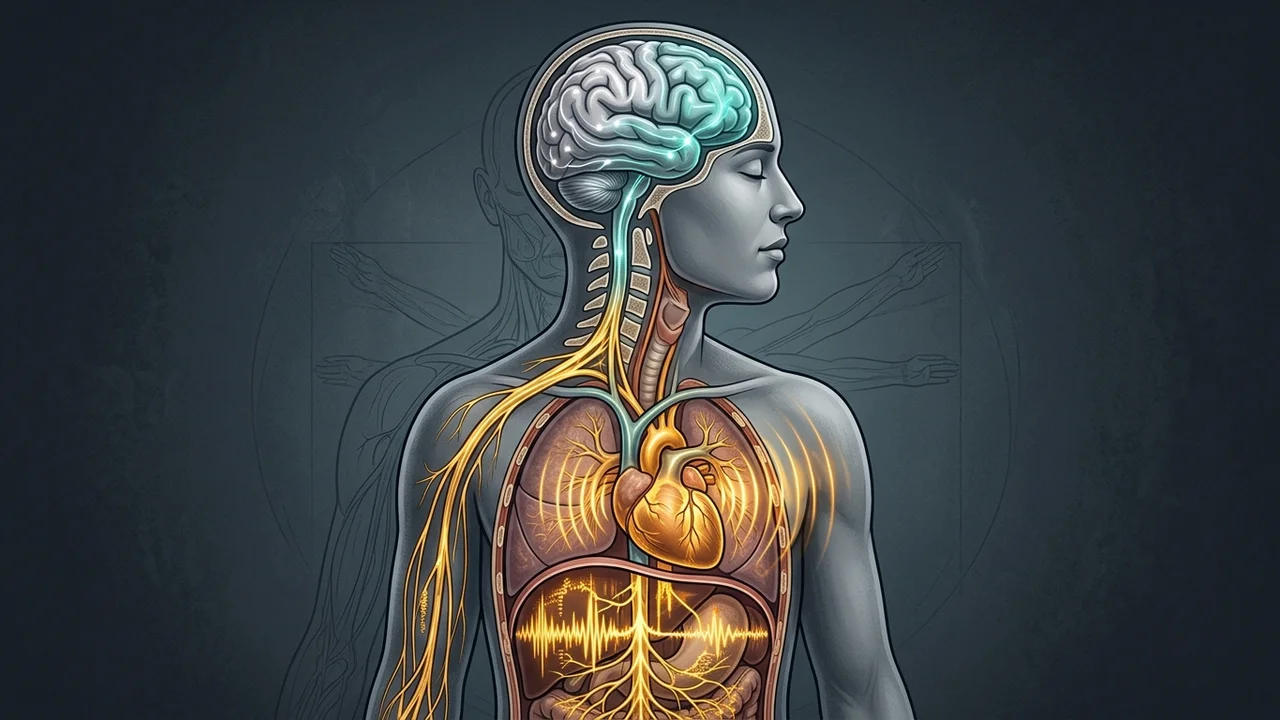
1. The Mind-Body Disconnect: Clinical Phenomenology
Modern psychiatry long operated under the assumption that anxiety originates in cognitive appraisal: a catastrophic thought triggers an emotional response, which subsequently drives physical tension. However, contemporary neuroimaging reveals that in tens of thousands of individuals, the reverse occurs—or the two systems detach completely.
Patients experiencing dissociated hyperarousal frequently find themselves lying comfortably on the sofa reading a book or enjoying a tranquil walk, only to have their body erupt into visceral panic. Tremors, air hunger, paroxysmal tachycardia, and gastrointestinal clenching develop abruptly. When clinicians investigate, patients pass cognitive assessments with flying colors: they are not catastrophizing, they have no acute stressors, and their subjective mental state is calm. Understanding these somatic nervous system overload symptoms requires moving beyond cognitive models into the deep brainstem.
2. Cortical vs. Subcortical Pathways: The Dual Neural Architecture
In groundbreaking research at New York University, neuroscientist Dr. Joseph LeDoux demonstrated that sensory information reaching the brain splits into two distinct operational pathways:
- The High Road (Cortical): Thalamus → Sensory Cortex → Prefrontal Cortex → Amygdala. This pathway is conscious, analytical, accurate, and relatively slow (taking approximately 250 to 300 milliseconds). It allows you to analyze context and realize that the coiled object on the hiking trail is merely a harmless garden hose.
- The Low Road (Subcortical): Thalamus → Basolateral Amygdala → Hypothalamus → Brainstem. This pathway is subconscious, evolutionary, reflex-based, and lightning-fast (taking approximately 12 milliseconds). It activates before the conscious cortex has processed a single pixel of visual information.
When subcortical circuits have been sensitized by chronic allostatic load, historical trauma, or autonomic conditioning, the Low Road can fire autonomously. The brainstem floods the spinal cord with sympathetic impulses and triggers adrenal adrenaline secretion without sending an alarm signal to the conscious prefrontal cortex. The body is in combat; the mind is reading a novel.
Neuro-Endocrine Insight: Peripheral Epinephrine vs. Central Cognition
Circulating epinephrine and norepinephrine released by the adrenal medulla do not cross the blood-brain barrier under normal physiological conditions. They stimulate peripheral beta-1 receptors on cardiomyocytes and alpha-1 receptors on peripheral vasculature, accelerating pulse and blood pressure while central prefrontal neurochemistry remains unaltered.
3. Visceral Afferents and the Nucleus Tractus Solitarius
The vagus nerve is 80% to 85% sensory (afferent), conveying continuous streams of mechanical, chemical, and inflammatory information from internal organs up to the nucleus tractus solitarius (NTS) in the medulla oblongata. If subclinical gut inflammation, diaphragmatic restriction, or postural tension stimulates vagal afferents, the NTS forwards these alarm signals directly to the locus coeruleus and amygdala.
This generates a bottom-up somatic alarm. The autonomic nervous system mobilizes cardiovascular and muscular tension based on internal physiological cues rather than environmental threats or mental worries. This illuminates why food intolerances, subclinical histamine release, or respiratory muscle fatigue can trigger acute physical anxiety in the complete absence of conscious worry.
4. Why Cognitive Reframing and Talk Therapy Fail
Traditional cognitive behavioral therapy (CBT) instructs individuals to identify negative automatic thoughts, examine cognitive distortions, and dispute irrational beliefs. However, when the mind is genuinely calm, this approach is fundamentally ineffective. The patient has no negative thoughts to reframe; demanding that they "examine their thinking" often produces iatrogenic distress as they struggle to invent a cognitive cause for a purely somatic event.
To resolve dissociated hyperarousal, interventions must be bottom-up (somatic-to-cerebral) rather than top-down (cerebral-to-somatic). The language of the brainstem is not verbal; it responds exclusively to changes in respiration, proprioceptive input, baroreceptor pressure, and sensory safety signals.
5. Somatic Nervous System Overload: Diagnostic Hallmarks
Clinicians evaluating dissociated autonomic hyperarousal observe a distinct constellation of physiological signs:
- Involuntary Tremor / Myoclonus: Unprovoked micro-tremors in the quadriceps, hands, or abdomen as muscle spindles discharge excess motor neuron excitability.
- Diaphragmatic Rigidity & Air Hunger: Spasm of the phrenic-innervated diaphragm causing rapid shallow thoracic breathing even while relaxed.
- Sinus Tachycardia with High Voltage ECG: Pulse accelerating above 100 bpm without rhythm disturbance or ST-segment abnormalities.
- Peripheral Vasoconstriction: Icy hands and feet accompanied by warm trunk temperatures, reflecting selective adrenergic alpha-constriction.
6. Bottom-Up Neuro-Sensory Pacing Protocols
To communicate safety directly to the brainstem without requiring cognitive intervention, neurophysiologists utilize targeted mechanosensory and autonomic pacing:
- Carotid Baroreceptor Activation via Extended Exhale: Exhaling against gentle pursed-lip resistance for 6 to 8 seconds increases intrathoracic pressure, stimulating aortic and carotid baroreceptors to signal the brainstem to downregulate heart rate.
- Bilateral Proprioceptive Grounding: Alternating rhythmic pressure between the left and right foot (or bilateral knee tapping) stimulates somatic sensory cortex circuits, inhibiting limbic hyperactivity.
- Oculocardiac Reflex Stimulation: Gently closing the eyes and engaging lateral divergence triggers vagal efferent deceleration via trigeminal-vagal brainstem connections.