
1. What Is an Emotional Flashback? The Somatosensory Siege
Unlike standard PTSD flashbacks, which often feature vivid visual or auditory hallucinations of a past event (such as an explosion or combat scene), emotional flashbacks are primarily somatic and affective. Characteristically observed in Complex PTSD (C-PTSD), an emotional flashback floods the individual with overwhelming visceral feelings: intense shame, catastrophic dread, extreme loneliness, profound helplessness, and physical collapse.
Because there is no visual memory attached, the person rarely realizes they are flashing back. Instead, they believe that their current life, their relationships, or their work situation is actively falling apart. The amygdala and insular cortex fire at emergency capacity, convincing the conscious mind that the present moment is mortally dangerous.
2. Interoception and the Insular Cortex: The Neural Blueprint
Interoception is the sense of the internal physiological condition of the body: heart rate, visceral distension, respiration, hunger, pain, and vascular temperature. Interoceptive signals travel via unmyelinated C-fibers and the vagus nerve to the thalamus, projecting to the posterior and anterior insular cortex.
The anterior insular cortex (AIC) is the biological seat of subjective emotional feeling. In a regulated nervous system, the AIC balances interoceptive signals to maintain homeostasis. During a trauma trigger, the AIC is hijacked by visceral alarms from the gut and heart, interpreting these somatic surges as proof of current catastrophe. To break this loop, the AIC must be directed toward an intentional, neutral somatic reference point.
Neuro-Biological Principle: The Somatic Island Concept
Even during the most violent panic or emotional flashback, trauma rarely occupies 100% of the human body. Certain anatomical zones—such as the thumbnail, the tip of the nose, the palms, or the heels—remain completely neutral or comfortable. Training the insular cortex to anchor onto these "somatic islands" allows the prefrontal cortex to regain inhibitory control over the amygdala.
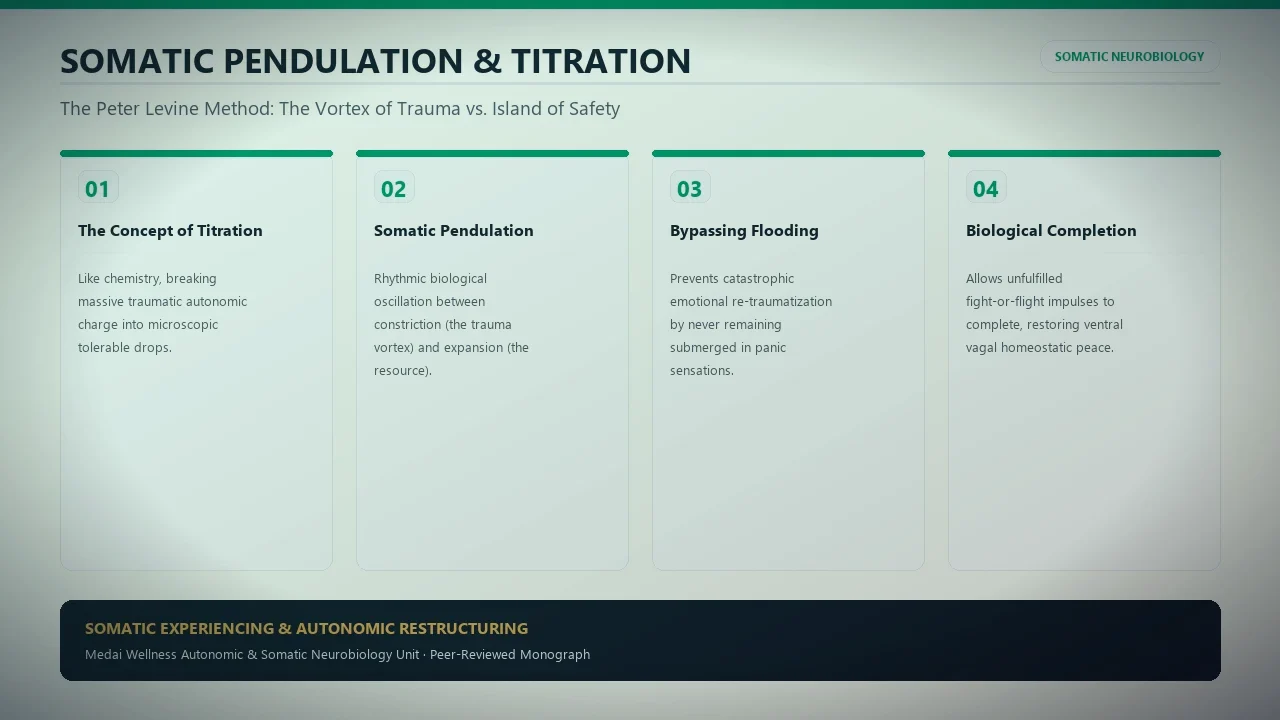
3. Somatic Pendulation and Titration: Dr. Peter Levine's Discovery
Developed by Dr. Peter Levine, founder of Somatic Experiencing, pendulation is the natural rhythmic movement between contraction and expansion, between distress and resource. When a traumatized individual focuses exclusively on their pain, terror, or racing heart, the nervous system enters an amplification loop: the tension increases, which frightens the mind, which increases the tension further.
Pendulation breaks this vortex by deliberately shifting attention between the vortex of trauma (the area of tightness or panic in the chest/throat) and the vortex of safety/resilience (the pre-identified interoceptive safety anchor). By oscillating attention back and forth in small, measured increments (titration), the nervous system discharges trapped survival energy without becoming overwhelmed.
4. Somatic Pendulation and Nervous System Safety
The neurobiology of somatic pendulation and nervous system safety demonstrates that the brain cannot sustain two conflicting affective states across the same neural networks. By repeatedly bringing conscious interoceptive focus back to a zone of safety, you activate the ventral vagal brake.
- Inhibition of Central Amygdala: Directing sensory focus to a neutral body part sends inhibitory signals from the medial prefrontal cortex down to the basolateral amygdala.
- Decreased Cardiac Acceleration: Shifting attention away from thoracic constriction normalizes respiratory depth, allowing carotid baroreceptors to slow the heart rate.
- Re-establishment of Dual Awareness: The patient simultaneously feels the emotional trigger and the physical anchor, training the brain that the trigger is merely an echo of the past.
5. Constructing Your Interoceptive Safety Anchor
An effective interoceptive safety anchor must be identified and practiced during periods of relative calm so that it is readily accessible during acute distress. Follow this clinical protocol to find your anchor:
- Scan for Neutrality: Close your eyes and slowly scan your peripheral anatomy: the earlobes, the back of your hands, the contact point between your calves and the chair, or the palms resting together.
- Locate a 0/10 Distress Zone: Find an area that feels completely neutral, calm, or pleasantly warm. It does not need to feel ecstatic; simple neutral ease is the goal.
- Kinesthetic Reinforcement: Pair this location with a subtle physical gesture, such as pressing the thumb and forefinger together or placing one hand firmly over the heart. Practice holding attention on this physical sensation for 30 seconds, twice daily.
6. The Step-by-Step Emergency Flashback Recovery Sequence
When an emotional flashback hits, execute this exact 5-step neuro-somatic protocol:
- Name the State: Say aloud: "I am having an emotional flashback. I am an adult in the year 2026. My body is remembering the past, but I am physically safe right now."
- Locate Your Interoceptive Anchor: Immediately divert 70% of your conscious attention to your pre-established physical anchor (e.g., the soles of your feet firmly planted on the floor or your thumb pressing your index finger).
- Practice Somatic Pendulation: Notice the sensation in your anchor for 10 seconds. Then, allow your attention to touch the edges of the tightness in your chest for just 2 seconds. Immediately return to your anchor for another 10 seconds. Repeat 5 times.
- Extend the Expiratory Phase: Inhale gently through your nose for 4 seconds, then exhale smoothly through pursed lips for 7 seconds to activate acetylcholine release at the heart.
- Orient Visually: Look around the room and find three circular objects and two blue objects. This re-engages the occipital-parietal visual cortex and pulls you fully into the present physical environment.