
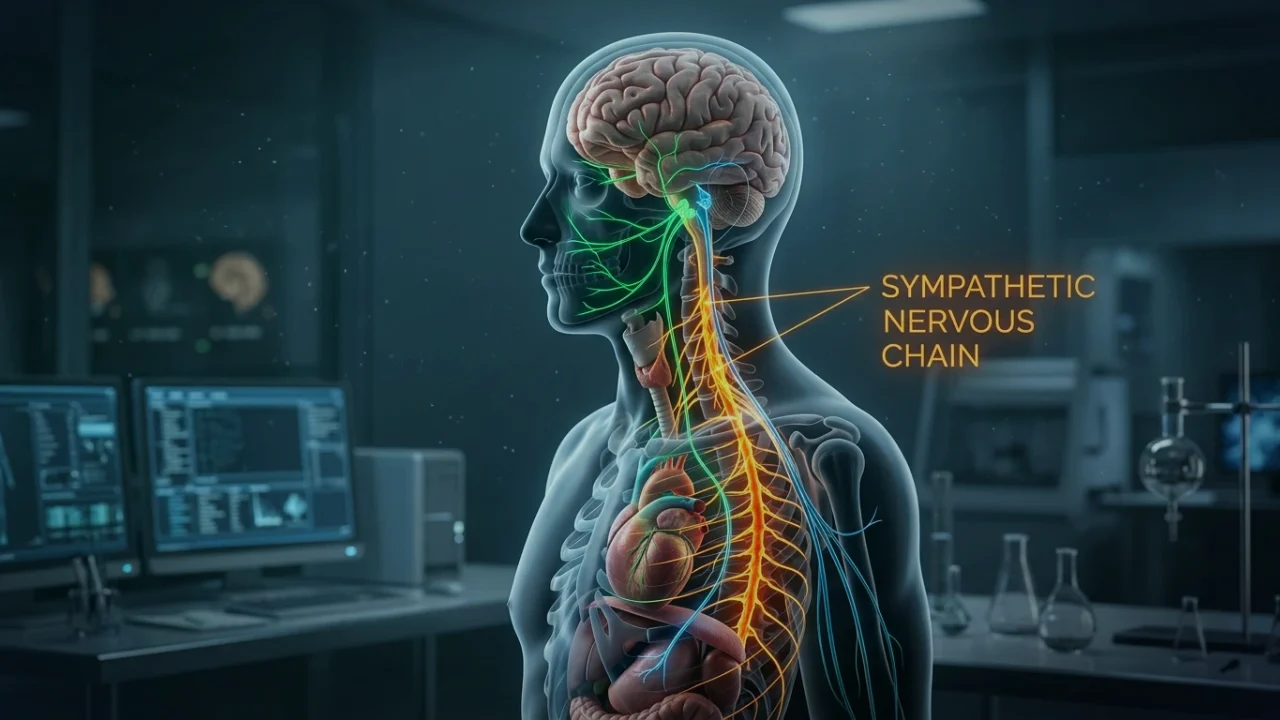
1. What Is Neuroception? Beyond Conscious Perception
In classical psychology, perception is understood as the conscious processing of sensory information: you look at an object, register its shape, and recognize it. In 2004, neuroscientist Dr. Stephen Porges introduced the term neuroception to describe an entirely different biological process: the continuous, subconscious scanning conducted by our nervous system to assess whether people and environments are safe, dangerous, or life-threatening.
Neuroception operates independently of the prefrontal cortex. Long before your rational mind can articulate whether a room is safe, your autonomic nervous system has already evaluated subtle acoustic frequencies, lighting conditions, body postures, facial micro-expressions, and internal visceral sensations. When neuroception detects safety, it activates the ventral vagal complex, allowing heart rate deceleration, spontaneous social engagement, and cellular rest. When it detects threat, it instantaneously mobilizes fight-or-flight or triggers shutdown.
2. The Amygdala-Insula Threat Architecture
The neural circuitry underlying neuroception spans several interconnected subcortical structures:
- Superior Temporal Sulcus & Fusiform Gyrus: Decode facial expressions, biological motion, and vocal prosody.
- Insular Cortex: Monitors interoceptive states—heartbeats, gut distension, and body temperature—determining whether the internal physiological landscape feels safe.
- Central Nucleus of the Amygdala (CeA): The master executor that receives converging sensory data and immediately commands the lateral hypothalamus and brainstem reticular formation to initiate defensive arousal.
In a healthy nervous system, the medial prefrontal cortex (mPFC) maintains strong inhibitory control over the amygdala, dampening false alarms. However, under prolonged allostatic load or adverse developmental experiences, mPFC neuroplastic connectivity degrades, leaving the amygdala uninhibited and hyper-responsive.
Clinical Diagnostic Insight: The False Alarm Threshold
In functional fMRI paradigms, individuals with trauma-distorted neuroception show robust amygdalar and insular BOLD activation in response to completely neutral facial expressions. The brainstem interprets ambiguous social cues as hostile threats, demonstrating that hypervigilance is a failure of neural threat inhibition rather than a failure of logical thought.
3. How Chronic Stress and Trauma Distort the Threat Radar
The evolutionary goal of the nervous system is not happiness or tranquility; it is survival. To maximize survival in unpredictable environments, the brain operates on a "better safe than sorry" heuristic. If a neutral sensory stimulus (such as a sudden silence, a specific tone of voice, or an open doorway) was historically paired with danger, neuroception permanently tags that sensory signature as threatening.
Over time, this creates a state where the individual cannot relax in safe environments. Quiet spaces become terrifying because silence historically preceded an ambush; resting becomes distressing because vulnerability is equated with catastrophe. This foundational distortion is the driving engine of neuroception and trauma-driven hypervigilance.
4. The Role of Acoustic and Visual Social Engagement Signals
One of the most profound discoveries in polyvagal neuroscience is that human neuroception is deeply attuned to vocal acoustics. The human middle ear muscles (stapedius and tensor tympani) are innervated by Cranial Nerves VII and V. When ventral vagal tone is high, these muscles contract, filtering out low-frequency background rumbles and optimizing hearing for the melodic, high-frequency range of the human voice (social prosody).
When neuroception shifts toward danger, the stapedius relaxes. The middle ear becomes tuned to low-frequency sounds (predator rumbles, thunder, mechanical hums) and high-frequency screeches, making human conversation sound distant, harsh, or threatening. This acoustic shift reinforces feelings of alienation and paranoia even within familiar social settings.
5. Neuroception and Trauma-Driven Hypervigilance
When neuroception is chronically calibrated toward threat, it generates systemic physiological consequences throughout the body:
- Continuous Sympathetic Tonus: Resting heart rates elevate above 80 bpm; high-frequency heart rate variability (HF-HRV) drops significantly.
- Inhibited Digestion: Salivation decreases, gastric acid production drops, and intestinal motility halts, fostering dysbiosis and food sensitivities.
- Compromised Immune Function: Pro-inflammatory cytokines (IL-6, TNF-alpha) surge while protective natural killer (NK) cell cytotoxicity is suppressed.
6. Neuroplastic Rewiring: Teaching the Brainstem Safety
Because you cannot argue with your amygdala through intellectual debate, recalibrating neuroception requires feeding the subcortical brain deliberate, sensory-rich cues of safety:
- Prosodic Vocal Interaction: Engaging in conversations with individuals who speak with warm, melodic vocal modulation directly stimulates the listener's middle ear and ventral vagal circuits.
- Visual Horizon Scanning: Expanding visual attention into panoramic peripheral awareness signals the superior colliculus and brainstem that no predators are lurking in proximity.
- Somatic Pendulation: Alternating awareness between an area of physical tension and an area of neutral or comfortable sensation (such as the palms or soles of the feet) trains the insula to process safety.
- Controlled Respiratory Pacing: 4-second inhales paired with 6-second exhales stimulate pulmonary mechanoreceptors, sending unmistakable sensory confirmation of safety up to the solitary tract.