
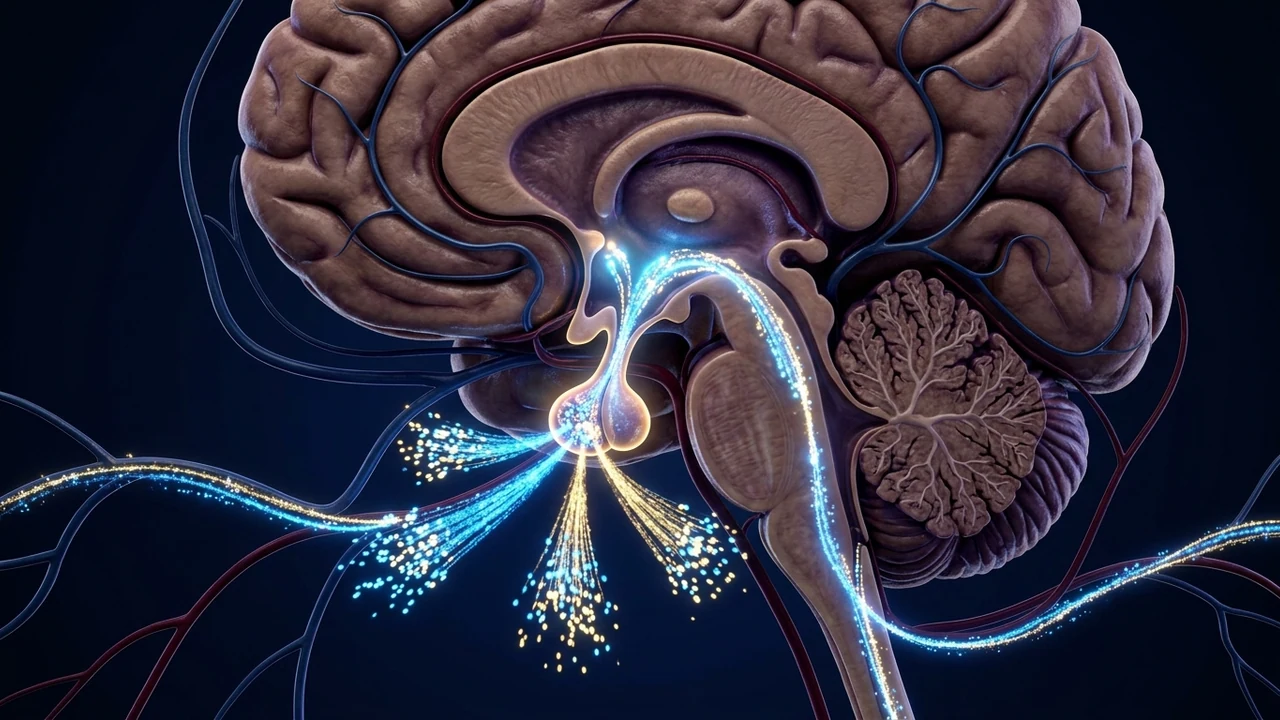
1. Defining the Neuroendocrine Somatopause
The term somatopause describes the progressive, age-associated attenuation of the somatotropic axis, comprising hypothalamic Growth Hormone-Releasing Hormone (GHRH), somatostatin, pituitary Growth Hormone (GH), and hepatic Insulin-like Growth Factor 1 (IGF-1).
While peak growth hormone production occurs during puberty, secretion begins a relentless downward trajectory around age 30. By age 60, most adults secrete less than one-third of the daily growth hormone produced in young adulthood. Age-related growth hormone decline forms a key pillar among the hormonal causes of lower belly fat distribution, transforming body composition even in individuals whose body weight remains unchanged.
2. Growth Hormone: The Master Visceral Lipolytic Hormone
In mature adults, growth hormone is not primarily an agent of linear skeletal growth; it is a master regulator of substrate metabolism. Specifically, GH exerts two non-negotiable physiological effects on fat tissue:
- Selective Visceral Lipolysis: GH directly binds to growth hormone receptors (GHR) on adipocytes, stimulating the transcription of adipose triglyceride lipase (ATGL) and hormone-sensitive lipase (HSL). Clinical studies demonstrate that visceral adipocytes are vastly more sensitive to GH-stimulated lipolysis than subcutaneous fat.
- Inhibition of Lipoprotein Lipase (LPL): GH potently suppresses LPL activity in central adipose tissue, preventing the uptake of circulating fatty acids into fat cells while directing them toward skeletal muscle for oxidation.
When growth hormone levels collapse during the somatopause, this powerful visceral brake is removed. LPL activity runs unchecked in omental fat, and intracellular lipolysis plummets.
3. The Slow-Wave Sleep Connection: Where GH Is Born
In healthy adults, up to 70% of total daily growth hormone is released in a massive, pulsatile surge during Stage 3 and Stage 4 Slow-Wave Sleep (SWS), typically within the first 90 minutes of sleep onset. This nocturnal surge is strictly dependent on parasympathetic autonomic dominance.
However, chronic psychological stress and autonomic dysregulation create nocturnal sympathetic hyperarousal. When nighttime cortisol and norepinephrine remain high:
- The hypothalamus secretes somatostatin (Growth Hormone-Inhibiting Hormone), which directly blunts the pituitary release of GH.
- Slow-wave deep sleep architecture is fragmented and abbreviated, depriving the pituitary of the neural trigger required for the nocturnal somatotropic pulse.
- The individual wakes up in a state of neuroendocrine deficit, with zero nocturnal visceral fat mobilization and elevated morning insulin resistance.
4. Clinical Comparison: Healthy Somatotropic Function vs. Somatopause
| Physiological Parameter | Optimal Somatotropic Function (Age 20–30) | Advanced Somatopause (Age 45–65+) |
|---|---|---|
| Daily GH Secretion Rate | 500 – 1000 mcg / 24 hours | 60 – 150 mcg / 24 hours |
| Serum IGF-1 Concentration | 220 – 350 ng/mL | 90 – 160 ng/mL |
| Percentage of Slow-Wave Sleep (SWS) | 20% – 25% of total sleep time | 5% – 10% (frequently near zero in severe insomnia) |
| Fat Distribution Pattern | Peripheral, subcutaneous, gynoid buffer | Central android, omental, intrahepatic ectopic fat |
| Skeletal Muscle Protein Synthesis | High anabolic preservation; rapid recovery | Accelerated sarcopenia; delayed recovery |
| Vascular Endothelial Nitric Oxide | Optimal arterial compliance & dilation | Endothelial stiffness; microvascular impairment |
5. The Visceral Sarcopenic Spiral
The convergence of growth hormone decline and visceral fat expansion creates a destructive self-reinforcing feedback loop termed the visceral sarcopenic spiral:
As visceral fat expands, it releases elevated quantities of Interleukin-6 (IL-6) and Tumor Necrosis Factor-alpha (TNF-alpha) directly into the portal circulation. These inflammatory cytokines travel to the liver and brain, where they cross the blood-brain barrier and stimulate hypothalamic somatostatin release, further suppressing growth hormone. Less growth hormone accelerates both muscle loss (sarcopenia) and visceral fat storage, deepening the metabolic trap.
6. Evidence-Based Protocols to Naturally Stimulate the Somatotropic Axis
While pharmaceutical recombinant human growth hormone (rhGH) therapy carries significant oncological and diabetogenic risks, endogenous somatotropic secretion can be profoundly amplified through physiological neuromodulation:
- Strict Elimination of Pre-Bed Hyperglycemia: Insulin and growth hormone are mutually antagonistic. Consuming carbohydrates within 2.5 hours of bed spikes insulin, which completely suppresses nocturnal pituitary GH release. Maintain a 3-hour fast before sleep.
- Thermal Stress (Sauna Conditioning): Hyperthermic conditioning (20–30 minutes in a dry sauna at 175°F/80°C) triggers heat shock proteins and induces a temporary, acute 200% to 500% spike in endogenous growth hormone that persists for several hours.
- Restoration of Delta Slow-Wave Sleep: Utilize non-invasive neuro-acoustic stimulation, glycine supplementation (3–5 grams), and nocturnal parasympathetic vagal stimulation to lengthen SWS duration and optimize the nocturnal pulse.
- High-Load Eccentric Resistance Training: Heavy compound resistance training (squats, deadlifts, presses at 75–85% of 1RM) stimulates maximal motor unit recruitment, triggering acute systemic growth hormone and IGF-1 elevation.