
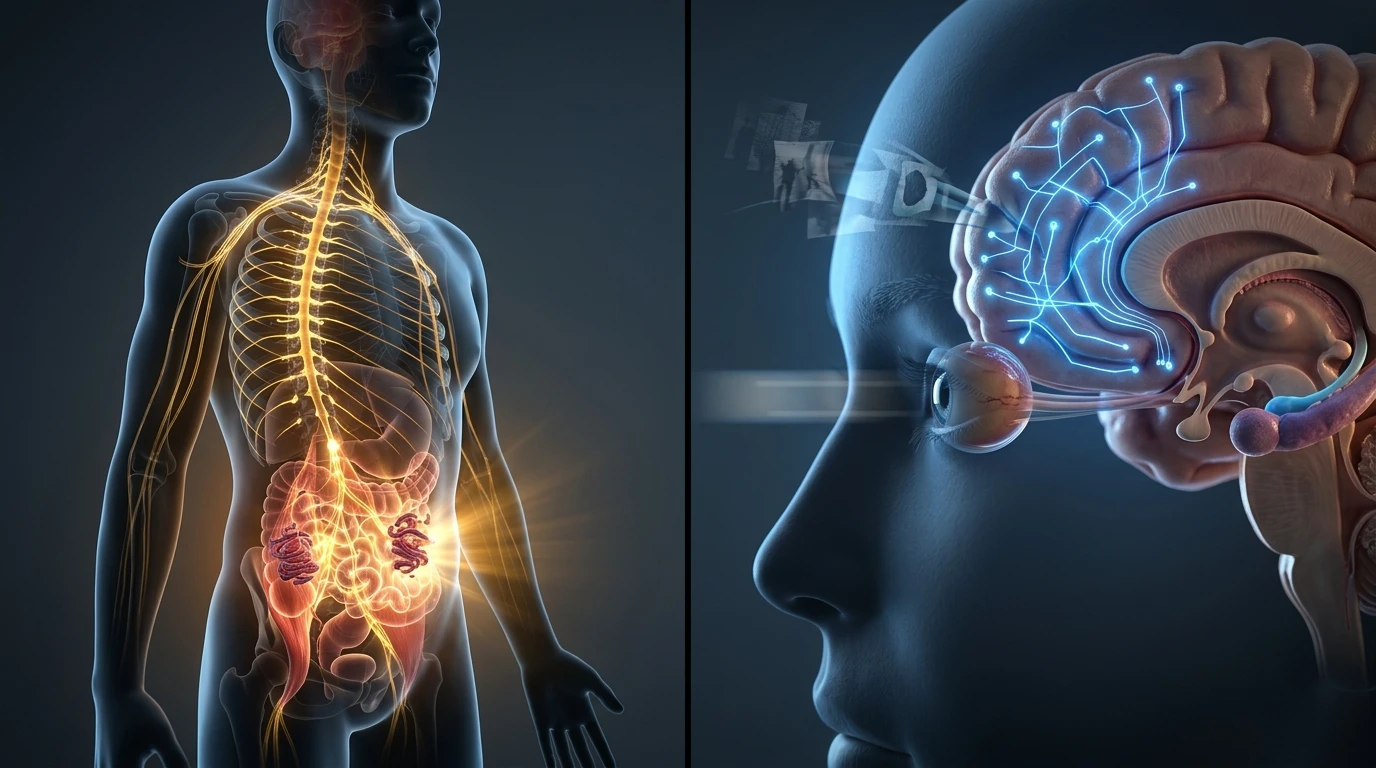
1. The Neurobiology of Trapped Survival Responses: Incomplete Flight, Fight or Freeze
When an organism encounters life threat, the autonomic nervous system mobilizes massive survival energy: the amygdala triggers the sympathetic fight-or-flight cascade, flooding tissues with adrenaline and cortisol. If active defense is impossible, the ancient unmyelinated dorsal vagal motor complex takes over, triggering the freeze/shutdown response (hypoarousal, analgesia, dissociation).
In wild animals, once danger passes, the freeze state is discharged through spontaneous neurogenic tremors, shaking, and deep respirations, resetting the nervous system to baseline. However, modern humans frequently abort this natural discharge due to social conditioning and fear of physical sensations. Consequently, survival energy remains trapped in the neuromuscular and autonomic architecture, generating chronic hyperarousal, muscle armor, anxiety, and somatic illnesses.
2. Somatic Experiencing (SE): Bottom-Up Interoceptive Titration & Pendulation
Created by Dr. Peter Levine, Somatic Experiencing is a "bottom-up" physiological therapy that focuses on internal visceral bodily sensations (interoception) rather than narrative cognitive storytelling. It operates through three core neurological principles:
- Circadian Endocrine Diagnostics: Explore our research on cortisol levels chart by time of day.
- Foundational Neurobiology: Review our clinical analysis on the physiological sigh and autonomic anxiety reset.
- The SIBAM Model: Tracks Experience across Sensation, Image, Behavior, Affect, and Meaning, prioritizing primary visceral sensation over cognitive meaning.
- Titration: Exposes the client to tiny, micro-doses of traumatic activation rather than overwhelming catharsis, keeping arousal within the client's "Window of Tolerance" and preventing re-traumatization.
- Pendulation: Guides the nervous system rhythmically between an island of physiological safety (resourced state) and a localized area of traumatic constriction. This alternating rhythm trains the autonomic nervous system to expand its resilience.
- Neurogenic Discharge: Completes previously thwarted survival motor impulses, manifesting as involuntary trembling, tingling, warmth, or deep spontaneous sighs that release trapped dorsal vagal energy.
3. EMDR: Bilateral Stimulation and Working Memory Taxation
Eye Movement Desensitization and Reprocessing (EMDR), developed by Dr. Francine Shapiro, is an 8-phase protocol that facilitates the Adaptive Information Processing (AIP) model. Traumatic memories are stored in raw, state-specific, maladaptive forms, frozen in the limbic system without proper integration into cortical episodic memory networks.
During EMDR, the patient holds an image of the traumatic memory, its negative cognitive belief, and associated bodily sensation while engaging in Bilateral Stimulation (BLS)—typically alternating saccadic horizontal eye movements, auditory tones, or tactile vibrations:
- Working Memory Taxation: The human central executive working memory has limited capacity. Performing simultaneous bilateral saccades while retrieving a traumatic memory taxes working memory resources, degrading the emotional vividness of the memory.
- De-arousal Reflex (The Orienting Response): Smooth bilateral saccades mimic REM sleep eye movements and engage the neurological orienting response, signaling to the amygdala that no immediate danger is present in the current room, rapidly reducing physiological arousal.
- Interhemispheric Communication: Bilateral movements promote functional connectivity between the right hemisphere (emotional, sensory data) and left hemisphere (linguistic, logical contextualization), enabling the memory to be filed away into long-term declarative history.
4. Comprehensive Clinical Comparison: SE vs. EMDR
| Clinical Parameter | Somatic Experiencing (SE) | EMDR |
|---|---|---|
| Primary Directionality | Bottom-Up (Body/viscera → Brainstem → Cortex) | Dual Processing (Cognitive image + Bilateral somatic tracking) |
| Need for Verbal Narrative | Minimal; can resolve trauma without ever speaking the event | Moderate; targets specific memories, beliefs, and emotions |
| Core Neurological Mechanism | Interoceptive titration, pendulation, motor completion | Working memory taxation, bilateral interhemispheric processing |
| Handling Dissociation / Freeze | Exceptionally Safe (Gentle titration prevents collapse) | Requires caution; rapid BLS can occasionally flood or dissociate |
| Physical Signs of Resolution | Involuntary neurogenic shaking, tingling, sighs, gut gurgles | Desensitization of SUDs score, cognitive shift, somatic calm |
| Ideal Target Indications | Pre-verbal trauma, chronic medical trauma, dysautonomia, hEDS | Single-incident shock trauma (car accidents, assaults), phobias |
5. Clinical Indications: Which Therapy Fits Your Nervous System Profile?
Neither therapy is universally superior; their efficacy depends on the patient's presenting autonomic state:
- Choose Somatic Experiencing if: You experience pervasive somatic symptoms (IBS, fibromyalgia, dysautonomia, MCAS), tend to dissociate or go numb under stress, have early childhood or pre-verbal developmental trauma, or find that thinking or talking about the trauma triggers immediate panic or physical spasms.
- Choose EMDR if: You have discrete, identifiable single-incident shock traumas (a specific motor vehicle accident, combat event, or physical assault), have sufficient emotional stability to tolerate brief intense imagery, and want a structured, protocol-driven resolution with clear before-and-after subjective units of distress (SUDs).
6. Synergistic Integration: Combining Somatic Tracking with Autonomic Regulation
Leading trauma clinics increasingly combine both modalities. An initial phase of Somatic Experiencing establishes bodily safety, autonomic regulation, and interoceptive capacity. Once the patient's "Window of Tolerance" is broadened, EMDR can be applied safely to clear complex cognitive memories and negative self-beliefs without risk of triggering dissociative shutdown.
Frequently Asked Questions (Clinical FAQ)
Can Somatic Experiencing heal trauma without having to retell the painful story?
Yes, completely. SE focuses on the physiological sensation of trapped survival energy in the body. A certified SE practitioner can guide you through physical discharge and autonomic pendulation without you ever having to describe what happened verbally.
Why do my hands or legs shake during Somatic Experiencing sessions?
Involuntary neurogenic trembling is a healthy biological sign that the nervous system is discharging trapped survival energy. In nature, animals shake vigorously after escaping a predator to reset their nervous system; SE allows humans to complete this natural discharge.
Can EMDR make trauma symptoms worse?
If an EMDR therapist moves into bilateral stimulation too quickly before establishing adequate grounding and resourcing, a patient can become emotionally flooded or dissociated. Skilled therapists carefully evaluate stability before targeting intense memories.
How many sessions of EMDR or SE are typically required?
For single-incident shock trauma (like an adult car crash), 3 to 8 sessions of EMDR often achieve complete desensitization. For complex developmental trauma (C-PTSD) spanning years of childhood adversity, Somatic Experiencing or phased EMDR may require several months of consistent work.
Which modality is better for treating chronic pain and fibromyalgia?
Somatic Experiencing is generally superior for chronic pain and fibromyalgia because it directly retrains the brainstem and interoceptive insular cortex to separate physical sensation from emotional threat signals.
Can I do Somatic Experiencing on myself at home?
While deep trauma discharge is best facilitated by an SEP (Somatic Experiencing Practitioner), self-directed somatic tracking—gently noting tension in the body and pendulating your focus between tight areas and neutral/pleasant areas—is a powerful daily regulation practice.
Scientific References & Clinical Citations
- Somatic experiencing: using interoception and proprioception in trauma therapy — Frontiers in Psychology (2015). [PubMed / Study Link]
- Eye movement desensitization and reprocessing (EMDR) therapy: an overview of the active mechanisms — Frontiers in Psychology (2018). [PubMed / Study Link]
- Working memory taxation during EMDR: why eye movements reduce emotional intensity — Journal of Anxiety Disorders (2011). [PubMed / Study Link]
- Waking the Tiger: Healing Trauma — North Atlantic Books (1997). [PubMed / Study Link]