
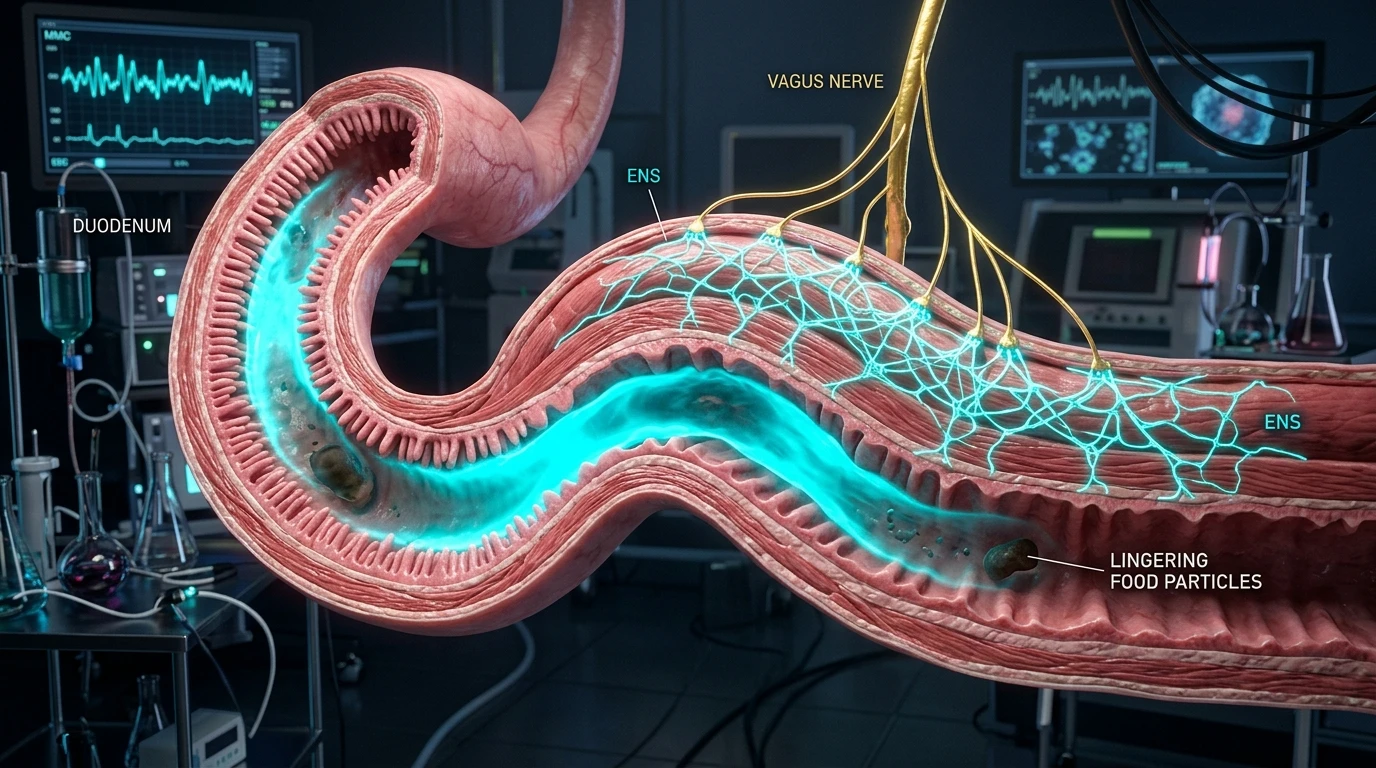
1. The Intestinal Sweeper: Anatomy and Phases of the MMC
In a healthy gastrointestinal tract, the stomach and small intestine exhibit a specialized cyclical motility pattern known as the Migrating Motor Complex (MMC). Operating as the digestive tract's "housekeeping wave," the MMC sweeps residual food particles, cellular debris, and bacteria down into the colon.
Crucially, the MMC operates exclusively during fasting—initiating 90 to 120 minutes after gastric emptying. The MMC cycles continuously until interrupted by food ingestion, which immediately aborts the complex in favor of postprandial mixing motility:
- Foundational Neurobiology: Review our clinical analysis on the physiological sigh and autonomic anxiety reset.
- Phase I (Quiet Period): 45 to 60 minutes of motor quiescence without mechanical contractions.
- Phase II (Irregular Contractions): 30 to 45 minutes of intermittent peristaltic contractions building in frequency.
- Phase III (The Housekeeping Wave): 5 to 10 minutes of intense, high-amplitude, propagating contractions (10–12 contractions/min) sweeping from stomach through ileum like a biological snowplow.
- Phase IV (Transition): A brief 2-to-5-minute decay returning to Phase I quiescence.
2. Neurological Wiring: Vagal Efferents & Interstitial Cells of Cajal
The execution of the MMC relies on a tripartite neurological hierarchy: the Central Autonomic Network (via the Vagus Nerve), the Enteric Nervous System (ENS), and electrical pacemakers called Interstitial Cells of Cajal (ICC).
Parasympathetic motor output originates in the Dorsal Motor Nucleus of the Vagus (DMNX). Long vagal efferent fibers descend into the abdomen and synapse on cholinergic neurons in the Myenteric (Auerbach's) Plexus between the smooth muscle layers. These neurons release acetylcholine and VIP to stimulate the Interstitial Cells of Cajal, which generate electrical slow waves that coordinate Phase III contractions. When vagal tone is suppressed by chronic stress, concussion, or systemic inflammation, the brainstem fails to coordinate the ICC pacemakers, intestinal stasis ensues, and bacteria flourish.
3. Post-Infectious Autoimmunity: Anti-CdtB & Anti-Vinculin Antibodies
In up to 60% of SIBO cases, the original trigger was an episode of infectious food poisoning (Campylobacter, Salmonella, Shigella, E. coli). Research by Dr. Mark Pimentel at Cedars-Sinai revealed the autoimmune mechanism:
- Cytolethal Distending Toxin B (CdtB): Pathogens secrete the CdtB toxin, provoking a vigorous host antibody response.
- Molecular Mimicry with Vinculin: A critical epitope on CdtB shares structural homology with human Vinculin, a cytoskeletal protein essential for the contractile networks of the Interstitial Cells of Cajal and myenteric neurons.
- Autoimmune Neuropathy: Cross-reactive anti-CdtB antibodies target and degrade host Vinculin, dismantling the neuromuscular junctions of the gut wall. Even though the food poisoning resolved, the patient is left with permanent MMC failure and relapsing SIBO.
4. Diagnostic Profiles: Autoimmune vs. Functional SIBO
| Diagnostic Marker | Post-Infectious Autoimmune SIBO | Functional / Stress-Induced SIBO |
|---|---|---|
| Serum Anti-CdtB Antibodies | Elevated (>1.56 optical density) | Negative / Normal baseline |
| Serum Anti-Vinculin Antibodies | Markedly Elevated (>1.60 optical density) | Negative / Normal baseline |
| Primary Underlying Pathology | Autoimmune neuropathy of Cajal cells and myenteric nerves | Autonomic vagal suppression / sympathetic overdrive |
| Relapse Rate Post-Antibiotics | Extremely High (>80%) without continuous prokinetics | Moderate; resolves once autonomic balance is restored |
| Small Bowel Transit Time | Severely delayed (>6 hours) | Moderately delayed or erratic |
| Core Therapeutic Strategy | Long-term prokinetics + immunomodulation + tVNS | Vagal activation + gut-directed hypnotherapy + meal spacing |
5. The Prokinetic Protocol: Botanical and Pharmacological Agents
Eradicating bacteria without restoring the MMC guarantees relapse. Every SIBO patient requires a dedicated prokinetic agent immediately upon completing antimicrobial therapy:
- Standardized Ginger Root Extract (1,000–1,500 mg at bedtime): Acts as a dual 5-HT4 agonist and cholinergic stimulator, promoting gastric emptying and Phase III intestinal waves.
- Artichoke Leaf Extract (Cynara scolymus): Contains cynaropicrin to stimulate bile acid secretion and duodenal motor activity, synergizing with ginger.
- Low-Dose Naltrexone (LDN, 1.5–4.5 mg at bedtime): Provides a temporary opioid receptor blockade that dampens myenteric neuro-inflammation and accelerates transit.
- Low-Dose Erythromycin (50 mg at bedtime): At sub-antimicrobial micro-doses, erythromycin acts as a direct agonist of the Motilin receptor, reliably triggering Phase III MMC waves.
- Prucalopride (0.5–2.0 mg at bedtime): Highly selective 5-HT4 receptor agonist that stimulates whole-gut peristalsis without cardiac risks.
6. Direct Vagal Neuromodulation: Restoring Intestinal Rhythm
Because the enteric nervous system depends on descending brainstem pacemaking, direct vagal stimulation is the ultimate root-cause therapy:
- Transcutaneous Auricular VNS (taVNS): 20 Hz stimulation to the left cymba conchae twice daily activates the nucleus tractus solitarius, driving efferent cholinergic signaling to the gut.
- Strict Meal Spacing Architecture: Enforcing a 4-to-5-hour fasting window between meals and a 12-hour overnight fast gives the gut uninterrupted windows to complete Phase III cycles.
- Pharyngeal and Laryngeal Activation: Forceful gargling with water, loud singing, and gag-reflex stimulation activate medullary motor nuclei, cross-stimulating descending vagal motor pathways to the gut.
Frequently Asked Questions (Clinical FAQ)
Why does SIBO recur so frequently after taking antibiotics like Rifaximin?
Antibiotics only clear the bacterial overgrowth present at that moment; they do not repair the broken Migrating Motor Complex. If your gut motility remains impaired, bacteria from the colon will migrate right back into the small intestine within weeks.
How does meal spacing help cure SIBO?
The Migrating Motor Complex functions only during fasting states. Eating or snacking immediately halts the MMC. Spacing meals 4 to 5 hours apart allows your digestive tract to complete multiple 90-minute Phase III cleaning waves that flush out bacteria.
Can chronic emotional stress directly cause SIBO?
Yes. Chronic stress triggers sympathetic dominance, shunting blood away from the viscera and suppressing vagus nerve output from the brainstem. Without vagal cholinergic input, the enteric nervous system cannot coordinate the Migrating Motor Complex.
What is the ibs-smart blood test?
The ibs-smart test measures anti-CdtB and anti-Vinculin antibodies. If elevated, it confirms that your SIBO/IBS was triggered by past food poisoning and is driven by an autoimmune neuropathy targeting your gut pacemakers, requiring long-term prokinetic therapy.
When should prokinetics be taken for maximum effect?
Prokinetics must be taken on an empty stomach—ideally immediately before bedtime (at least 3 to 4 hours after your last meal) to amplify the nocturnal Migrating Motor Complex throughout the night.
Is constipation always associated with methane SIBO (IMO)?
Typically, yes. Methanogenic archaea (such as Methanobrevibacter smithii) produce methane gas, which acts as a local neuromuscular paralytic in the bowel, slowing transit and worsening MMC failure.
Scientific References & Clinical Citations
- Autoimmunity to Vinculin and CdtB is common in patients with irritable bowel syndrome and SIBO — PLoS One (2015). [PubMed / Study Link]
- The migrating motor complex: control mechanisms and its role in health and disease — Nature Reviews Gastroenterology & Hepatology (2012). [PubMed / Study Link]
- Hydrogen and Methane-Based Breath Testing in Gastrointestinal Disorders: The North American Consensus — American Journal of Gastroenterology (2017). [PubMed / Study Link]
- The Vagus Nerve at the Interface of the Microbiota-Gut-Brain Axis — Frontiers in Neuroscience (2018). [PubMed / Study Link]