
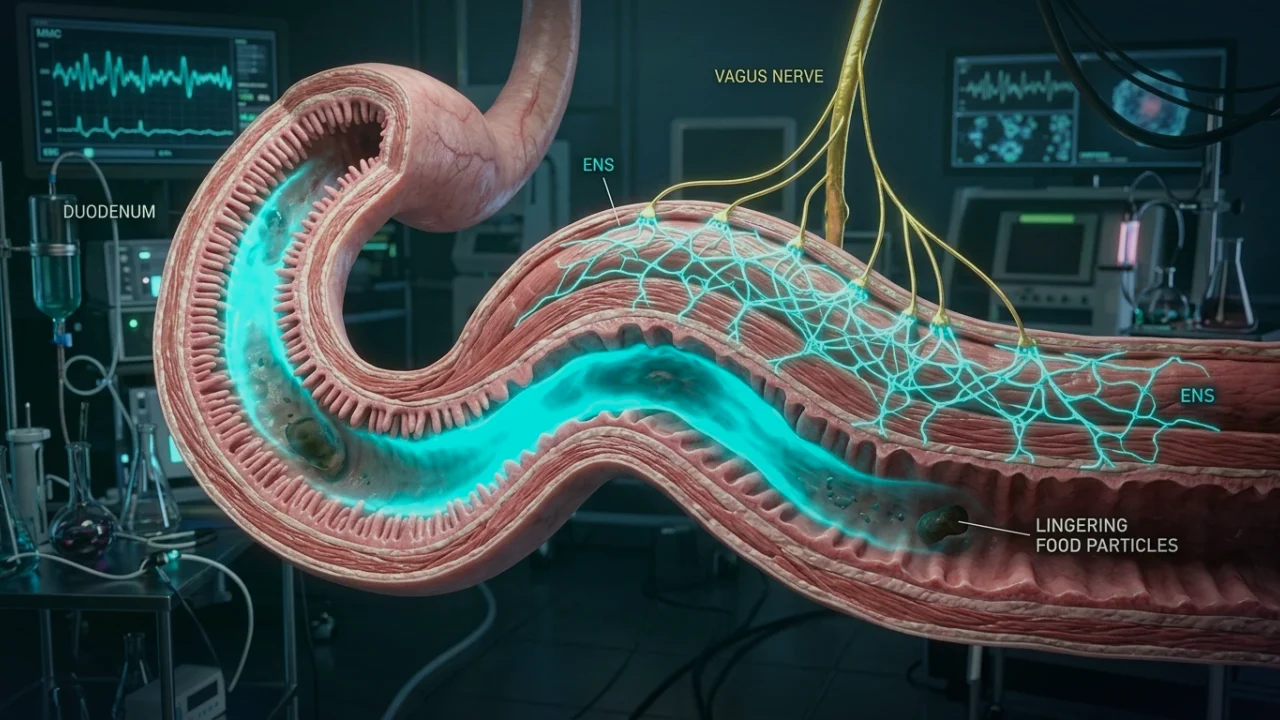
1. What Is the Migrating Motor Complex? The Digestive Housekeeper
While postprandial motility is characterized by mixing, segmentation, and slow transit to maximize nutrient absorption, the gastrointestinal tract switches to an entirely different motor pattern once absorption is complete. First described in canine models by Szurszewski in 1969, the Migrating Motor Complex (MMC) is an interdigestive rhythm that sweeps across the stomach, duodenum, jejunum, and ileum.
The primary evolutionary purpose of the MMC is mechanical sanitation. It prevents luminal stasis, sweeps sloughed mucosal epithelial cells and digestive secretions downward, and critically maintains an antimicrobial gradient between the densely populated colon (1011 bacteria/mL) and the relatively sterile small intestine (less than 103 bacteria/mL).
2. The Four Phases of the MMC: Anatomy of the Phase III Wave
The MMC cycles continuously through four distinct physiological phases during fasting, repeating every 90 to 120 minutes:
- Phase I (Quiescence): Lasting 45 to 60 minutes. A period of total motor stillness with zero contractions, allowing mucosal recovery.
- Phase II (Irregular Segmenting Activity): Lasting 30 to 45 minutes. Intermittent, low-amplitude contractions that slowly mix residual fluids.
- Phase III (The Housekeeper Wave): Lasting 5 to 10 minutes. An intense burst of rhythmic, high-amplitude propagating contractions migrating at 3 cycles per minute in the stomach and 11 to 12 cycles per minute in the duodenum. These contractions generate lumen-clearing pressures of 40 to 80 mmHg, physically scouring the intestinal lining.
- Phase IV (Transition): A brief 5-minute deceleration back into Phase I quiescence.
3. Neuro-Hormonal Triggers: Motilin, Serotonin, and Vagal Tone
The initiation of Phase III waves is governed by a precise neuro-endocrine relay:
- Motilin Secretion: Synthesized by endocrine M-cells in the crypts of the duodenum and jejunum. Peak circulating motilin levels synchronize perfectly with the onset of Phase III gastric and duodenal sweeping waves.
- Vagal Parasympathetic Tone: While motilin triggers gastric Phase III contractions, uninterrupted vagal efferent signaling is mandatory for propagating the wave through the jejunum and ileum. In patients who have undergone surgical vagotomy, gastric Phase III waves are completely abolished.
- Enteric Serotonin (5-HT): Vagal stimulation activates enterochromaffin cells to release serotonin, which binds to 5-HT4 receptors on myenteric intrinsic primary afferent neurons, releasing acetylcholine to drive downstream smooth muscle propulsion.
4. The SIBO Connection: Why a Paralyzed MMC Allows Bacterial Overgrowth
In our comprehensive clinical guide to migrating motor complex and SIBO prevention, we explore how failure of the MMC is the single most common root cause of refractory Small Intestinal Bacterial Overgrowth (SIBO).
When Phase III housekeeper waves disappear—whether due to chronic stress, post-infectious antibodies against vinculin (anti-vinculin autoantibodies), or vagus nerve dysfunction—bacteria from the large intestine backwash across the ileocecal valve into the small intestine. Trapped in a stagnant lumen, these microbes feast on dietary carbohydrates, producing massive clouds of hydrogen and methane gas, inducing debilitating bloating, brain fog, and severe abdominal cramping within 30 minutes of eating.
5. The Snacking Trap: How Constant Grazing Paralyzes Cleansing
A widespread modern dietary habit is constant grazing—eating small snacks, protein bars, fruit, or drinking lattes every 2 hours throughout the day. From an evolutionary gastrointestinal standpoint, this habit is disastrous for gut hygiene.
The moment calories touch the taste buds and enter the stomach, the MMC is instantaneously aborted. The gut converts from the interdigestive housekeeping mode to the fed motor mode. If an individual eats every 2 to 3 hours, their small intestine never completes a single Phase III cleansing wave during the entire day. The small intestine remains permanently stagnant until nighttime sleep, leaving residual food particles to ferment.
6. Natural and Pharmacological Prokinetics: Re-Activating the MMC
Restoring robust MMC function requires spacing meals and utilizing targeted prokinetic agents that specifically stimulate Phase III waves:
| Prokinetic Agent | Mechanism of Action | Clinical Timing & Use |
|---|---|---|
| Ginger Extract (Gingerols/Shogaols) | 5-HT3 antagonist / 5-HT4 agonist and cholinergic stimulation | 1,000 mg before bed on an empty stomach |
| Artichoke Leaf Extract | Stimulates bile flow and duodenal motilin-mediated contractions | Combined with ginger between meals or at bedtime |
| Low-Dose Erythromycin | Direct motilin receptor agonist (non-antibiotic micro-dose) | 50 mg at bedtime (prescription prokinetic) |
| Prucalopride (Motegrity) | High-affinity selective 5-HT4 receptor agonist | 0.5–2.0 mg at bedtime to stimulate colonic and small bowel MMC |
Additionally, enforcing a strict 4 to 5-hour window between meals and an overnight fast of 12 hours provides the gastrointestinal tract with the uninterrupted time windows required to execute complete Phase III cleaning cycles.