
When your doctor says there's nothing wrong but you know something feels off, that gap between perception and diagnostics isn't negligence. It's a fundamental blind spot in biomedicine: we treat symptoms in isolation while ignoring the vagus nerve's role in integrating organ systems. When vagal tone drops, your body issues early warning signs—subtle, persistent physical clues—before anxiety escalates into a full-blown panic cascade.
The modern stress response is designed for acute threats: fight a predator, escape a fire, control a crisis. In those scenarios, the sympathetic nervous system flips on for seconds or minutes, then shuts off. In chronic modern life, that response is chronically engaged by endless deadlines, economic pressure, and social overload. The nervous system begins to misread ordinary sensations—like a racing heart or shallow breath—as imminent danger, amplifying them into physical symptoms.
The Vagus Nerve Architecture Behind Symptom Generation
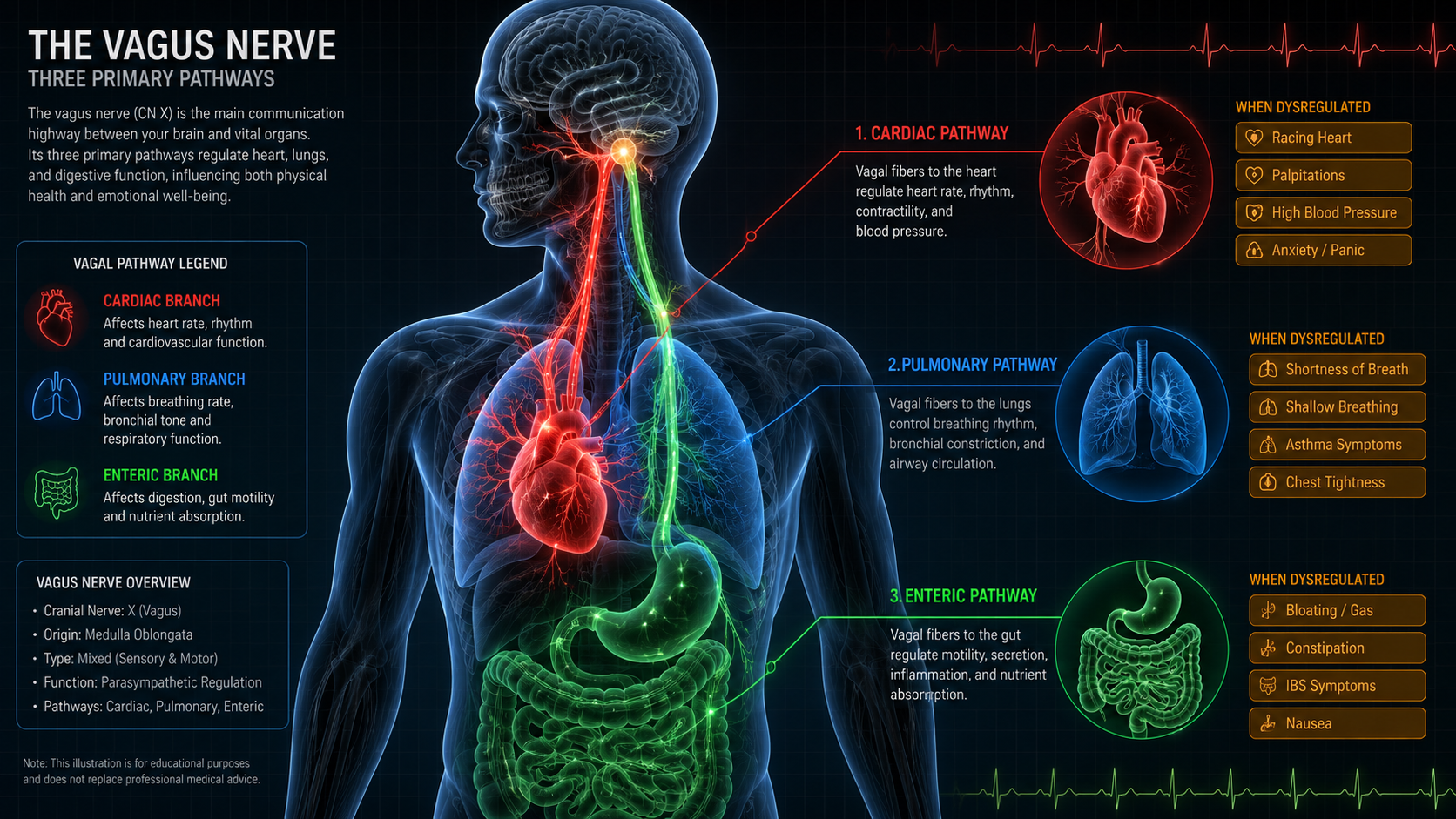
The vagus nerve is the longest cranial nerve, branching to the heart, lungs, stomach, intestines, and spleen. It carries 80-90% of parasympathetic output. When vagal afferents detect distress—through blood pH shifts, baroreceptor signals, or inflammatory cytokines—they relay the information to the brainstem. An impaired vagus fails to modulate these signals efficiently, leading to misinterpretations that manifest as physical discomfort.
Three core vagal pathways generate distinct symptom clusters:
- Cardiac vagus: Controls heart rate variability (HRV). Loss of HRV correlates with chronic tachycardia, palpitations, and resting heart rates above 80 bpm. It is often the first measurable sign of emerging dysregulation.
- Pulmonary vagus: Regulates bronchoconstriction and breathing depth. Chronic activation leads to chest tightness, hyperventilation susceptibility, and a sensation of "air hunger" that fuels panic.
- Enteric vagus: Governs gut motility and secretion. Dysregulated output produces acid reflux, nausea, bloating, diarrhea, or constipation—often misdiagnosed as IBS or functional gastrointestinal disorders.
Diagnosing Physical Symptom Patterns
Because physical symptoms of anxiety are so varied, clinicians rely on pattern recognition rather than single biomarkers. The following checklist helps categorize symptoms by likely vagal pathway involvement:
| Symptom | Likely Vagal Pathway | What to Observe |
|---|---|---|
| Resting tachycardia (>80 BPM) | Cardiac | Check HRV via fitness tracker; if < 50 ms at rest, vagal tone is compromised. |
| Chest tightness or non-exertional dyspnea | Pulmonary | Note whether breathing feels shallow or rapid when at rest; look for hyperventilation triggers. |
| Heartburn, acid reflux, bloating | Enteric | Track meals and stress levels; symptom onset within 30-60 mins of perceived stress is typical. |
| Insomnia or fragmented sleep | All pathways | Observe if anxiety precedes sleep onset; elevated cortisol at night often precedes somatic flare-ups. |
| Frequent urination or dysuria | Parasympathetic | Consider as a stress-related response; differentiate from infection or diabetes. |
These symptom maps are not diagnostic tools; they are a way to pause and ask "Is this stress-related?" instead of reaching for an over-the-counter medication or an unnecessary medical visit.
Why Symptom-Based Labels Matter
Our culture labels "anxiety" as purely emotional. In fact, anxiety is an autonomic state that manifests physically. When a patient tells a clinician "I have heart palpitations," the clinician may search for arrhythmias, electrolyte imbalances, or structural heart disease. If tests are negative, the patient is often told "it's all in your head." But the nervous system is a network of physical signals, not a figment of imagination. Mislabeling the experience creates two harmful feedback loops:
- Self-doubt: The patient internalizes the lack of medical confirmation and may dismiss real physiological distress.
- Delayed Intervention: Because the trigger is "mental," patients often avoid targeted vagal-tone interventions until symptoms become severe.
Correct framing empowers action: instead of "I have anxiety," you can say "my cardiac vagus is underactive, and I need to restore vagal tone." That shift opens concrete steps: targeted breathing, cold exposure, certain supplements, or structured activity.
Counter-Arguments and Common Misconceptions
Misconception: The physical symptoms of anxiety are "just stress."
Counter-Fact: Stress is an external stimulus; anxiety is an internal autonomic state that can be triggered by stress but persists independently due to learned neural pathways. Neuroimaging studies show persistent hypo-activation of the ventrolateral prefrontal cortex in chronic anxiety, suggesting a hardwired component.
Misconception: Breathing exercises alone can cure anxiety.
Counter-Fact: Extended exhale breathing is an effective mechanical block for panic onset, but it does not address the underlying loss of HRV. Comprehensive restoration requires a combination of daily vagal-toning practices (e.g., humming, laughter, cold exposure) and targeted lifestyle changes.
Practical Protocol: Track and Reset Your Vagal Tone
- Daily HRV Tracking: Use a chest-strap or smartwatch to log morning resting HRV. Record each morning; a downward trend of > 20% over two weeks indicates declining vagal tone.
Intervention: If HRV drops, initiate a 5-day "Vagal Stoke" cycle: extended exhale breathing (4-6-8 count), cold splash on face (30 seconds), humming or chanting "Om" for 2 minutes (the vibration stimulates the vagus), and finish with 10 minutes of upright diaphragmatic breathing. - Cold Exposure Routine: 30 seconds of 50°F (10°C) water on the face each morning. This triggers the trigeminal-vagal reflex, instantly boosting vagal tone. Build tolerance by gradually decreasing temperature.
- Humming or Laughter Practice: 2 minutes of vibratory sounds (humming, gargling, laughing) each morning. The 30-Hz vibration activates the pneumogastric branch of the vagus.
- Nutrition for Vagal Health: A diet rich in omega-3 fatty acids, magnesium, and probiotic-rich fermented foods supports mitochondrial and gut-brain axis function. Studies show omega-3 supplementation can increase HRV by up to 12% after 8 weeks.
Core Psychological Note: Avoid catastrophizing symptom onset. Treat early physical cues (elevated heart rate, shallow breath) as signals to engage the protocol rather than emergencies requiring medication.
Beyond the Body: Cognitive Re-training
Physical training rewires the nervous system, but cognitive patterns often reinforce the cycle. The following mindset shifts help lock in progress:
- Label, Don't Personalize: Replace "I am anxious" with "I am experiencing sympathetic arousal." This reduces amygdala amplification.
- Schedule Worry Time: Allocate a 15-minute "worry window" each day. When anxiety appears later, remind yourself it can be addressed later, weakening continuous rumination.
- Body Scanning Practice: Spend 5 minutes each evening scanning for tension and actively releasing it. This builds interoceptive awareness and reduces automatic sympathetic spillover.
When physical symptoms become chronic, they erode quality of life, leading to sleep deprivation, reduced work performance, and strained relationships. Understanding the vagal-tone model equips you to intervene early, before symptoms cascade into deeper dysregulation.
Educational content only. This article is for informational purposes and does not constitute medical advice. Consult a qualified healthcare professional before making changes to your health routine.