
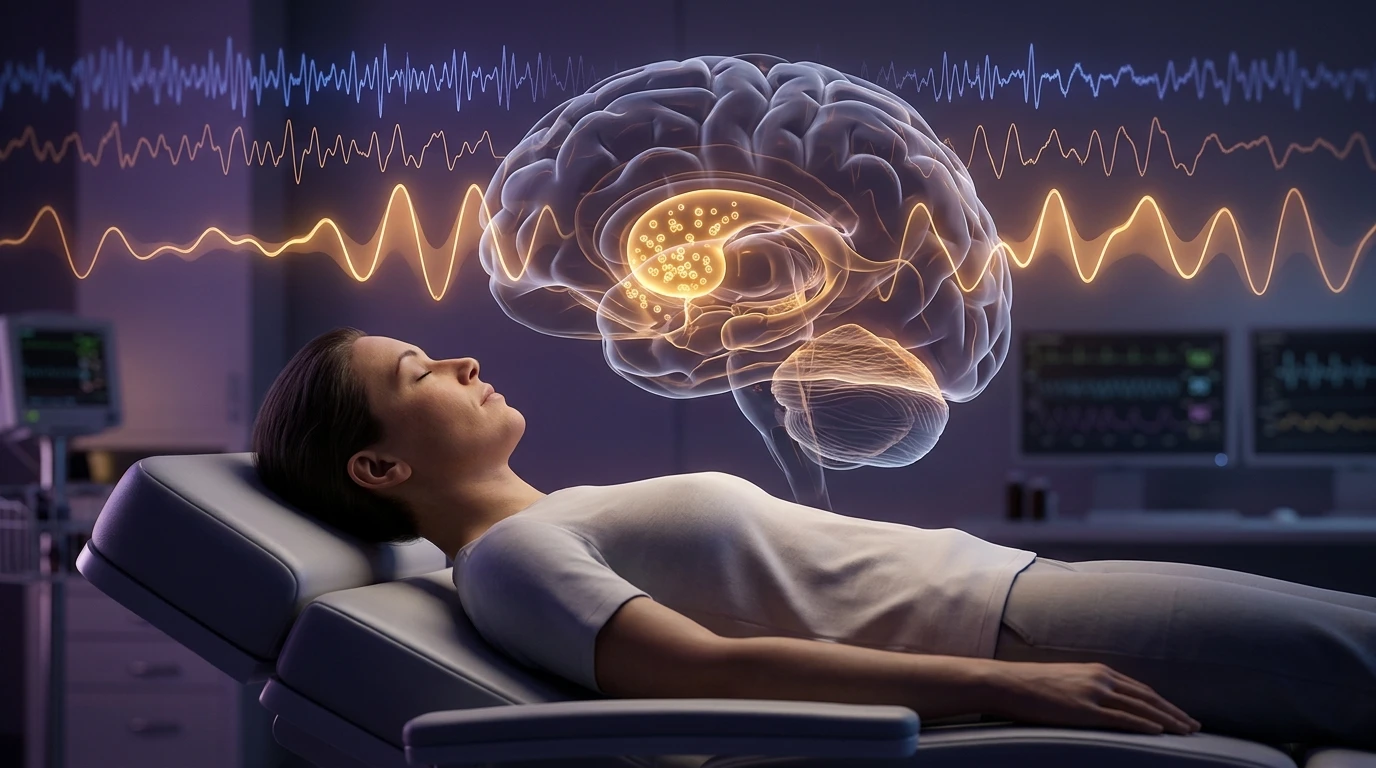
1. The Neurobiology of NSDR: Shifting Brainwaves from Beta to Theta
During normal waking life, human brain activity is characterized by high-frequency beta oscillations (13–30 Hz), reflecting active sensory processing, executive decision-making, and vigilance. In high-stress states, high-beta firing (>20 Hz) dominates, consuming vast amounts of glucose and maintaining elevated sympathetic tone.
Non-Sleep Deep Rest systematically shifts cortical architecture by disengaging the thalamocortical sensory loop without allowing the loss of conscious self-awareness:
- Vagal Tone Measurement: Explore our research on HRV normative benchmarks by age and gender.
- Foundational Neurobiology: Review our clinical analysis on the physiological sigh and autonomic anxiety reset.
- Alpha Wave Induction (8–12 Hz): Closing the eyes and focusing attention on internal somatic sensations suppresses occipital visual processing, producing rhythmic alpha synchrony. This corresponds to calm, alert relaxation.
- Theta Transition (4–7 Hz): As body scanning and prolonged expirations continue, the brain enters the hypnagogic theta state—the exact borderland between waking consciousness and Stage 1 sleep. In this window, the default mode network (DMN) quiets, narrative rumination dissolves, and parasympathetic efferent outflow surges.
2. Striatal Dopamine Replenishment: Restoring the Neurochemical Reserve
One of the most remarkable discoveries regarding NSDR/Yoga Nidra was published in an authoritative 11C-raclopride PET study at the University of Copenhagen (Kjaer et al.). The researchers documented an astounding 65% increase in endogenous dopamine release in the ventral striatum during the practice.
Under continuous cognitive effort and sensory stimulation, baseline vesicular dopamine in the striatum and substantia nigra becomes depleted. This manifests clinically as loss of motivation, executive fatigue, procrastination, and mental burnout. By achieving profound sensory withdrawal (pratyahara in traditional terminology) while maintaining relaxed vigilance, NSDR allows dopaminergic neurons to re-synthesize and store vesicular dopamine, resetting motivational drive without pharmaceutical stimulants.
3. Autonomic Shift: Vagal Brake Engagement & Sympathetic Quiescence
The physical mechanism of NSDR centers on intentional respiratory and somatic modulation. By guiding the individual to perform prolonged exhalations (such as physiological sighs or 2:1 exhale-to-inhale ratios), NSDR exploits the mechanics of Respiratory Sinus Arrhythmia (RSA).
During prolonged exhalations, intrathoracic pressure increases, causing venous return to accelerate into the heart. Baroreceptors in the aortic arch and carotid sinus fire action potentials up the glossopharyngeal and vagus nerves into the nucleus tractus solitarius (NTS). The NTS immediately signals the Nucleus Ambiguus to discharge bursts of acetylcholine onto the cardiac SA node, slowing heart rate and engaging the parasympathetic vagal brake. Systemic muscle tone relaxes, peripheral arterioles dilate, and salivary secretion increases.
4. Comparative Physiological States: NSDR vs. Meditation vs. Sleep
| Parameter / Feature | NSDR / Yoga Nidra | Focused Mindfulness Meditation | Stage 3 Slow-Wave Sleep |
|---|---|---|---|
| Conscious State | Hypnagogic (Border of sleep; fully conscious) | Focused alert awareness / metacognition | Unconscious; unarousable without strong stimulus |
| Dominant Brainwave | Alpha (8-12 Hz) transitioning to Theta (4-7 Hz) | Alpha (8-12 Hz) with Gamma (40 Hz) bursts | High-amplitude Delta (0.5 - 4.0 Hz) |
| Autonomic State | High Parasympathetic (vagal dominant) | Balanced Autonomic (calm alertness) | Maximum Parasympathetic quiescence |
| Striatal Dopamine | Increased by up to 65% in ventral striatum | Modest modulation; enhances stability | Baseline metabolic turnover |
| Motor Atonia | Deep somatic muscular flaccidity | Upright postural motor control retained | Substantial muscle relaxation (non-REM) |
| Primary Clinical Application | Dopamine reset, fatigue reversal, neuroplasticity | Attention training, emotional regulation | Glymphatic clearance, HGH pulse, tissue repair |
5. Neuroplasticity Acceleration: Memory Reconsolidation in Waking Rest
Neuroplasticity—the physical rewiring of synaptic connections in response to learning—is a two-phase biological process. Phase 1 occurs during high-focus waking effort, where acetylcholine and epinephrine tag specific synaptic circuits. However, Phase 2—the actual physical strengthening and pruning of those synapses—occurs strictly during subsequent rest states.
Research at NIH and Stanford demonstrates that engaging in a 20-minute period of NSDR immediately following an intense learning or skill-acquisition session accelerates learning rates by 200% to 300%. During NSDR, the hippocampus replays the newly acquired neural sequences at 20 times normal speed (fast-forward replay), consolidating the motor or cognitive circuitry without requiring a full night's sleep.
6. The Clinical 20-Minute NSDR Protocol: Step-by-Step Execution
To implement Dr. Andrew Huberman's standardized NSDR protocol for clinical or personal recovery:
- Positioning: Lie supine (flat on your back) in a quiet, darkened room. Place a thin pillow beneath the head and a bolster under the knees to eliminate lumbar tension. Keep the arms resting comfortably at the sides with palms facing upward.
- The Physiological Sigh Initialization (2 Minutes): Perform 3 consecutive physiological sighs: two deep nasal inhalations (the second "topping off" lung capacity) followed by a long, slow, unforced exhalation through pursed lips. This collapses residual sympathetic tension and resets alveolar ventilation.
- Systematic Somatic Scan (10 Minutes): Shift attention systematically through anatomical checkpoints without moving: crown of the head, brow, jaw, throat, right shoulder, right elbow, right hand, left shoulder, left elbow, left hand, torso, abdomen, hips, knees, and feet. Consciously "switch off" muscular tension in each target zone.
- Expanded Spatial Awareness (5 Minutes): Imagine sensation expanding beyond the physical boundaries of the skin, perceiving ambient air temperature and acoustic space. This dissolves egocentric default mode network narrative chatter.
- Gradual Emergence (3 Minutes): Slowly deepen respiration, gently wiggle fingers and toes, and open the eyes, retaining the calm, focused dopaminergic baseline for subsequent daytime activities.
Frequently Asked Questions (Clinical FAQ)
Can NSDR replace lost nighttime sleep?
While NSDR cannot fully replace the glymphatic clearance and growth hormone release of deep Slow-Wave Sleep, studies show that a 20-to-30-minute NSDR session can recover cognitive alertness and subjective energy equivalent to several hours of lost sleep.
What is the exact difference between NSDR and Yoga Nidra?
NSDR is the scientific term coined by Dr. Andrew Huberman to describe the biological mechanics of Yoga Nidra stripped of any mystical or esoteric jargon, focusing purely on autonomic regulation, brainwaves, and neurochemistry.
When is the best time of day to do an NSDR session?
The optimal window is during the early afternoon circadian dip (between 1:00 PM and 3:30 PM), or immediately after an intense learning, studying, or physical training block to accelerate synaptic consolidation.
Is it bad if I fall completely asleep during NSDR?
No. Falling asleep simply indicates that your homeostatic sleep debt was extraordinarily high. However, the unique neurological benefits of NSDR (such as the 65% dopamine reset) occur when you hover in the theta hypnagogic state on the borderline of sleep.
How does NSDR replenish dopamine without taking supplements?
By withdrawing all sensory inputs and conscious motor commands while maintaining relaxed awareness, striatal dopaminergic neurons stop discharging continuously, allowing intracellular reserves of dopamine to re-synthesize and fill storage vesicles.
Can people with ADHD benefit from NSDR?
Yes, profoundly. Individuals with ADHD often suffer from chronic striatal dopamine deficiency and autonomic hyperarousal. Daily NSDR practice helps stabilize dopamine baseline and calms restlessness.
Scientific References & Clinical Citations
- Increased dopamine tone during an altered state of consciousness — Brain Research. Cognitive Brain Research (2002). [PubMed / Study Link]
- Brief structured respiration practices enhance mood and reduce physiological arousal — Cell Reports Medicine (2023). [PubMed / Study Link]
- Waking rest accelerates motor memory consolidation through offline replay — Cell Reports (2021). [PubMed / Study Link]
- The neurobiology of meditative states and autonomic regulation — Nature Reviews Neuroscience (2015). [PubMed / Study Link]