
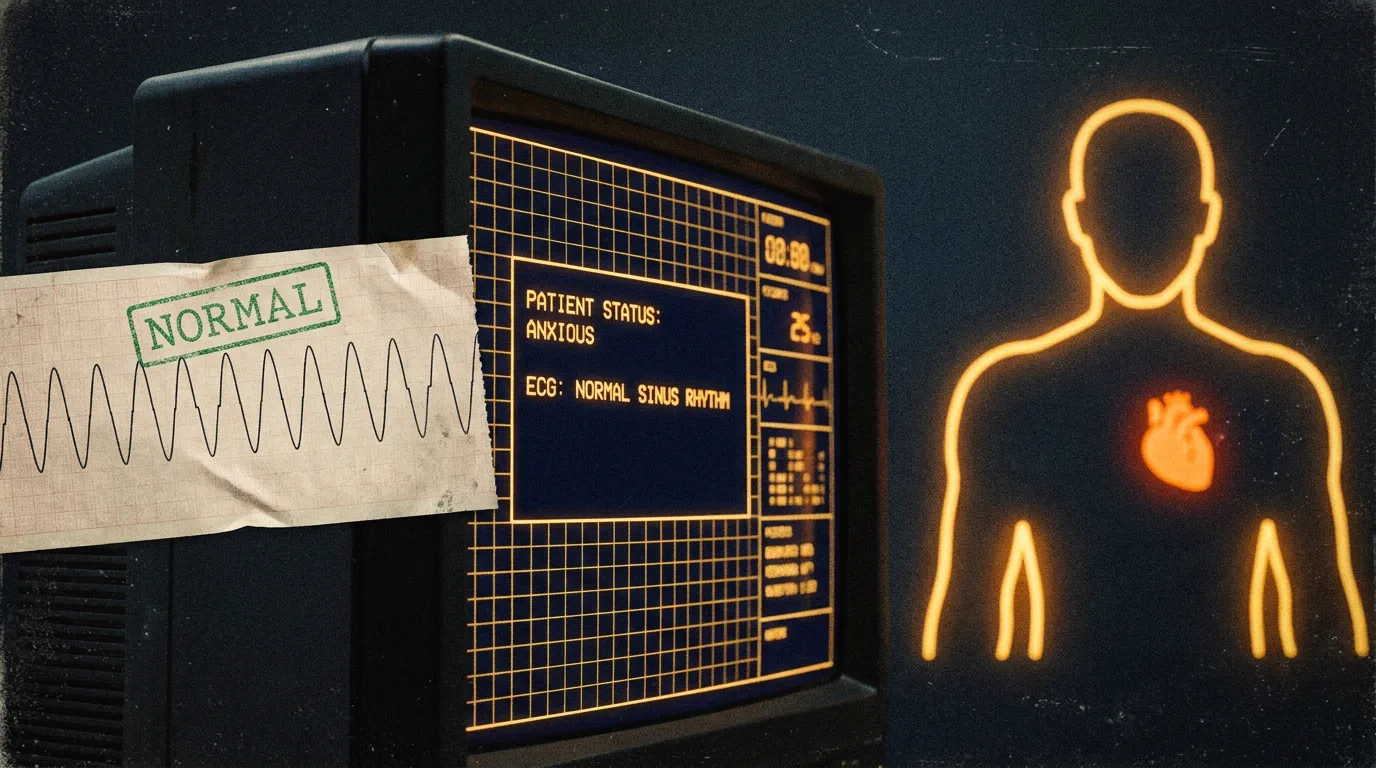
You went to the ER. The ECG was normal. The emergency or cardiology workup did not find an acute heart problem. And yet — days later — your heart still races at night, your chest still tightens, and you are still convinced something is wrong. You are not alone, and you are not imagining it.
This pattern has a name: cardiac anxiety — the persistent fear that something is wrong with your heart despite normal test results. It is one of the most common reasons for repeat ER visits and repeated cardiology consultations. Understanding the distinction between reassuring test results and ongoing body alarm is the key to breaking the loop.
This article explains why a normal ECG does not automatically erase the fear, what cardiac anxiety does to your nervous system, and the evidence-based steps that actually stop the cycle.
Key Takeaways
- A normal ECG rules out acute damage in that moment — it does not instantly cure a wired nervous system
- Cardiac anxiety is a real, treatable condition, not a sign of weakness
- Anxiety lowers vagal tone and raises adrenaline, which creates the very palpitations you fear
- Seeking more and more tests can reinforce the fear instead of resolving it
- CBT, interoceptive exposure, and vagal tone training are the proven exits
- Certain red flags (exertion, fainting, radiation) still deserve a deeper cardiac workup
Last updated: August 10, 2026 · Reviewed by Dr. Thomas Whitaker, MD, PhD, Medai Wellness Research Editor
Why a Normal ECG Doesn't Erase the Fear
An ECG is a 10-second snapshot of your heart's electrical activity. It is excellent at catching an acute heart attack in progress and at detecting structural rhythm abnormalities that persist. It is, by design, nearly blind to the moments right before and right after the test.
That is why the sequence is so common: the doctor runs the ECG while you happen to be calm, the test comes back clean, and then — hours later, lying in bed — the racing heart returns with full force. Logically you know the test was normal. Emotionally, your nervous system never received the memo.
The fear is not a failure of understanding. It is a learned threat response. Your brain has paired the sensation of a fast heartbeat with the idea of dying. Every palpitation re-fires that pairing, and no amount of reassurance from a clean test overwrites it — the nervous system responds to experience, not to facts.
What Is Cardiac Anxiety?
Cardiac anxiety (sometimes called cardiophobia) is a cluster of fears centered on the heart: fear of palpitations, fear of a heart attack, fear of sudden death, and fear of the sensations the body produces during stress. It often develops after a panic attack that felt like a heart attack, after a cardiac scare, or after losing someone to heart disease.
It is closely related to health anxiety and panic disorder. The shared engine is interoceptive sensitivity — an amplifier in the brain that notices heartbeat, breath, and chest sensations more loudly than usual, and labels them as dangerous.
Crucially, cardiac anxiety is not "imagined pain." The sensations are real: anxiety genuinely raises heart rate, increases the force of each beat, tightens chest wall muscles, and can provoke real (but benign) palpitations. The problem is the interpretation, not the existence, of the sensations.
What a Normal ECG Actually Rules Out (and What It Doesn't)
| A normal ECG does NOT mean | If symptoms persist, ask about | |
|---|---|---|
| Acute heart attack in progress | "The heart was fine for all time" | A stress test or exercise ECG |
| Persistent rhythm abnormalities | "I can never have a palpitation again" | A Holter monitor (24-48h) captured during symptoms |
| Current muscle damage (troponin) | "I can never have chest tightness again" | An echocardiogram if there is a family history or murmur |
| Anxiety-driven symptoms | "I should feel calm now" | A cardiac anxiety assessment, not another ER visit |
The takeaway is not "tests are useless." It is that the ECG answers a specific question — is there acute damage right now? — and that question has already been answered. What remains is a nervous system question, and it needs a nervous system answer.
Why Anxiety Creates the Symptoms It Fears
This is the cruelest part of the loop, and the most important to understand.
- Adrenaline rises: every anxious thought about your heart dumps adrenaline, which increases heart rate and the force of contraction.
- Vagal tone drops: the parasympathetic brake that normally keeps heart rate low in rest loses ground to sympathetic drive.
- Hyperventilation: shallow rapid breathing lowers carbon dioxide, which can produce chest tightness, tingling, and — ironically — a racing heart.
- Chest wall tension: the intercostal muscles stay contracted, creating a pressure sensation that reads as "cardiac."
Each symptom reinforces the fear, which raises adrenaline again, which produces more symptoms. Once this loop is running, a normal ECG is powerless against it — the loop is fueled by the nervous system, not by the heart.
The Reassurance Trap: Why Seeking More Tests Backfires
There is a natural instinct after a normal ECG: get another test, then another, then maybe an entirely different hospital. This is called reassurance seeking, and it is a trap.
The relief from a clean test lasts hours to days — then the anxiety re-attaches to a new symptom or a new worry ("was that a real reading?"). Each new test briefly lowers the fear and then raises it higher, because the brain learns: "I needed testing to feel safe, therefore I must be unsafe."
Studies of health anxiety and cardiophobia show that excessive testing is associated with more anxiety and more ER visits over time, not fewer. The exit is not another scan. It is retraining the response.
Breaking the Loop: What Actually Works
Cognitive Behavioral Therapy (CBT)
CBT is the best-evidenced treatment for health anxiety and panic. It challenges the catastrophic interpretation ("this palpitation = death") and replaces it with a realistic one ("this palpitation = adrenaline, again").
Interoceptive Exposure
Deliberately and safely recreating the feared sensation — walking stairs to raise the heart rate, warm-up exercises, caffeine in controlled amounts — teaches the brain that a fast heartbeat is survivable. This is the direct antidote to avoidance.
Vagal Tone Training
Because anxiety suppresses the parasympathetic system, raising baseline vagal tone reduces the frequency and severity of the very symptoms being feared. Slow extended-exhale breathing, cold facial immersion, humming, and HRV-guided recovery are the practical levers. For a step-by-step reset see our article on how to stop a panic attack and the broader nervous system approach to anxiety.
Limit Reassurance to a Plan
Agree with your physician on a single diagnostic plan and a single follow-up date. Outside that plan, treat further testing as an anxiety symptom, not a solution.
When a Normal ECG Still Deserves a Second Look
Cardiac anxiety is common — but so is dismissing a real signal. Schedule a deeper cardiac evaluation (Holter, stress test, echocardiogram) with your doctor if:
- Chest pain or palpitations occur during exercise and reliably on each session
- Symptoms wake you from sleep with crushing pressure or a racing heart
- You have fainted or felt close to fainting (syncope or near-syncope)
- Pain radiates to the jaw, neck, or left arm with sweating or nausea
- You have cardiac risk factors: diabetes, hypertension, high cholesterol, smoking, or strong family history of early heart disease
If you are reading this at 3 a.m. with crushing chest pain and sweating, call emergency services. The rule is simple: when in doubt, rule it out in person.
Normal ECG But Still Anxious: FAQ
Can I still have a heart problem even if my ECG is normal?
A normal resting ECG rules out most acute ongoing heart damage in that moment, but it does not rule out intermittent arrhythmias or stable coronary disease. If symptoms occur only during episodes, a Holter monitor, stress test, or exercise ECG performed during the episode is more sensitive. If your ECG was captured during your worst symptoms and was normal, current damage is very unlikely.
Why do I still feel my heart racing even with a normal ECG?
Palpitations with a normal ECG are usually sinus tachycardia with heightened perception. Anxiety raises adrenaline, which increases heart rate and makes the heartbeat more forceful. The brain's threat system also amplifies awareness of the heartbeat — a feature of anxiety, not a malfunction.
Why do I still get heart palpitations with a normal ECG?
Because a resting ECG captures only a few seconds of your heart rhythm. Palpitations that come and go are often missed in that window. When the ECG is normal but palpitations persist, the cause is usually sinus tachycardia plus anxiety-driven heightened awareness of the heartbeat — especially if the episodes coincide with stress, worry, or poor sleep. A 24–48 hour Holter monitor can confirm whether any rhythm abnormality is present when your symptoms actually occur.
Is cardiac anxiety or cardiophobia treatable?
Yes. Cardiac anxiety responds well to cognitive behavioral therapy (CBT), interoceptive exposure, and nervous system regulation. Studies show CBT reduces unnecessary cardiac testing and ER visits by retraining the brain's interpretation of heartbeat sensations.
Does anxiety cause palpitations even when the ECG is normal?
Yes. Anxiety raises sympathetic drive and lowers vagal tone, producing skipped beats, racing heart, and chest tightness that are real but benign. These palpitations correlate with stress levels and typically resolve as baseline vagal tone improves.
When should a normal ECG still be investigated further?
If symptoms occur during exercise, awaken you from sleep, are accompanied by syncope or chest pain radiating to the jaw or arm, or if you carry cardiac risk factors, ask your doctor about a Holter monitor, echocardiogram, or stress test. Always follow a cardiologist's recommendation.
How the breathing protocol Fits In
The breathing protocol was designed for exactly this pattern: a nervous system generating symptoms that tests cannot find. Its 28-day, 8-mission structure rebuilds baseline vagal tone so that heart rate, chest tension, and breathlessness stop being automatically triggered by stress. When the parasympathetic brake is strong again, the palpitations lose their power — and the fear starves.
When to See a Doctor
If cardiac anxiety is limiting your life, book a single appointment with a physician to (1) confirm the heart workup is complete and (2) get a referral for CBT or health-anxiety treatment. If you experience new exercise-related chest pain, fainting, or radiating pain with sweating, seek urgent care immediately.