
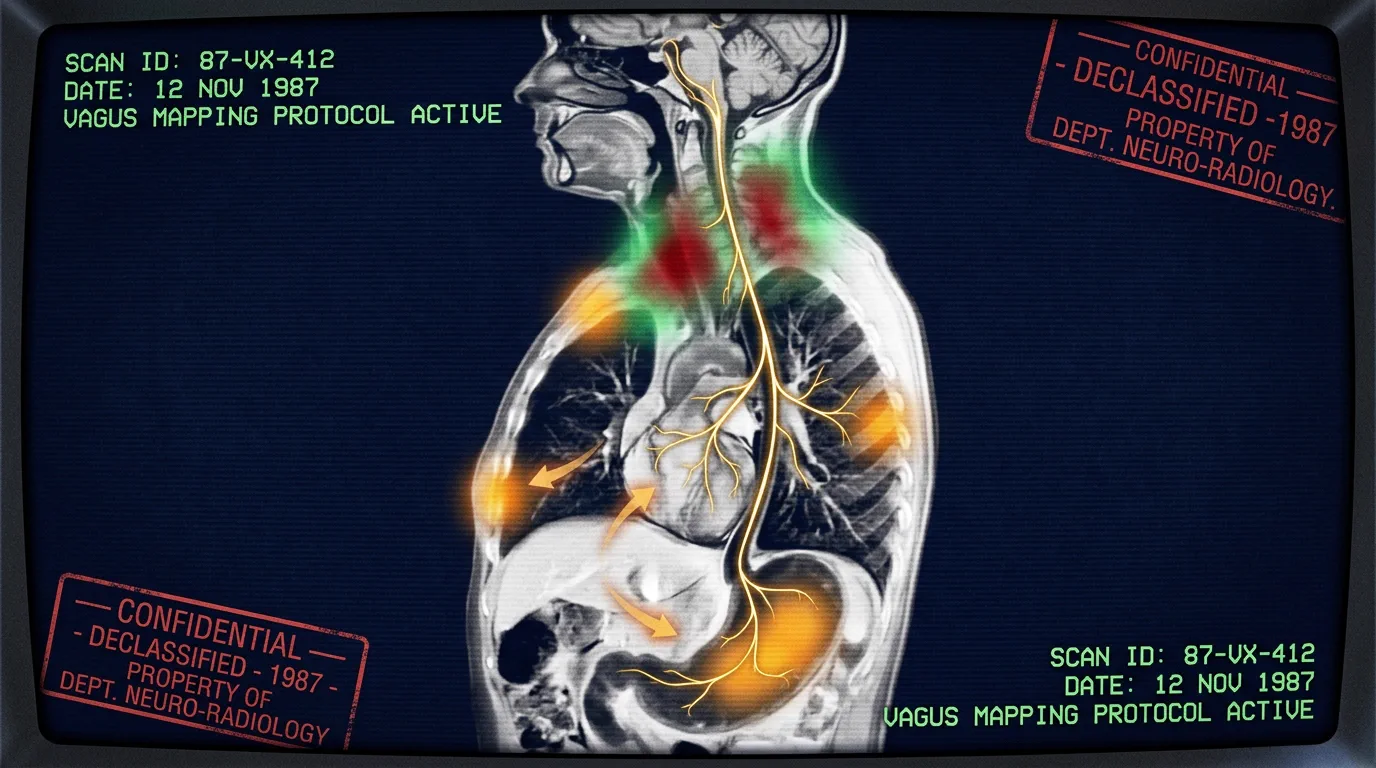
Pressure in the middle of your chest. A tight band around your ribs. A strange lump feeling in your throat and the urge to swallow. The thought arrives instantly: is this my heart? For many people, the answer is not a heart attack — it is their vagus nerve.
The vagus nerve is the longest and most influential nerve in the autonomic nervous system. It connects your brainstem to your heart, lungs, esophagus, stomach, and intestines. Because it carries both motor and sensory information from all of these organs, it is a prime suspect when chest pain appears with a normal ECG, normal troponin, and no climbing the stairs to trigger it.
This article answers the question directly — yes, the vagus nerve can cause chest pain — and explains the mechanisms, the symptoms, and the crucial line between a false alarm and an emergency.
Key Takeaways
- The vagus nerve can generate real chest pain through three pathways: esophageal spasm, chest-wall tension, and referred gut pain
- Vagal chest pain usually changes with breathing and position, and often responds to a vagal reset within minutes
- Anxiety lowers vagal tone and keeps the chest muscles contracted — creating a tight, aching sensation that reads as "cardiac"
- Crushing pain lasting more than 20 minutes that radiates to the arm or jaw is a red flag — never delay seeking emergency care
- Raising baseline vagal tone is the long-term treatment for neurogenic chest pain
Last updated: August 10, 2026 · Reviewed by Dr. Thomas Whitaker, MD, PhD, Medai Wellness Research Editor
Yes: The Vagus Nerve Can Generate Chest Pain
Chest pain is not produced exclusively by the heart. It is a signal from the brain received through nerves — and the vagus nerve is a major highway for that signal. When the vagus is dysregulated, three separate mechanisms can create chest pain that feels alarming but originates outside the heart (Cleveland Clinic, 2025).
1. Esophageal Spasm
The vagus nerve directly controls the muscles of the esophagus. When vagal signaling becomes uncoordinated — under stress, with acid reflux, or with low parasympathetic tone — the esophagus can contract forcefully and painfully. This is esophageal spasm, and its most infamous feature is that it produces crushing, squeezing, retrosternal pain almost identical to a heart attack. A substantial share of patients evaluated for "atypical chest pain" turn out to have esophageal motility disorders of vagal origin.
2. Chest-Wall Muscle Tension
Chronic stress keeps the intercostal and pectoral muscles in a state of low-grade contraction. Over time this produces a tight, aching pressure band across the chest — usually worse with deep breaths or certain positions, and reproducible when you press on the ribs. Because the sensation is deep and diffuse, it is easy to misinterpret as cardiac.
3. Referred Pain from the Stomach and Diaphragm
The vagus carries sensory input from the stomach and diaphragm up to the same brainstem nuclei that process heart signals. Gastric distension, hiatal irritation, and even heavy meals can therefore be "read" by the brain as chest pain. This shared pathway is why heart pain and stomach pain overlap so confusingly.
What Vagus Nerve Chest Pain Feels Like
People describe vagal chest pain in a few recurring ways:
- Pressure or tightness in the center of the chest, often worse with deep breathing
- A band-like squeezing sensation around the ribs or breastbone
- Pain that moves with position — better leaning forward, worse lying flat
- Pain that is reproducible on palpation (pressing on the chest wall)
- A lump-in-throat feeling, excessive swallowing, or mild nausea alongside the chest pressure
- Pain that starts or worsens during stress and improves with slow breathing or a cold face
None of these features are present in every case — chest pain is notoriously variable. But when several are present together, a neurogenic (vagal) source becomes far more likely.
Vagal Chest Pain vs. Cardiac Pain: Side by Side
| Feature | Vagus nerve (neurogenic) | Cardiac (heart attack) |
|---|---|---|
| Quality | Tight, aching, pressure band | Crushing, squeezing, "elephant on chest" |
| Duration | Comes and goes; shifts with position | Persistent, unrelenting >20 min |
| Trigger | Stress, reflux, heavy meal, breathing | Exertion or occurs at rest; may wake you |
| Movement | Changes with position and breathing | Constant regardless of position |
| Reproducible on palpation | Often yes | Usually no |
| Responds to vagal reset | Often within minutes | No |
| Radiation to arm/jaw + sweating | Rare | Common and concerning |
Use this table as a guide after you have ruled out the emergency criteria below — not instead of doing so.
Why It's Confused With a Heart Attack
The heart and the stress circuit share the same afferent pathways. Visceral sensory fibers from the heart travel through the vagus and the sympathetic cardiac nerves to the dorsal horn and the nucleus tractus solitarius — the same relay stations that process esophageal and gastric signals. The brain cannot perfectly distinguish "ischemia" from "vagal overload," because both activate the same second-order neurons (Cleveland Clinic, 2025).
Anxiety amplifies this: it raises heart rate, tightens the chest wall, and triggers esophageal hyper-reactivity — producing a perfect storm of sensations that feel cardiac. This is why a person can experience crushing chest pressure, a normal ECG, and a diagnosis of "anxiety" in the same ER visit.
Quick Tests You Can Do — After Ruling Out Red Flags
If this is a familiar, recurring pattern and you have previously had a cardiac workup, three observations help confirm a vagal source:
- Position test: does the pain change when you lean forward, lie flat, or press on the rib space? Position-dependent pain is musculoskeletal or esophageal, not ischemic.
- Palpation test: can you reproduce the exact sensation by pressing on the chest? Cardiac pain is not reproducible on palpation.
- Vagal reset test: perform slow extended-exhale breathing (4 seconds in, 8 seconds out) with a cold wet cloth on the face for 60-90 seconds. If the pain eases meaningfully within about 5 minutes, the vagus is the likely conductor.
For a deeper mechanical breakdown of how anxiety chest pain differs, see Anxiety Chest Pain vs Heart Attack.
When to Go to the ER: The Red Flags
Vagal chest pain is real — but a heart attack is terminal if missed. Call emergency services immediately if any of the following is true, regardless of how "vagal" the pain feels:
- Pain is crushing or pressure-like and lasts more than 20 minutes
- Pain radiates to the left arm, jaw, neck, or back
- You have cold sweat, nausea, or feel like fainting with the pain
- You are short of breath at rest or cannot speak in full sentences
- You have diabetes, known heart disease, or strong risk factors
- The pain is new, different from your usual episodes, or lasts longer than expected
The safe rule: when in doubt, rule it out in person. An ER visit for reassurance is never a mistake if the alternative is an unrecognized heart attack.
Long-Term: Raising Vagal Tone Stops the False Alarms
Because low vagal tone is the root of esophageal hyper-reactivity, chest-wall tension, and the referral of gut pain to the chest, the treatment is to raise it:
- Daily extended-exhale breathing — the 4-6 pattern or 4-8 exhale, 10-15 minutes daily.
- Cold face or cold shower — 30-60 seconds, at least once a day.
- Humming or gargling — 30-60 seconds of vocal vibration stimulates the laryngeal branch of the vagus.
- Zone 2 exercise and HRV tracking — see our guide on exercise and vagal tone.
- Management of reflux, since acid exposure sensitizes vagal esophageal signaling.
- Stress physiology training — the breathing protocol trains all of the above in one 28-day sequence (start with the vagus nerve guide).
Vagus Nerve Chest Pain FAQ
Can the vagus nerve cause chest pain?
Yes. The vagus nerve carries sensory fibers from the heart, esophagus, stomach, and chest wall to the brainstem. When vagal signaling is dysregulated, it can produce chest pain through esophageal spasm, chest-wall muscle tension, and referred pain from the stomach and diaphragm.
What does vagus nerve chest pain feel like?
Vagal chest pain is usually pressure-like or tight, can shift with breathing and position, may come with a lump-in-throat or swallowing discomfort, and often improves within minutes of a vagal reset (slow exhale, cold face, humming). It rarely produces crushing pain radiating to the arm and jaw.
How can I tell vagus nerve chest pain from a heart attack?
Cardiac pain is typically crushing or pressure-like, lasts more than 20 minutes, radiates to the arm or jaw, and does not improve with rest or breathing changes. If your pain changes with position, reproduces on palpation, or resolves with a vagal reset, it is more likely neurogenic — but when in doubt, seek emergency care.
Can esophageal spasm from the vagus nerve mimic a heart attack?
Yes. Esophageal spasm can produce crushing retrosternal pain that is almost indistinguishable from angina, and it is mediated by the vagus nerve. It is a leading cause of "atypical chest pain" seen in cardiology clinics. A thorough workup, including endoscopy or manometry, can distinguish the two.
How do I stop vagus nerve chest pain?
Start with a vagal reset: slow extended-exhale breathing (4 seconds in, 8 seconds out), cold facial immersion for 30 seconds, and humming for 30-60 seconds. Raise baseline vagal tone long-term with daily breathing practice, cold exposure, and regular exercise. If pain is severe, persistent, or radiates to the jaw or arm, call emergency services.
How the breathing protocol Addresses Vagal Chest Pain
The breathing protocol was built for exactly this problem: symptoms that are physiologically real but originate in nervous system dysregulation. Over 28 days, its 8 guided audio missions rebuild the parasympathetic baseline — reducing esophageal hyper-reactivity, releasing chest-wall tension, and lowering the brain's tendency to read stomach and muscle signals as cardiac alarms.
When to See a Doctor
If you are experiencing recurring chest pain, schedule a cardiac evaluation so a cardiologist confirms the heart is clear. After that confirmation, work with a clinician on esophageal and nervous-system factors — reflux management, esophageal testing if swallowing is involved, and a structured anxiety treatment, of which vagal tone training is one evidence-based pillar. Never self-diagnose a heart problem away.