
1. The Trifecta: POTS, MCAS, and Hypermobility Spectrum
In modern autonomic medicine, clinicians frequently encounter a triad of comorbid disorders: Postural Orthostatic Tachycardia Syndrome (POTS), Mast Cell Activation Syndrome (MCAS), and Hypermobile Ehlers-Danlos Syndrome (hEDS). Termed the "trifecta," this triad affects up to 30% of refractory dysautonomia patients, predominantly young females.
In patients with hypermobility, defective collagen synthesis leads to hyper-elastic blood vessels that distend excessively upon standing, precipitating gravitational venous pooling. Simultaneously, abnormal connective tissue matrices alter mast cell anchorage in interstitial tissues, lowering the threshold for mechanical and immunological degranulation.
Understanding this hyper-reactive state requires examining both autonomic tone and neuro-inflammation, discussed in our analysis of somatic dissociation and autonomic crash.
2. Histamine Hemodynamics: Why Degranulation Spikes Heart Rate
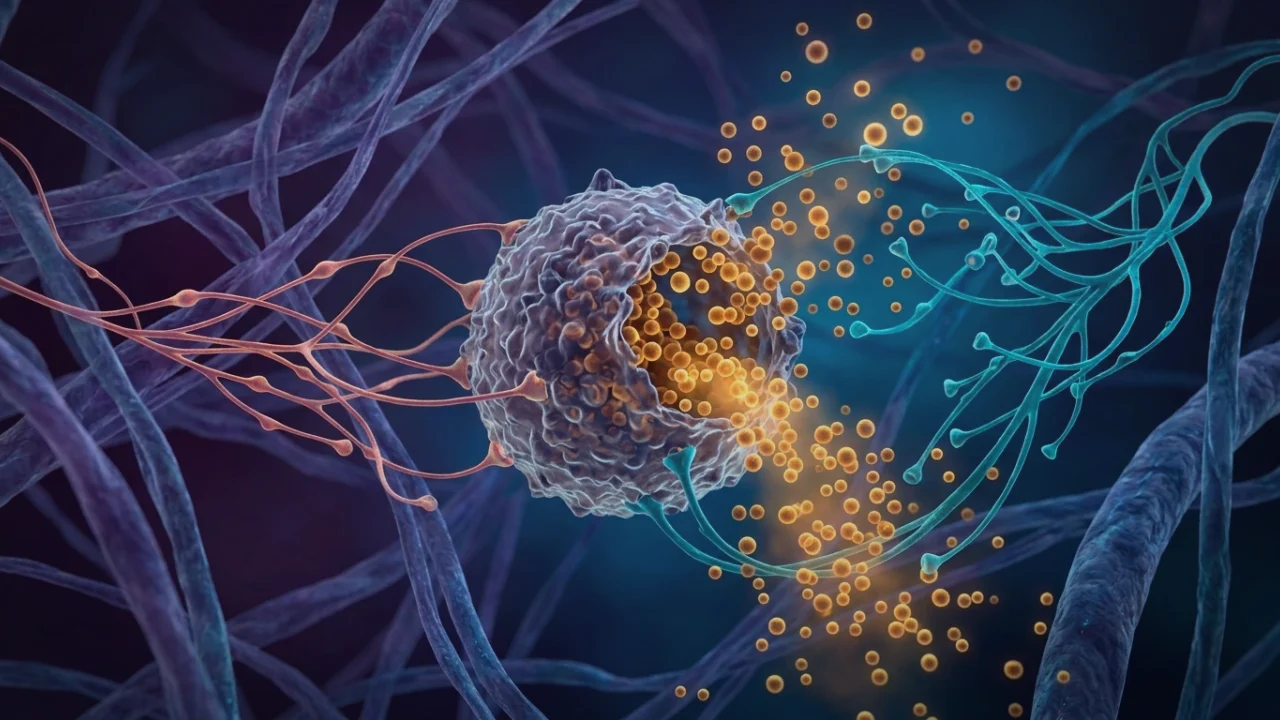
Mast cells are immune sentinels located at environmental interfaces: skin, respiratory tract, gastrointestinal tract, and adjacent to peripheral nerves and blood vessels. Upon activation, they release over 200 inflammatory mediators, with histamine, tryptase, prostaglandin D2 ((PGD_2)), and leukotriene C4 being the most hemodynamically active.
When mast cells degranulate into circulation:
- Arteriolar Vasodilation: Histamine binds to H1 and H2 receptors on endothelial and vascular smooth muscle cells, triggering immediate nitric oxide release and profound peripheral vasodilation.
- Plasma Extravasation: Microvascular permeability increases dramatically, causing fluid to leak from the intravascular space into interstitial tissues (causing facial flushing, hives, brain fog, and nasal congestion).
- Reflex Sympathetic Firestorm: The acute drop in systemic vascular resistance (SVR) and effective circulating blood volume unloads the carotid baroreceptors. The brainstem responds with an emergency surge of norepinephrine, provoking violent tachycardia (130–160 bpm), tremors, cold extremities, and severe anxiety.
3. The Vagus-Mast Cell Axis: Acetylcholine as a Natural Mast Cell Stabilizer
One of the most profound discoveries in neuro-immunology is the direct inhibitory control exerted by the parasympathetic vagus nerve over mast cells. Unmyelinated vagal motor and sensory fibers synapse directly in close proximity to mast cells within the gut mucosa, meninges, and bronchial tree.
Vagal efferents release acetylcholine (ACh), which binds to α7 nicotinic acetylcholine receptors (α7 nAChR) expressed on the surface of resting mast cells. Activation of this cholinergic receptor pathway inhibits intracellular calcium influx, effectively "locking" the mast cell granules and preventing degranulation.
When a patient experiences chronic autonomic dysregulation or low vagal tone (measurable via Heart Rate Variability RMSSD decline), this endogenous parasympathetic brake is lost. Deprived of cholinergic inhibition, mast cells become hyper-excitable, degranulating in response to minor triggers like temperature changes, stress, exercise, or high-histamine foods.
4. Diagnostic Biomarkers: Serum Tryptase, Urine Prostaglandins & Histamine
Diagnosing MCAS in POTS patients requires strict objective laboratory criteria established by the Consensus-2 Proposal:
| Diagnostic Biomarker | Specimen & Collection Protocol | Diagnostic Cutoff Threshold | Clinical Significance |
|---|---|---|---|
| Serum Total Tryptase | Baseline serum vs. draw taken 30–120 min post-flare | Peak > (1.2 × Baseline Tryptase) + 2 ng/mL | Gold standard consensus formula for acute degranulation |
| 24-Hour Urine N-Methylhistamine | 24-hour urine collection, kept chilled continuously | > 200 μg/g creatinine | Reflects systemic histamine turnover over full circadian cycle |
| 24-Hour Urine 11β-PGF2α | 24-hour urine collection, refrigerated | > 1,000 pg/mg creatinine | Direct metabolite of prostaglandin D2 produced exclusively by mast cells |
| 24-Hour Urine Leukotriene E4 | 24-hour urine collection, frozen upon completion | > 104 pg/mg creatinine | Marker of leukotriene bronchoconstriction and vascular permeability |
| Hereditary Alpha-Tryptasemia (HaT) | Buccal swab / peripheral blood DNA testing | Extra copies of TPSAB1 gene | Genetic trait in 5-8% of population, multiplying MCAS/POTS severity |
5. Integrated Treatment: H1/H2 Blockers, Cromolyn & Vagal Toning
Managing the MCAS-POTS connection requires a multi-layered pharmacological and autonomic strategy:
- Dual Histamine Receptor Blockade: Second-generation H1 antagonists (Cetirizine, Fexofenadine, or Levocetirizine 10-20 mg twice daily) paired with H2 receptor antagonists (Famotidine 20-40 mg twice daily) block vasodilating receptors on vascular smooth muscle, preventing reflexive adrenaline surges.
- Mast Cell Stabilizers: Cromolyn Sodium (oral solution, 100-200 mg four times daily before meals) coats gastrointestinal mucosal mast cells. Ketotifen (1-2 mg twice daily) acts as both a potent H1 blocker and systemic mast cell stabilizer that crosses the blood-brain barrier.
- Natural Bioflavonoids: High-purity Quercetin Phytosome (500-1,000 mg daily) and Luteolin inhibit mast cell kinase signaling and blunts histamine release.
- Non-Invasive Vagus Nerve Neuromodulation: Transcutaneous auricular vagus nerve stimulation (tVNS) applied to the left tragus stimulates the cholinergic anti-inflammatory pathway, upregulating acetylcholine to quiet mast cell hyperactivity (review our protocol on tVNS electrode placement and safety).