
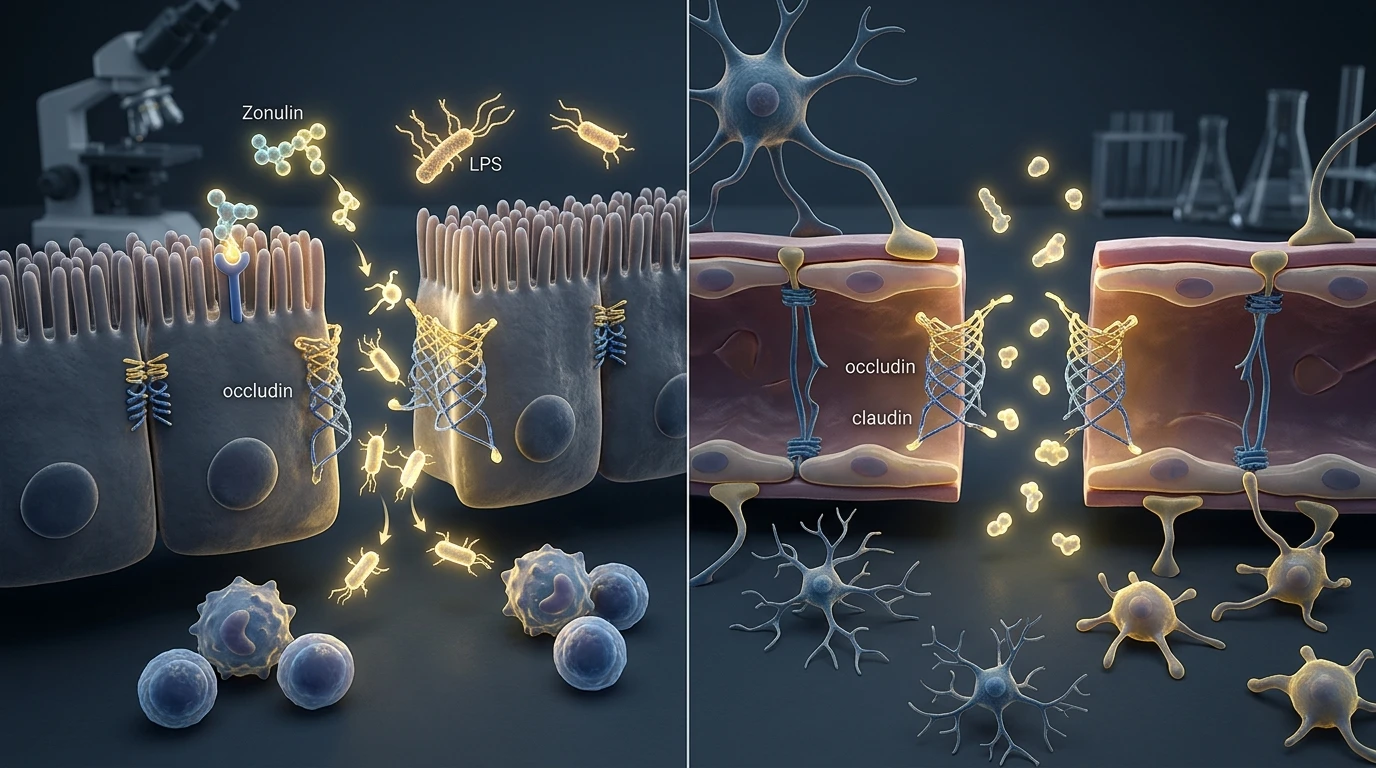
1. Molecular Architecture: Occludins, Claudins & Zonula Occludens
Both the human intestinal mucosa and the cerebral microvascular endothelium rely on multiprotein junctional complexes to seal paracellular clefts:
- Foundational Neurobiology: Review our clinical analysis on the physiological sigh and autonomic anxiety reset.
- Claudins: Transmembrane proteins that span the intercellular space. Claudins-1, -3, and -5 form the primary seal preventing macromolecule diffusion, whereas Claudin-2 acts as an inducible pore allowing fluid leak during inflammation.
- Occludin: A tetraspan transmembrane protein that senses cellular redox status. Dephosphorylation or oxidative stress triggers occludin internalization, widening paracellular gaps.
- Zonula Occludens (ZO-1, ZO-2): Intracellular scaffolding proteins containing PDZ domains that anchor the cytoplasmic tails of claudins and occludins directly to the actin cytoskeleton. Detachment of ZO-1 dismantles the tight junction assembly.
These barriers maintain electrical resistance exceeding 1,000–2,000 Ω·cm², allowing selective passage of electrolytes while excluding macromolecules, food antigens, and bacterial endotoxins.
2. The Zonulin Trigger: Gliadin and Dysbiosis Dismantle the Barrier
In 2000, Dr. Alessio Fasano discovered Zonulin (pre-haptoglobin 2), the only known physiological modulator of intercellular tight junctions in humans. Under pathological conditions, zonulin is chronically overproduced. The two primary clinical triggers are:
- Gliadin (The Gluten Fraction): Non-digestible gliadin peptides bind to Chemokine Receptor CXCR3 on intestinal enterocytes, triggering a MyD88-dependent cascade that drives mass zonulin secretion.
- Small Intestinal Dysbiosis: Gram-negative bacterial lipopolysaccharide (LPS) binds enterocyte Toll-Like Receptor 4 (TLR4), provoking intense zonulin release as an evolutionary flush reflex.
Secreted zonulin binds EGFR and PAR2 receptors on enterocytes, activating Protein Kinase C to contract the actin cytoskeleton. This rips ZO-1 away from occludin, unzipping the tight junctions—the condition known as "Leaky Gut."
3. The Gut-to-Brain Translocation: How Leaky Gut Unzips the BBB
Breaching the gut barrier allows bacterial Lipopolysaccharide (LPS) into portal and systemic circulation, inducing Metabolic Endotoxemia. LPS travels to cerebral capillaries, triggering a parallel breakdown:
- Circulating Zonulin Engages Cerebral Endothelium: Gut-derived zonulin binds PAR2 receptors on brain microvessels, down-regulating Claudin-5 and Occludin.
- Endothelial Activation & Cytokine Influx: Activated cerebral vessels secrete IL-6, TNF-α, and MCP-1, recruiting circulating leukocytes across the weakened barrier.
- Microglial Priming: As LPS crosses the compromised blood-brain barrier, it binds CD14 and TLR4 on microglia. Microglia shift into reactive phagocytes, producing reactive oxygen species, glutamate, and quinolinic acid, degrading synaptic connections and causing profound cognitive fatigue ("brain fog").
4. Biomarker Concordance: Gut vs. Blood-Brain Barrier Permeability
| Diagnostic Parameter | Intestinal Barrier (Gut) | Blood-Brain Barrier (Brain) |
|---|---|---|
| Primary Sealing Claudins | Claudin-1, Claudin-3, Claudin-4 | Claudin-5 (High-density capillary seal) |
| Direct Permeability Biomarker | Serum Zonulin & Fecal Zonulin | Serum S100B Protein & Claudin-5 Antibodies |
| Endotoxin Translocation Marker | Lipopolysaccharide-Binding Protein (LBP) | Anti-LPS Antibodies / Anti-GFAP |
| Clinical Manifestations | Bloating, food reactivities, histamine intolerance | Brain fog, neuro-fatigue, depression, memory deficits |
| Primary Receptors | CXCR3 (Gliadin) & TLR4 (Bacterial LPS) | PAR2 / EGFR (Zonulin) & TLR4 (Endotoxemia) |
| Vagal Autonomic Influence | Cholinergic Anti-Inflammatory Pathway | Central microglial cholinergic regulation |
5. The Vagus Nerve as the Master Guardian of Epithelial Integrity
The Vagus Nerve serves as the central nervous system's chief defense through the Cholinergic Anti-Inflammatory Pathway (CAIP):
Efferent vagal fibers release acetylcholine, binding alpha-7 nicotinic acetylcholine receptors (α7nAChR) on intestinal macrophages and brain microglia, halting NF-κB translocation and suppressing barrier-destroying cytokines. Furthermore, vagal signaling stimulates enteric glial cells to up-regulate Occludin and ZO-1 synthesis. In animal models, cervical vagotomy unzips both the gut and blood-brain barriers within 24 hours, demonstrating that active vagal tone is essential to maintain tight junction seals.
6. Evidence-Based Dual-Barrier Repair Protocol
Reversing systemic neuro-inflammation requires repairing both barriers concurrently while eliminating upstream zonulin triggers:
- Eliminate Dietary Zonulin Inducers: Strict avoidance of gluten (gliadin) for at least 12 weeks to eliminate continuous CXCR3 activation, alongside elimination of emulsifiers (polysorbate-80) that solubilize mucosal layers.
- Zinc Carnosine (75 mg BID): Clinically shown to reduce gut permeability by 70% and stimulate rapid re-assembly of occludin and ZO-1.
- L-Glutamine (5–10 g daily): Primary fuel for enterocytes, stimulating cell renewal and preventing cytokine-mediated tight junction internalization.
- Serum-Derived Bovine Immunoglobulins (SBI, 2.5–5.0 g/day): High-affinity antibodies that bind luminal LPS and bacterial toxins, preventing TLR4 activation.
- Sodium Butyrate (1,200 mg daily): Acts as an HDAC inhibitor, up-regulating Claudin-5 and Claudin-1 transcription across gut and blood-brain barriers.
- Transcutaneous Vagal Stimulation (tVNS): 20 Hz auricular stimulation engages α7nAChR receptors, dampening microglial reactivity and accelerating mucosal repair.
Frequently Asked Questions (Clinical FAQ)
What is the relationship between "leaky gut" and "leaky brain"?
The gut lining and the blood-brain barrier share identical tight junction proteins (occludin, claudins, ZO-1). When inflammation or zonulin breaks down the gut barrier, translocating bacterial endotoxins and circulating zonulin travel through the bloodstream to unzip the blood-brain barrier as well.
Can zonulin be measured in clinical blood tests?
Yes, serum zonulin and stool zonulin can be quantified via specialized functional labs. Elevated levels indicate active paracellular tight junction breakdown.
Does gluten cause gut permeability in people without Celiac Disease?
Yes. Dr. Alessio Fasano demonstrated that gliadin binds the CXCR3 receptor on intestinal enterocytes in all humans, triggering transient zonulin release. In individuals with non-celiac gluten sensitivity, this zonulin surge is exaggerated and prolonged.
What is S100B and why does it signal blood-brain barrier permeability?
S100B is a calcium-binding protein produced by central nervous system astrocytes. Under healthy conditions, it cannot cross the intact blood-brain barrier. Detecting elevated S100B in peripheral blood confirms that the blood-brain barrier has become permeable.
How long does it take to repair the gut and blood-brain barriers?
Intestinal enterocytes renew every 3 to 5 days, so initial mucosal repair begins within 2 to 4 weeks once triggers are removed. Full tight junction stabilization and microglial normalization typically require 12 to 24 weeks of consistent nutritional and autonomic support.
How does the vagus nerve protect barrier integrity?
Vagus nerve acetylcholine engages alpha-7 nicotinic receptors on immune cells, suppressing barrier-destroying cytokines like TNF-α and IL-1β while stimulating enteric glial cells to maintain ZO-1 and occludin scaffolding.
Scientific References & Clinical Citations
- Zonulin and its regulation of intestinal barrier function — Physiological Reviews (2011). [PubMed / Study Link]
- Gut reactions: How the blood-brain barrier connects the microbiome and the brain — Experimental Biology and Medicine (2018). [PubMed / Study Link]
- Interplay among gut microbiota, mucosal barrier and enteric neuro-immune system — Acta Neuropathologica (2018). [PubMed / Study Link]
- Anti-inflammatory properties of the vagus nerve in inflammatory bowel diseases — Frontiers in Neuroscience (2016). [PubMed / Study Link]