
1. Beyond Resting HRV: What Is Heart Rate Recovery?
In the wellness and health-tracking community, Heart Rate Variability (HRV) has become the primary metric for autonomic health. While resting HRV provides valuable insight into nocturnal parasympathetic recovery, it is notoriously volatile—easily distorted by a single late meal, dehydration, or an extra hour of sleep.
Cardiologists and exercise physiologists rely on a far more rigorous, dynamic biomarker: Heart Rate Recovery (HRR). HRR measures how rapidly your heart rate decelerates immediately following the cessation of strenuous physical exercise.
2. The Biphasic Physiology of Post-Exercise Deceleration
When you abruptly stop vigorous exertion, your heart does not slow down at a constant, uniform rate. The deceleration occurs in two biochemically distinct phases:
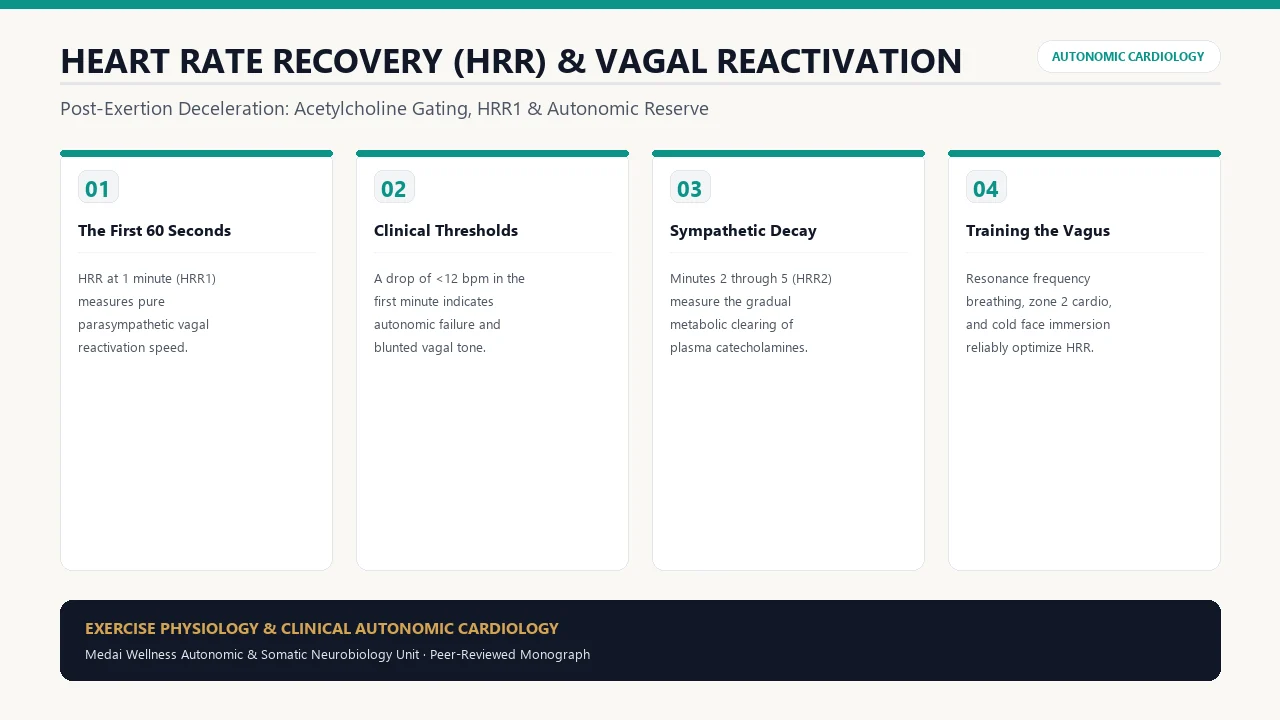
- Phase 1: The Fast Phase (0 to 60 Seconds / HRR1): In the first 60 seconds post-exercise, sympathetic catecholamines (epinephrine and norepinephrine) remain extremely high in the bloodstream. The initial drop in heart rate is driven almost 100% by parasympathetic vagal reactivation. Efferent cardiac vagal fibers fire bursts of acetylcholine onto the Sinoatrial (SA) node to aggressively brake heart rate against circulating adrenaline.
- Phase 2: The Slow Phase (1 to 5 Minutes / HRR2): After the first minute, the ongoing deceleration is governed by the gradual hepatic and renal clearance of circulating catecholamines and the restoration of normal arterial blood pressure by the baroreflex.
3. Clinical Thresholds and Mortality Risk (The Cole et al. Landmark Study)
The clinical significance of HRR was demonstrated in a landmark study published in The New England Journal of Medicine by Cole et al. (Cleveland Clinic), following 2,428 patients over six years:
| HRR1 Value (At 60 Seconds Post-Exercise) | Autonomic Assessment | Clinical & Prognostic Implication |
|---|---|---|
| < 12 bpm (Upright) / < 18 bpm (Supine) | Severe Vagal Blunting (Abnormal) | 4-fold increased relative risk of cardiovascular and all-cause mortality; profound autonomic failure. |
| 13 to 20 bpm | Borderline / Suboptimal | Sluggish parasympathetic reactivation; typical in sedentary individuals with chronic sympathetic stress. |
| 21 to 30 bpm | Healthy Autonomic Function | Robust vagal brake; normal parasympathetic flexibility and rapid post-stress recovery. |
| > 35 to 45+ bpm | Elite Vagal Power | Exceptional cardiovascular conditioning and parasympathetic reserve; common in elite endurance athletes. |
4. Why Chronic Anxiety Destroys Your HRR Score
Patients suffering from Generalized Anxiety Disorder (GAD) or chronic sympathetic overdrive frequently discover their HRR is abnormally blunted (often dropping fewer than 10 bpm at 1 minute). Why?
- Vagal Atrophy: Chronic hyperarousal chronically suppresses the nucleus ambiguus, causing functional atrophy of cardioinhibitory vagal circuits.
- Adrenal Hyper-Sensitization: The adrenal medulla continues to secrete catecholamines even after exercise ceases, overwhelming the blunted vagal brake.
- Post-Exertional Malaise: In conditions like Dysautonomia or POTS, impaired venous return and blunted baroreflexes keep pulse elevated to maintain cerebral perfusion.
5. How to Measure Your HRR with Wearables (Apple Watch & Garmin)
You do not need a clinical treadmill laboratory to assess your HRR accurately:
- The Test Protocol: Perform 3 to 5 minutes of high-intensity interval exertion (running, cycling, or stair climbing) until your heart rate reaches at least 80% to 85% of your age-predicted maximum (\(220 - ext{age}\)).
- The Immediate Stop: Stop moving immediately. Stand still (do not sit down or pace around) for exactly 60 seconds.
- The Calculation: Subtract your heart rate at exactly 60 seconds from your peak heart rate at the moment you stopped.
Example: Peak HR = 168 bpm. HR at 60 seconds = 142 bpm. HRR1 = 26 bpm (Healthy). - Apple Watch: The Apple Watch automatically records HRR at 1 and 2 minutes following any logged workout. Check the Fitness app → Workouts → Heart Rate Recovery graph.
6. Clinical Protocols to Accelerate Vagal Reactivation
To train your vagus nerve to brake faster:
- Post-Exercise Extended Exhalations: Immediately upon completing exercise, perform 5 cycles of 4-second inhales followed by 8-second slow pursed-lip exhales. Extended exhalation stimulates pulmonary stretch receptors that project to cardiac vagal nuclei.
- Zone 2 Aerobic Base Conditioning: Performing 30 to 45 minutes of low-intensity aerobic cardio (where you can easily breathe exclusively through your nose) 3 times per week increases stroke volume and upregulates SA node muscarinic M2 receptor density.
- Cold Water Facial Immersion: Activating the mammalian dive reflex by splashing freezing water on the ophthalmic division of the face immediately post-workout forces instant parasympathetic vagal reactivation.
Frequently Asked Questions
Why does sitting down immediately after exercise alter the HRR calculation?
Sitting or lying down immediately increases venous return to the heart, which activates the low-pressure cardiopulmonary receptors and artificially boosts HRR by 6 to 10 bpm. Standard clinical protocols require standing completely upright for an accurate assessment.
How quickly can a blunted HRR score be improved through training?
With consistent Zone 2 aerobic training and daily resonance breathing exercises, measurable improvements in HRR1 (gaining 6 to 12 bpm) are typically documented within 6 to 8 weeks.
Can beta-blockers artificially elevate Heart Rate Recovery?
Yes. Beta-adrenergic receptor antagonists (such as propranolol or metoprolol) block sympathetic stimulation of the heart, which can cause a faster deceleration post-exercise. Inform your physician of any cardiovascular medications prior to clinical stress testing.