
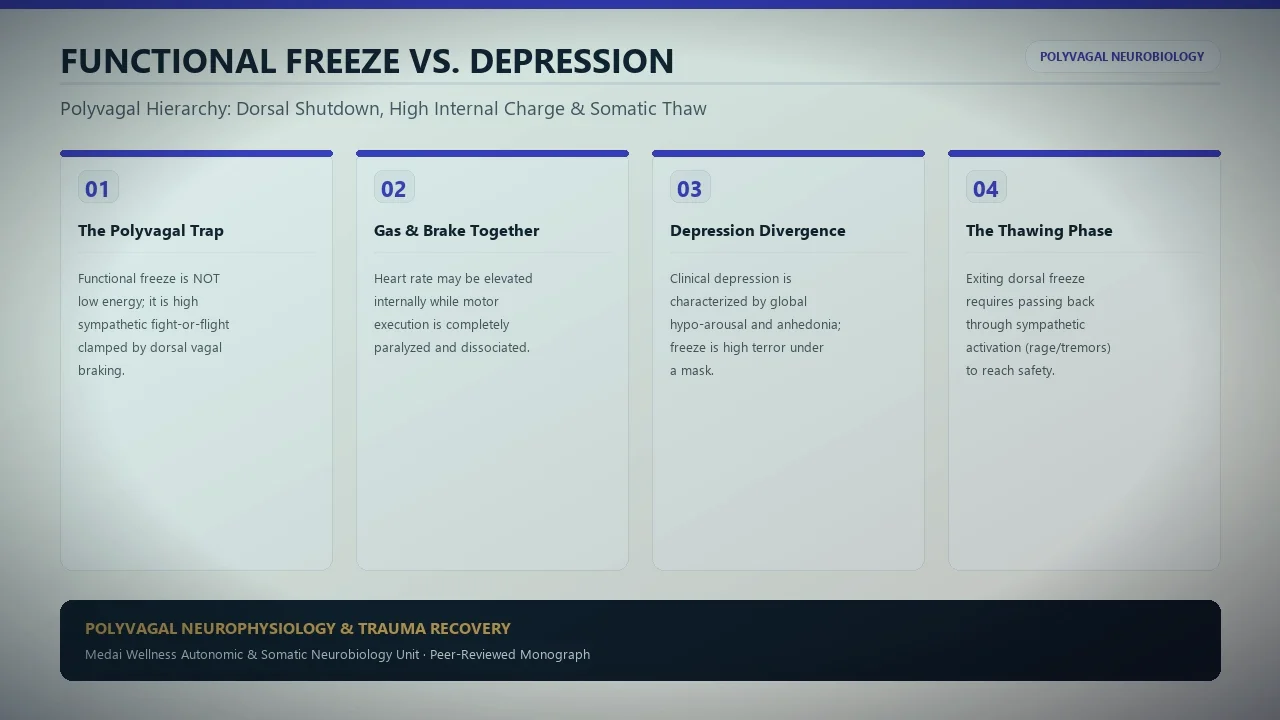
1. What Is Functional Freeze? The High-Performance Paradox
Classical psychology describes the freeze response as complete immobilization: an animal playing dead, or a trauma survivor curled into a fetal position unable to speak. For high-achieving professionals, executives, physicians, and caregivers, overt collapse is socially and professionally unacceptable. The nervous system adapts by developing a specialized hybrid posture: functional freeze.
In functional freeze, the cortical networks responsible for procedural memory and social performance remain operational. You can deliver a flawless presentation, prepare meals, and smile politely at colleagues. However, this output is powered entirely by learned behavioral scripts rather than genuine affective engagement. Internally, the patient is experiencing profound depersonalization, emotional blunting, spatial detachment, and physiological exhaustion.
2. The Dual-Activation Trap: Sympathetic Gas vs. Dorsal Brake
From an autonomic neurophysiology standpoint, functional freeze is one of the most metabolically exhausting states a human body can maintain. It is not low energy; it is extreme trapped energy.
Imagine driving a high-performance sports car with your right foot pressing the accelerator flat to the floor (sympathetic fight-or-flight drive fueled by adrenaline and cortisol), while your left foot stomps with equal force on the emergency brake (dorsal vagal parasympathetic shutdown commanded by the DMNX). The engine screams, the brakes smoke, and the transmission tears itself apart, yet the car barely crawls forward. That mechanical analogy accurately describes the physiology of functional freeze.
Cardiovascular Diagnostics: The Dissociated Autonomic Profile
In functional freeze, 24-hour Holter monitoring reveals a bizarre paradox: daytime heart rate may stay elevated (85-95 bpm) reflecting sympathetic tone, yet standard deviation of NN intervals (SDNN) drops to dangerously low levels. The nervous system lacks autonomic flexibility, oscillating rigidly between compensatory drive and cellular collapse.
3. Cortical Scripts vs. Visceral Vitality
How can a person perform complex cognitive labor while in a biological shutdown state? Functional MRI studies demonstrate that well-rehearsed professional tasks rely heavily on the dorsolateral prefrontal cortex (dlPFC) and the basal ganglia—the brain's habit execution centers. These circuits can run independently of the limbic system and insular cortex.
However, the ventromedial prefrontal cortex (vmPFC) and anterior insula—the networks responsible for feeling connected to others, sensing intuitive desires, and experiencing joy—are heavily down-regulated during dorsal vagal dominance. The high performer operates as a sophisticated biological automaton: intellectually brilliant, procedurally flawless, but emotionally deadened inside.
4. How to Identify and Recover from Dorsal Vagal Shutdown
Recognizing functional freeze requires looking past external achievements into the patient's private physiological reality. Learning how to identify and recover from dorsal vagal shutdown is the critical fork in the road between sustainable health and catastrophic health collapse.
| Functional Dimension | Healthy Resilience | Functional Freeze State |
|---|---|---|
| Work Execution | Creative, flexible, energizing | Rigid, perfectionistic, draining autopilot |
| Downtime Experience | Restorative, leisurely, playful | Paralyzed phone scrolling, binge-watching, numbness |
| Interoceptive Sense | Clear hunger, fullness, and fatigue cues | Numb to hunger until starved; ignores exhaustion |
| Social Connection | Spontaneous, warm, authentic co-regulation | Performing the "mask"; dreads small talk |
| Digestive Tone | Normal peristalsis and regular motility | Severe bloating, delayed gastric emptying, IBS |
5. The Somatic Consequences of Chronic Functional Freeze
Because individuals in functional freeze rarely take sick days, their physiology absorbs extreme long-term wear and tear:
- Occult Adrenal Exhaustion: The hypothalamic-pituitary-adrenal axis eventually flattens, producing low morning cortisol and paradoxical evening spikes.
- Immune Dysregulation: Unrelieved co-activation impairs natural killer cell function while driving chronic low-grade neuroinflammation.
- Metabolic Resistance: Chronically elevated baseline cortisol paired with poor autonomic digestion promotes visceral fat storage around mesenteric organs despite strict dieting.
6. The Clinical Exit Strategy: Thawing Without Triggering Panic
One of the greatest dangers in treating functional freeze is attempting to "thaw" the nervous system too quickly. Because the dorsal freeze is holding back an enormous reservoir of trapped sympathetic panic, aggressive interventions can cause the patient to rebound straight into acute terror or rage. Clinical treatment requires micro-dosed somatic titration:
- Micro-Movement Thawing: Instead of rigorous cardio, initiate gentle involuntary tremors—wiggling the toes, rolling the ankles, or shaking the hands for 60 seconds to release trapped motor energy.
- Sensory Contrast Grounding: Alternating between holding a warm mug of tea and touching a cool stone trains the insular cortex that somatic feeling is safe.
- Establishing Boundaries for Real Rest: Scheduling "unproductive non-rest"—time where the individual is strictly forbidden from multitasking or self-improving, allowing the cortical executive loop to genuinely power down.
- Safe Co-Regulation: Spending quiet time in the physical presence of a calm, non-demanding person or pet to stimulate ventral vagal mirror neuron circuits without conversational pressure.