
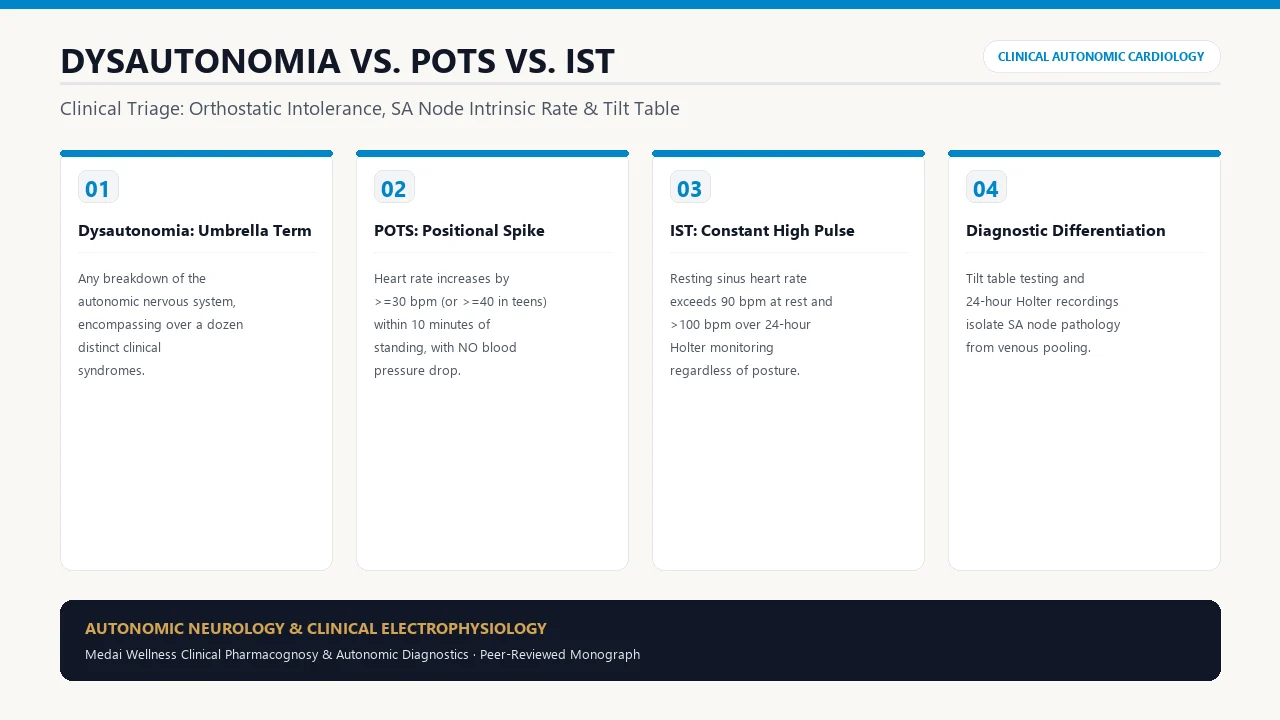
1. Deconstructing the Terminology: Umbrella vs. Syndromes
If you tell a cardiologist you have "dysautonomia," you have given them an umbrella description comparable to saying you have "an infection." It indicates that your autonomic nervous system is misfiring, but it does not identify the specific biological mechanism.
Dysautonomia encompasses dozens of distinct conditions, ranging from life-threatening neurodegenerative diseases like Multiple System Atrophy (MSA) to functional orthostatic disorders like POTS, Neurocardiogenic Syncope, and Inappropriate Sinus Tachycardia (IST). Distinguishing between them is essential for effective treatment.
2. POTS: The 30 BPM Orthostatic Challenge
Postural Orthostatic Tachycardia Syndrome is strictly a posture-dependent condition. When a healthy human stands up, approximately 500 to 1,000 mL of blood pools in the abdomen and lower extremities. The baroreflex triggers mild vasoconstriction, and heart rate increases slightly (10 to 15 bpm) to maintain cerebral perfusion.
In POTS, peripheral vasoconstriction fails, and blood pools massively in the veins of the pelvis and legs. The brain senses this threat of cerebral hypoperfusion and demands an emergency sympathetic adrenaline surge to force blood back up to the brain. The official consensus diagnostic criteria require:
- A sustained heart rate increase of \(\ge 30\) beats per minute (or \(\ge 40\) bpm for adolescents ages 12–19) within 10 minutes of standing or head-up tilt.
- Absence of orthostatic hypotension (systolic blood pressure does NOT drop by more than 20 mmHg).
- Chronic orthostatic symptoms (lightheadedness, palpitations, tremulousness, brain fog) lasting \(\ge 3\) months.
- Crucially: In pure POTS, resting supine heart rate is completely normal (60–80 bpm) when lying down flat in bed.
3. Inappropriate Sinus Tachycardia (IST): The Runaway Pacemaker
Inappropriate Sinus Tachycardia is fundamentally different: it is not posture-dependent. In patients with IST, the Sinoatrial (SA) node pacemaker itself is hyperactive or hypersensitive to low levels of adrenergic stimulation.
The diagnostic consensus criteria (Heart Rhythm Society / HRS) require:
- Resting daytime sinus heart rate \(> 90\) beats per minute in a seated or supine position.
- Mean 24-hour heart rate \(> 100\) beats per minute on continuous Holter monitoring.
- Disproportionate, exaggerated tachycardia in response to minimal emotional or physiological stress (e.g., pulse spiking to 140 bpm simply walking to the refrigerator).
- Exclusion of secondary medical causes (hyperthyroidism, anemia, pheochromocytoma, infection).
4. What About Orthostatic Hypotension (OH)?
A frequent error is confusing POTS with Orthostatic Hypotension (OH). In OH, standing up causes a profound drop in systolic blood pressure (\(\ge 20 ext{ mmHg}\)) or diastolic pressure (\(\ge 10 ext{ mmHg}\)) within 3 minutes due to failed sympathetic noradrenergic arterial constriction. If a patient meets the blood pressure drop criteria for OH, they cannot be diagnosed with POTS by definition.
5. Master Differential Diagnosis Comparison Table
| Diagnostic Feature | POTS | Inappropriate Sinus Tachycardia (IST) | Orthostatic Hypotension (OH) |
|---|---|---|---|
| Resting Supine Heart Rate | Normal (60–80 bpm) | Elevated (> 90 bpm at rest) | Normal (60–80 bpm) |
| Standing Heart Rate Delta | Spikes \(\ge 30\) bpm sustained | Variable increase from already high baseline | Compensatory increase (often blunted in neurogenic OH) |
| Blood Pressure Upon Standing | Stable or slightly elevated (Hyperadrenergic) | Stable | Drops precipitously (\(\ge 20\) mmHg systolic) |
| Primary Pathophysiology | Peripheral venous pooling + sympathetic surge | Intrinsic SA node pacemaker hypersensitivity | Failure of efferent sympathetic arteriolar constriction |
| 24-Hour Holter Mean HR | Normal (70–80 bpm average) | Pathologically High (> 100 bpm average) | Normal |
6. The Clinical Diagnostic Pathway: Tilt Table & Holter
To obtain an accurate, definitive clinical diagnosis:
- NASA 10-Minute Lean Test: A simple in-office clinical test where vitals are recorded while lying supine for 5 minutes, followed by standing relaxed with shoulder blades against a wall for 10 minutes.
- Head-Up Tilt Table Test (HUTT): The gold-standard laboratory test where the patient is strapped to a motorized table tilted to 70 degrees for 30 to 45 minutes with continuous ECG and beat-to-beat finger plethysmography blood pressure monitoring.
- 24-Hour Holter Monitor: Mandatory to calculate the mean 24-hour rate to rule in or rule out IST.
Frequently Asked Questions
Can a person suffer from both POTS and IST simultaneously?
Yes. Approximately 10% to 15% of patients with autonomic dysfunction exhibit clinical overlap: an elevated 24-hour resting heart rate (IST) combined with an additional \(\ge 30\) bpm orthostatic surge upon standing (POTS).
Why is POTS so frequently misdiagnosed as panic disorder?
Because the orthostatic compensatory adrenaline surge releases massive quantities of norepinephrine into the bloodstream, producing tremors, sweating, chest tightness, and hyperventilation identical to an acute panic attack. However, in POTS, the symptoms resolve rapidly upon lying down flat.
Does Ivabradine work for both POTS and IST?
Yes. Ivabradine selectively blocks the hyperpolarization-activated cyclic nucleotide-gated (HCN) funny current (\(I_f\)) in the Sinoatrial node, slowing heart rate without lowering blood pressure, making it a premier pharmacological choice for both conditions.