
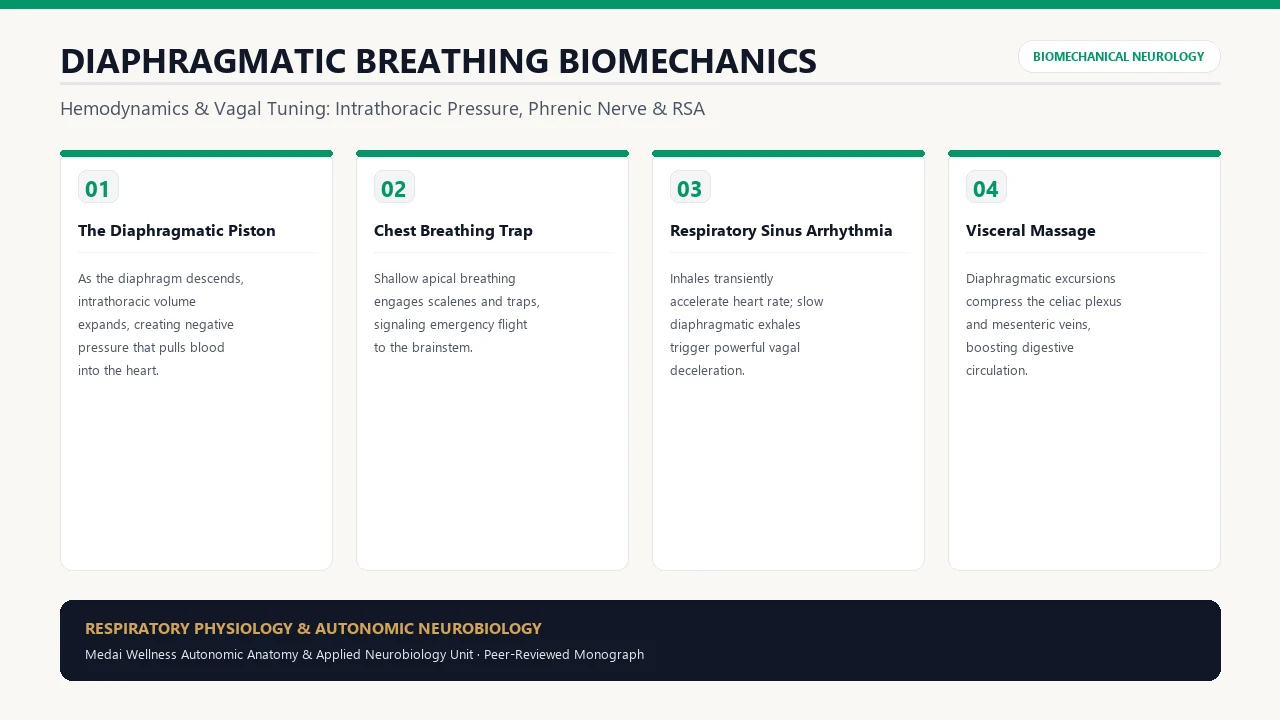
1. The Anatomical Piston: Diaphragm vs. Accessory Muscles
The human diaphragm is the primary muscle of respiration: a large, dome-shaped musculotendinous sheet separating the thoracic cavity (lungs and heart) from the abdominal cavity. Innervated by the phrenic nerve (originating from cervical roots C3, C4, and C5), the diaphragm is built for continuous, effortless aerobic work across an entire human lifespan.
However, under chronic psychosocial anxiety, trauma, or prolonged sedentary desk posture, humans subconsciously abandon diaphragmatic excursion. They transition into apical chest breathing, forcing secondary accessory muscles—the scalenes, sternocleidomastoid (SCM), pectoralis minor, and upper trapezius—to lift the heavy ribcage 20,000 times per day. These auxiliary muscles were designed only for emergency sprinting, and their chronic overuse leads to tension headaches, neck spasms, and persistent sympathetic hyperarousal.
2. Intrathoracic Pressure Dynamics: The Respiratory Heart Pump
Diaphragmatic movement functions as a hydraulic hemodynamic pump:
- During Inhalation: The diaphragm contracts and flattens downward toward the pelvis. This expands thoracic volume, dropping intrathoracic pressure below atmospheric pressure (-3 to -8 mmHg). This negative suction pulls blood upward from the inferior vena cava into the right atrium, increasing end-diastolic cardiac filling.
- During Exhalation: The diaphragm recoils passively upward. Intrathoracic pressure rises, gently compressing the ventricles and facilitating efficient systolic ejection into the aorta.
3. Respiratory Sinus Arrhythmia (RSA): The Vagal Gateway
The hemodynamic changes of diaphragmatic breathing directly govern Respiratory Sinus Arrhythmia (RSA)—the natural biological fluctuation where heart rate accelerates during inhalation and decelerates during exhalation:
- When you inhale, increased venous blood temporarily stretches the right atrium. The Bainbridge reflex and medullary respiratory center transiently suppress vagal firing, allowing the heart to beat faster to clear the incoming blood volume.
- When you exhale slowly and smoothly, the vagal brake is fully restored. Acetylcholine floods the Sinoatrial node, causing instant cardiac deceleration.
- By consciously prolonging your exhalation (e.g., inhaling for 4 seconds and exhaling for 6 to 8 seconds), you spend the majority of each minute in pure parasympathetic vagal dominance.
4. Why Apical Chest Breathing Locks You in Sympathetic Panic
Shallow apical chest breathing traps the nervous system in a vicious physiological loop:
- Hypocapnia and Alkalosis: Shallow, rapid breaths ventilate only the upper lung dead space, blowing off carbon dioxide and inducing subtle respiratory alkalosis. This restricts cerebral blood flow by up to 30%, producing lightheadedness and derealization.
- Afferent Threat Signatures: The brain monitors somatic muscle feedback. When the brainstem detects the scalenes and neck muscles contracting frantically, it concludes that you are running for your life from a physical predator, releasing adrenaline to match the perceived emergency.
5. Biomechanical Comparison: Diaphragmatic vs. Apical Breathing
| Biomechanical Metric | Diaphragmatic (Abdominal) Breathing | Apical (Chest / Shoulder) Breathing |
|---|---|---|
| Primary Musculature | Diaphragm & transverse abdominis | Scalenes, sternocleidomastoid, upper traps |
| Thoracic Pressure Swing | Large, rhythmic swings (-8 to +4 mmHg) | Minimal, shallow, high-frequency pressure changes |
| Heart Rate Variability (rMSSD) | High (maximizes RSA amplitude) | Low / suppressed (flat cardiac intervals) |
| Gas Exchange Efficiency | High; utilizes vascularized lung bases | Low; utilizes under-perfused lung apexes |
| Secondary Somatic Symptoms | Deep relaxation, warm hands, digestive gurgling | Tension headaches, TMJ jaw clenching, air hunger |
6. Clinical Biofeedback Drills to Retrain the Diaphragm
To eliminate chest-breathing habits and restore optimal diaphragmatic excursion:
- The Book on the Belly Drill: Lie flat on your back with knees bent. Place a medium hardcover book on your abdomen just above your navel. Place one hand flat on your upper chest. Breathe slowly through your nose: the book must rise and fall 2 to 3 inches with each breath, while the hand on your chest remains completely motionless.
- 360-Degree Lower-Rib Expansion: Wrap an elastic resistance band or hands around your lower lateral ribcage. Inhale not just "into the stomach", but expanding the ribs outward laterally like an accordion.
- Pursed-Lip Exhalation: Exhale through pursed lips (as though blowing through a straw). This creates positive expiratory airway pressure (PEEP), keeping lower airways open and maximizing vagal stimulation.
Frequently Asked Questions
Should my stomach push out when I breathe?
Yes. As the diaphragm contracts and descends downward into the abdominal cavity, it physically displaces the abdominal organs (stomach, intestines, liver) outward. Abdominal expansion is visual proof that your diaphragm is moving properly.
Why does diaphragmatic breathing make me feel dizzy at first?
If you have been chronically shallow-breathing for years, suddenly taking deeper diaphragmatic breaths can transiently alter your blood \(CO_2\) balance. Slow your breathing down: aim for fewer breaths per minute (5 to 6 breaths), rather than huge gasping lungfuls.
Can tight clothing prevent diaphragmatic breathing?
Absolutely. Tight belts, waist cinchers, shapewear, and tight waistbands physically restrict abdominal displacement, forcing the body into emergency apical chest breathing and perpetuating anxiety.