
1. The Surreal Terror of Unreality: Phenomenology of DP/DR
During acute derealization, the external world appears two-dimensional, synthetic, or viewed through a thick glass partition. Colors may look muted or unnaturally stark, familiar rooms feel foreign, and loved ones appear as strangers or actors in a stage play. Depersonalization shifts this perceptual distortion inward: your hands seem alien, your reflection in the mirror feels disconnected from your identity, and your own voice sounds hollow or distant, as though traveling through water.
This is emphatically not psychosis. In psychotic spectrum disorders (such as schizophrenia), reality testing is impaired: the patient believes the delusion as an absolute objective fact. In depersonalization and derealization (DP/DR), reality testing remains 100% intact—you are acutely, painfully aware that reality feels abnormal, and that very insight causes profound existential dread.
2. Neurobiology of the Freeze State: The Fronto-Limbic Circuit Breaker
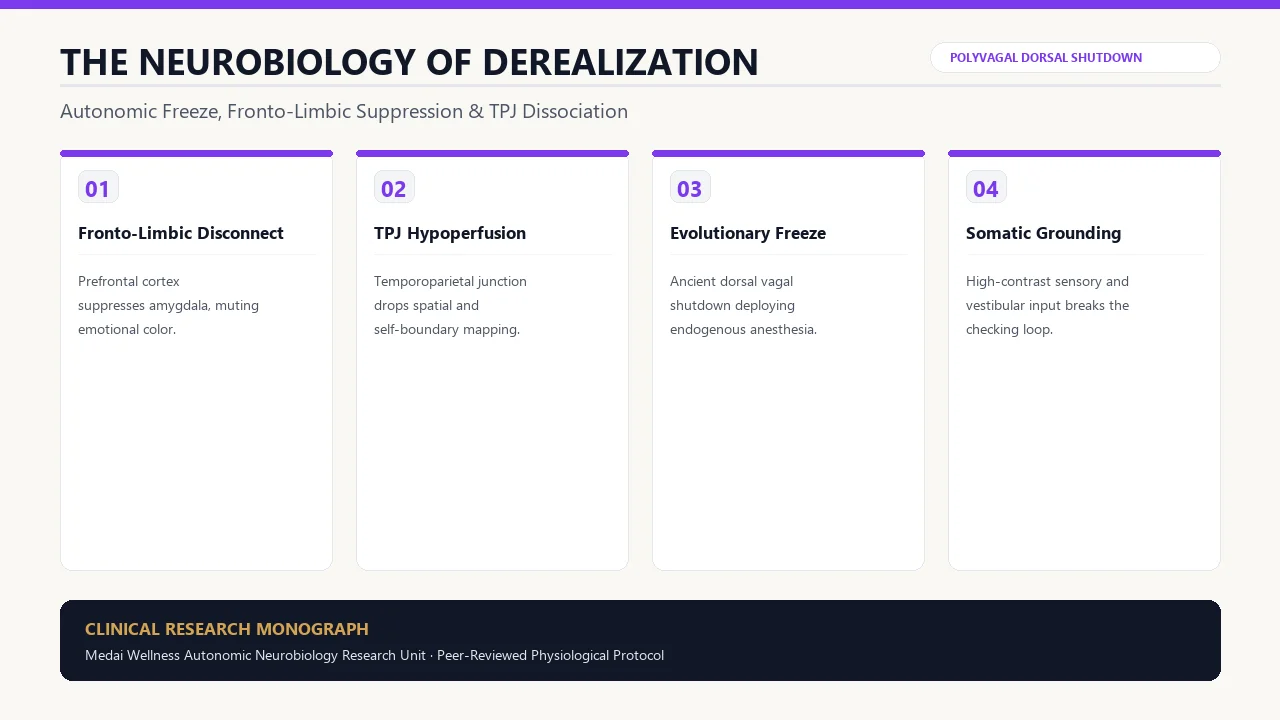
Functional neuroimaging (fMRI and PET) has elucidated the exact neural mechanisms governing DP/DR. Under Stephen Porges' Polyvagal Theory, when fight-or-flight sympathetic arousal reaches an unsustainable peak without resolution, the nervous system drops into the primitive dorsal vagal freeze state:
- Circadian Endocrine Diagnostics: Explore our research on cortisol levels chart by time of day.
- Foundational Neurobiology: Review our clinical analysis on the physiological sigh and autonomic anxiety reset.
- Fronto-Limbic Disconnect: The medial prefrontal cortex (mPFC) and anterior cingulate cortex (ACC) fire intense inhibitory signals down into the amygdala. This "emotional anesthesia" is an evolutionary defense against inescapable agony: it shuts down emotional resonance, leaving incoming sensory data flat, sterile, and drained of emotional meaning.
- Temporoparietal Junction (TPJ) Hypoperfusion: The right temporoparietal junction integrates visual, vestibular, and somatosensory coordinates to build your internal sense of spatial body-ownership. Neuroimaging shows that during DP/DR, perfusion to the TPJ plummets by 20% to 30%, destabilizing your proprioceptive anchor and generating classic out-of-body sensations.
- Endogenous Opioid Flooding: To protect against psychic trauma, the brainstem floods synaptic spaces with dynorphins and beta-endorphins, muting nociception and creating a persistent "dreamlike" state.
| Clinical Domain | Derealization & Depersonalization (Anxiety) | Psychotic Illness (Schizophrenia) |
|---|---|---|
| Reality Testing | Intact: Distress stems from knowing that things feel unreal | Lost: Delusions and hallucinations are accepted as literal truth |
| Autonomic Baseline | Sympathetic hyperarousal or dorsal vagal immobilization | Variable; dopamine D2 receptor hyperactivity without panic |
| Primary Mechanism | Prefrontal hyper-inhibition of amygdala + TPJ hypoperfusion | Mesolimbic dopaminergic dysregulation & structural changes |
| Prognosis with Vagal Regulation | Full recovery once autonomic threat circuitry de-escalates | Requires ongoing pharmacological antipsychotic management |
3. The Panic-Derealization Loop: Breaking the Cycle
The core clinical danger of DP/DR is that the sensation itself acts as an acute panic catalyst. An anxious individual looks at their surroundings, notices that the room feels artificial, and immediately thinks: "I am losing my mind. My brain is broken." This catastrophic interpretation fires the amygdala, releasing more epinephrine, driving further hyperventilation, and deepening the frontolimbic shutdown.
To interrupt this self-reinforcing loop, patients must recognize that derealization is not a disease—it is a physiological fuse. Just as an electrical circuit breaker trips to prevent wiring from melting under high voltage, your brain trips into dissociation when your autonomic voltage is too high. You do not need to fight the sensation; you must lower the autonomic voltage.
4. Step-by-Step Somatic Grounding Protocols to Reverse DP/DR
Because cognitive logic cannot penetrate a dissociated brainstem, recovery relies on direct sensory, thermal, and vestibular inputs:
- Cold Trigeminal Shock (Mammalian Dive Reflex): Submerge your face into a bowl of cold water (50°F / 10°C) for 15 seconds, or apply an ice pack to your cheekbones and bridge of the nose. This stimulates the ophthalmic branch of the trigeminal nerve, forcing immediate parasympathetic bradycardia and breaking opioid-mediated dissociation.
- Saccadic Horizon Scanning: Step outside or look across the room. Move your eyes horizontally from extreme left to extreme right along the widest horizon for 60 seconds without moving your neck. Lateral eye movements recruit the superior colliculus and vestibular nuclei, signaling to the brainstem that panoramic space is safe.
- Proprioceptive High-Friction Anchoring: Stand barefoot on rough texture (carpet, wood, grass). Push your heels firmly into the ground while verbally naming aloud 5 objective physical textures, 4 colors, and 3 sounds in your immediate environment.
- Controlled Carbon Dioxide Recovery: Practice strictly nasal breathing with extended exhalations (4 seconds in, 7 seconds out). This halts hypocapnic vasoconstriction, restoring normal blood flow to the visual cortex and temporoparietal junction.