
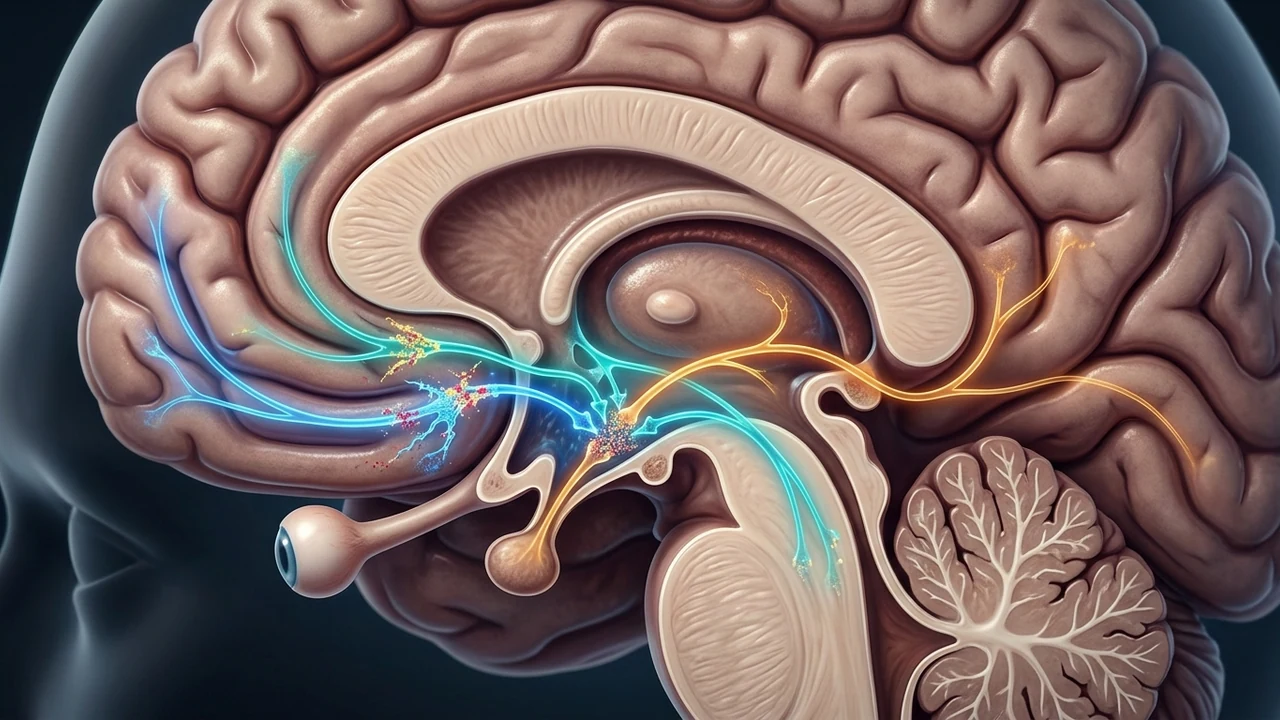
1. The Leptin-Hypothalamic Communication Circuit
Produced almost exclusively by adipose tissue, leptin is released into the bloodstream in direct proportion to total body fat mass. Under healthy metabolic conditions, leptin crosses the blood-brain barrier (BBB) via a saturable transport system and binds to the long form of the leptin receptor (LepRb) located on key neuronal populations within the Arcuate Nucleus (ARC) of the hypothalamus:
- POMC/CART Neurons (Anorexigenic): When leptin binds, it stimulates Pro-opiomelanocortin (POMC) neurons to synthesize alpha-MSH, which binds to MC4 receptors, extinguishing hunger and ramping up resting metabolic expenditure via sympathetic outflow to brown adipose tissue.
- NPY/AgRP Neurons (Orexigenic): Simultaneously, leptin strongly inhibits Neuropeptide Y (NPY) and Agouti-Related Peptide (AgRP) neurons, turning off the primal urge to forage for carbohydrates and fats.
In a healthy nervous system, as fat stores grow, leptin rises, hunger falls, and energy expenditure increases. But under chronic stress, this negative feedback loop breaks down entirely, leading directly to the phenomenon of why stress causes persistent cravings and abdominal fat.
2. How Cortisol Induces Central Leptin Resistance
Cortisol and glucocorticoids disrupt leptin signaling at the intracellular molecular level through two primary mechanisms:
- Upregulation of SOCS3: Prolonged exposure to elevated cortisol induces the transcription of Suppressor of Cytokine Signaling 3 (SOCS3) in hypothalamic neurons. SOCS3 binds to the phosphorylated tyrosine-985 residue on the LepRb receptor and directly inhibits JAK2/STAT3 signaling, terminating leptin's ability to trigger neurochemical satiety.
- Induction of PTP1B: Cortisol enhances Protein Tyrosine Phosphatase 1B (PTP1B), an enzyme that dephosphorylates JAK2, effectively cutting the electrical wire that informs the brain how much fat is stored in the body.
The tragic paradox is that the stressed patient often has astronomically high circulating leptin levels in their blood, yet their hypothalamus perceives absolute starvation.
3. The "Brain Starvation" Response
When the hypothalamic arcuate nucleus is blinded to leptin by cortisol and SOCS3, it executes a hardwired evolutionary survival program: the brain starvation cascade:
| Physiological Domain | Leptin-Sensitive Brain | Cortisol-Induced Leptin-Resistant Brain |
|---|---|---|
| Hypothalamic Perception | "Energy stores are abundant and safe." | "Emergency famine: energy stores are exhausted." |
| Neuropeptide Y (NPY) Level | Suppressed; calm and unhurried satiety | Massively elevated; intense, urgent drive to eat |
| Food Preference Bias | Flexible; receptive to nutrient-dense foods | Obsessive craving for hyper-palatable, sugar-fat combinations |
| Basal Metabolic Rate | Optimal thermogenesis and mitochondrial burn | Depressed by 20% – 30% to conserve cellular energy |
| Visceral Fat Partitioning | Balanced peripheral storage and mobilization | Hyperactive visceral LPL; rapid abdominal fat deposition |
4. The Hedonic Reward Overlap: Dopamine & Stress Eating
Cortisol does not merely dysregulate hypothalamic homeostatic hunger; it hijacks the mesolimbic dopamine reward pathway connecting the ventral tegmental area (VTA) to the nucleus accumbens.
Normally, leptin dampens dopamine release in response to food cues. Under cortisol-induced leptin resistance, however, this inhibitory brake is removed. Highly processed foods rich in sugar and saturated fats trigger massive, hyper-potent dopamine surges. This provides temporary, transient relief from stress-induced dysphoria, reinforcing a deep neurological addiction to comfort eating as a subconscious coping mechanism for nervous system distress.
5. Clinical Markers of Leptin Resistance
How can you confirm whether your appetite struggles and abdominal fat are driven by leptin resistance rather than simple lack of willpower?
- Fasting Serum Leptin Above 12 ng/mL (in men) or 20 ng/mL (in women): Elevated circulating leptin in the presence of excess body fat and persistent hunger is pathognomonic for central receptor-level leptin resistance.
- The "Bottomless Pit" Sensation After Full Meals: Finishing a substantial, calorically complete dinner yet feeling an irresistible psychological craving for sweets within 30 minutes.
- Severe Nighttime Cravings: Leptin naturally follows a diurnal rhythm, peaking at night to suppress appetite while you sleep. When cortisol disrupts this rhythm, cravings peak precisely between 8:00 PM and 11:00 PM.
6. Protocol to Re-Sensitize Hypothalamic Leptin Receptors
Restoring hypothalamic sensitivity to leptin requires clearing the neuro-inflammatory signaling blunting the LepRb receptor:
- Down-Regulating Neuroinflammation with Omega-3 Resolvins: High-potency EPA/DHA (minimum 2,000 mg combined EPA/DHA) reduces hypothalamic microglial activation and lowers SOCS3 expression, reopening the receptor channel.
- Restoring Deep Slow-Wave Sleep: Sleep deprivation directly induces acute leptin resistance within 48 hours. Prioritizing slow-wave sleep via non-sleep deep rest (NSDR) and evening parasympathetic downregulation is non-negotiable.
- Eliminating Dietary Fructose Overload: Unbound dietary fructose undergoes first-pass hepatic metabolism that rapidly elevates hepatic uric acid and triglycerides, which cross the blood-brain barrier and directly induce leptin resistance.
- Timed Protein Satiety Anchoring: Consuming 35 to 45 grams of protein within 60 minutes of waking stabilizes morning dopamine and GLP-1, preventing the midday cortisol spike that triggers evening cravings.