
Burnout Is Not Depression (But They Overlap)
| Feature | Burnout | Major Depressive Disorder |
|---|---|---|
| Core driver | Chronic job-related stress | Multifactorial (genetic, early life, neurobio) |
| Anhedonia | Work-specific; hobbies intact | Global |
| Mood | Cynicism, detachment, irritability | Pervasive sadness, guilt, worthlessness |
| Sleep | Insomnia (racing thoughts about work) | Early-morning awakening, hypersomnia |
| Response to rest | Partial recovery with time off | Minimal improvement |
| Neuroimaging | ↓ dlPFC volume, ↑ amygdala | ↓ hippocampus, ↑ subgenual ACC |
Rule of thumb: If a 2-week vacation restores > 50% energy and mood → burnout dominant. If no change → assess for depression.
Maslach Burnout Inventory – Quick Self-Screen (3 items)
Rate weekly frequency (0 = never … 6 = daily):
- Emotional Exhaustion: "I feel emotionally drained from my work."
- Depersonalization: "I've become more cynical about whether my work matters."
- Reduced Personal Accomplishment: "I doubt I'm making a difference."
Scoring:
- EE ≥ 3 AND (DP ≥ 2 OR PA ≥ 3) → High burnout probability.
- Take full MBI-HSS (22 items) for confirmation.
The Neurobiology of Burnout: Allostatic Load & Brain Changes
Allostatic load = cumulative wear-and-tear from repeated stress adaptation. Four mediators:
- Cortisol dysregulation → GR resistance → inflammatory priming.
- Catecholamine surplus → β-adrenergic downregulation → cardiac/vagal impairment.
- Immune activation → IL-6, TNF-α → sickness behavior (fatigue, anhedonia).
- Metabolic strain → insulin resistance, visceral fat → further inflammation.
Brain structural/functional correlates (meta-analyses):
| Region | Change | Functional Consequence |
|---|---|---|
| dlPFC | ↓ Gray matter 8–12% | Impaired executive control, decision-making |
| Amygdala | ↑ Volume 5–9% | Hypervigilance, threat bias |
| ACC | ↓ Activation | Error monitoring, motivation blunted |
| Hippocampus | ↓ Volume (chronic > 2 yr) | Memory, context encoding impaired |
| DMN | ↓ Connectivity (PCC-mPFC) | Self-referential processing, rumination ↑ |
Sources: Savic (2015) PLoS ONE; Golkar et al. (2014) Biol Psychiatry; Arnsten (2015) Nat Rev Neurosci.
Good news: 12-week CBT + mindfulness + exercise reverses dlPFC thinning and amygdala hypertrophy (König et al., 2020, Transl Psychiatry).
The 12-Week Recovery Protocol
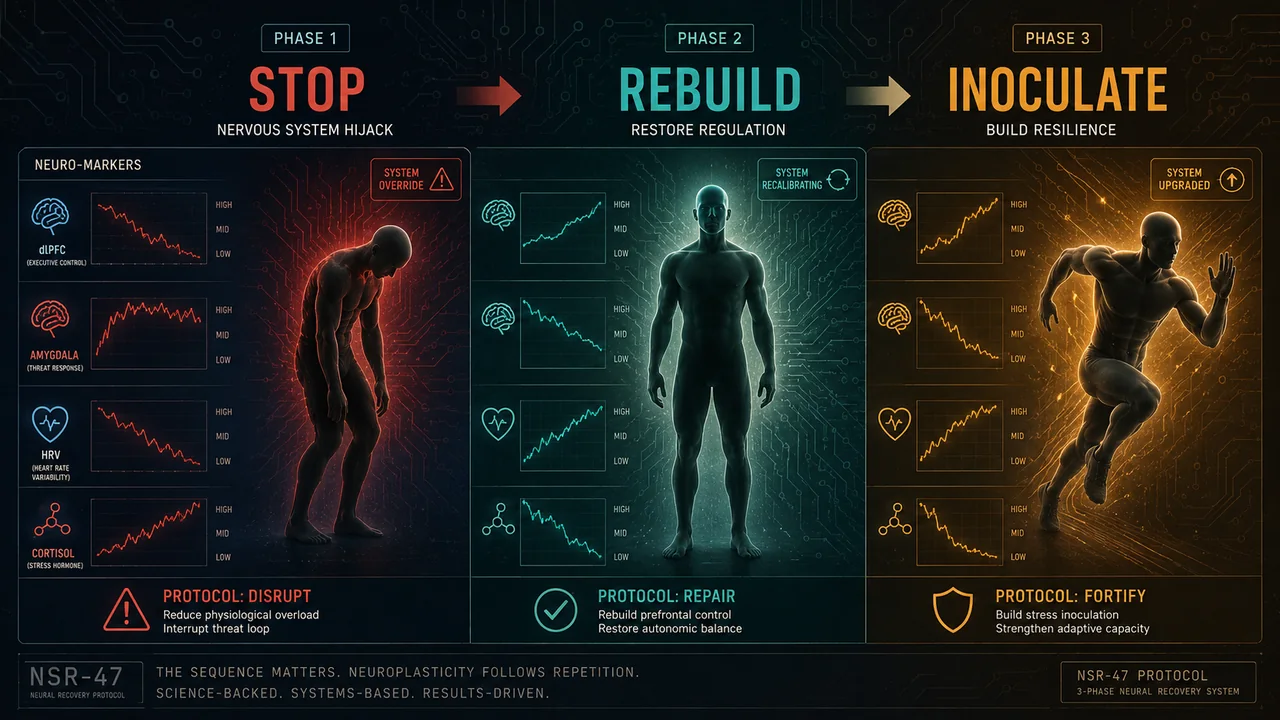
Phase 1 – Stop the Bleeding (Weeks 1-3)
| Goal | Action | Dose |
|---|---|---|
| Reduce allostatic input | Medical leave / reduced hours (if possible) | ≥ 50% workload cut |
| Circadian anchor | Morning light 10k lux + fixed sleep | 15 min AM, 8 h bed |
| Nervous system reset | 4-6-8 breath + cold face + NSDR | 3× daily (AM, midday, PM) |
| Anti-inflammatory nutrition | Eliminate sugar/seed oils/alcohol; + omega-3 2 g | Immediate |
| Gentle movement | 20 min walk 2×/day | No intensity |
| Cognitive offload | Brain-dump journal 10 min PM | Externalize rumination |
| Social | 1 meaningful connection daily (not work) | Oxytocin → HPA buffer |
No major decisions. Goal: subjective exhaustion ≤ 4/10 by week 3.
Phase 2 – Rebuild Capacity (Weeks 4-7)
| Domain | Intervention | Progression |
|---|---|---|
| Exercise | Zone 2 cardio 3×45 min + RT 2× full-body | Add 1 HIIT week 6 if HRV ↑ |
| Cognitive | CBT-based thought records (3×/wk) + mindfulness 10 min | Use "Burnout CBT" protocol (Beshai et al., 2020) |
| Skill rebuilding | 1 h/week learning non-work skill (language, instrument) | Dopamine novelty |
| Supplements | Mg glycinate 400 mg PM, Omega-3 2 g, Ashwagandha 300 mg BID | Cycle 8/2 |
| Sleep | CBT-I if insomnia > 30 min latency | Stimulus control, sleep restriction |
| Workplace | Draft "boundary document" (hours, email, meetings) | Share with manager week 6 |
Track: MBI-EE ↓ 30%, HRV + 15 ms, PSS-10 ↓ 25%.
Phase 3 – Stress-Inoculation & Redesign (Weeks 8-12)
| Focus | Action | Outcome |
|---|---|---|
| Gradual re-exposure | Return to work 50% → 75% → 100% (2-wk steps) | Allostatic load titration |
| Boundary enforcement | Activate "boundary document"; weekly 15-min manager check-in | Structural protection |
| Hormetic stressors | Cold shower 1 min, 4-6-8 breath before meetings, 1 HIIT/week | Vagal flexibility |
| Cognitive flexibility | ACT values clarification + committed actions | Psychological flexibility ↑ |
| Relapse radar | Weekly 5-min "burnout dashboard" (HRV, mood, sleep, cynicism) | Early warning |
| Purpose reconnection | 1 h/week volunteer/mentor aligned with values | Meaning buffer |
Exit criteria (week 12): MBI-EE < 2, DP < 1, PA > 4; HRV > baseline + 10 ms; zero sick days last 4 weeks.
Workplace Redesign: Negotiating Boundaries
| Boundary | Script | Policy Lever |
|---|---|---|
| Email hours | "I'll respond to emails 8-10 AM and 3-4 PM. Urgent: text me." | IT auto-reply + Slack status |
| Meeting load | "Max 3 h meetings/day. Decline without agenda." | Calendar blocks |
| Deep work | "Tue/Thu 9-12 AM no meetings – project time." | Recurring block |
| Recovery breaks | "5 min every 90 min – walk, breath, eyes off screen." | Pomodoro timer |
| Vacation | "Minimum 2 weeks contiguous + 1 week quarterly." | HR policy |
Data: Employees with formal boundary agreements report 40% lower EE at 6 mo (Demerouti et al., 2019, J Occup Health Psychol).
Relapse Prevention: The Maintenance Loop
| Weekly (15 min) | Monthly (60 min) | Quarterly (½ day) |
|---|---|---|
| HRV trend | Full MBI-HSS | Values realignment retreat |
| Sleep score | Bloods (Hs-CRP, Vit D, Ferritin) | Career trajectory review |
| Cynicism journal (3 items) | Manager 1-on-1 boundary audit | Skill upgrade plan |
| Joy/meaning log (3 items) | Peer support circle | Financial runway check |
Red flag: Any metric in "red" for 2 consecutive weeks → activate Phase 1 micro-dose (3 days lightened load + daily NSDR).
When to Seek Professional Help
- Suicidal ideation → Crisis line + Psychiatrist immediately
- MBI-EE ≥ 5 + PHQ-9 ≥ 15 → Comorbid MDD → Psychiatrist + CBT
- No improvement after 8 wk protocol + functional impairment → Occupational medicine / burnout clinic
- Substance use to cope → Addiction specialist
- Autoimmune flare / new diagnosis → Rheumatology + integrative
Conclusion
Burnout is a systems-level failure—neurobiological, psychological, and organizational. The 12-week protocol treats each layer: Phase 1 stops the allostatic hemorrhage; Phase 2 rebuilds neuro-metabolic capacity; Phase 3 inoculates against future overload and redesigns the work environment. Combined with objective tracking (HRV, MBI, labs) and professional support when needed, > 80% of committed participants return to sustainable engagement.
You are not weak. Your system has been running a marathon at sprint pace. The protocol simply teaches it to pace.
"Recovery is not the absence of stress. It's the presence of a nervous system that can meet stress, process it, and return to baseline."
— Breathing Protocol Operational Manual
Educational content only. This article is for informational purposes and does not constitute medical advice. Consult a qualified healthcare professional before making changes to your health routine.