
What People Really Mean by "Lower Belly Fat"
When people talk about lower belly fat, they usually mean the area below the navel — the pouch that persists above the waistband even after weight is lost elsewhere. It is helpful to be precise from the start: there is no single "lower belly fat" organ or depot, but the region is a visible focal point for fat that accumulates centrally and is often the last to leave.
The lower abdomen contains both subcutaneous fat (the soft layer under the skin you can pinch) and, deeper inside, visceral fat packed around the intestines and lower organs. Visceral fat is the metabolically active portion most associated with health risk, and it is the part most responsive to overall energy balance.Saad F, et al. (2005). Pathophysiology of sex hormones in men and their clinical U-shape curve. (visceral vs subcutaneous discussion) — Endocrine.
Understanding that there are two layers helps explain the confusion: when someone loses fat, the deeper visceral layer may shrink first while the subcutaneous pouch above the waistband lingers, so it honestly looks like "nothing is working" at the waist for a while.
Cortisol and the "Stubborn Pouch": The Stress Link
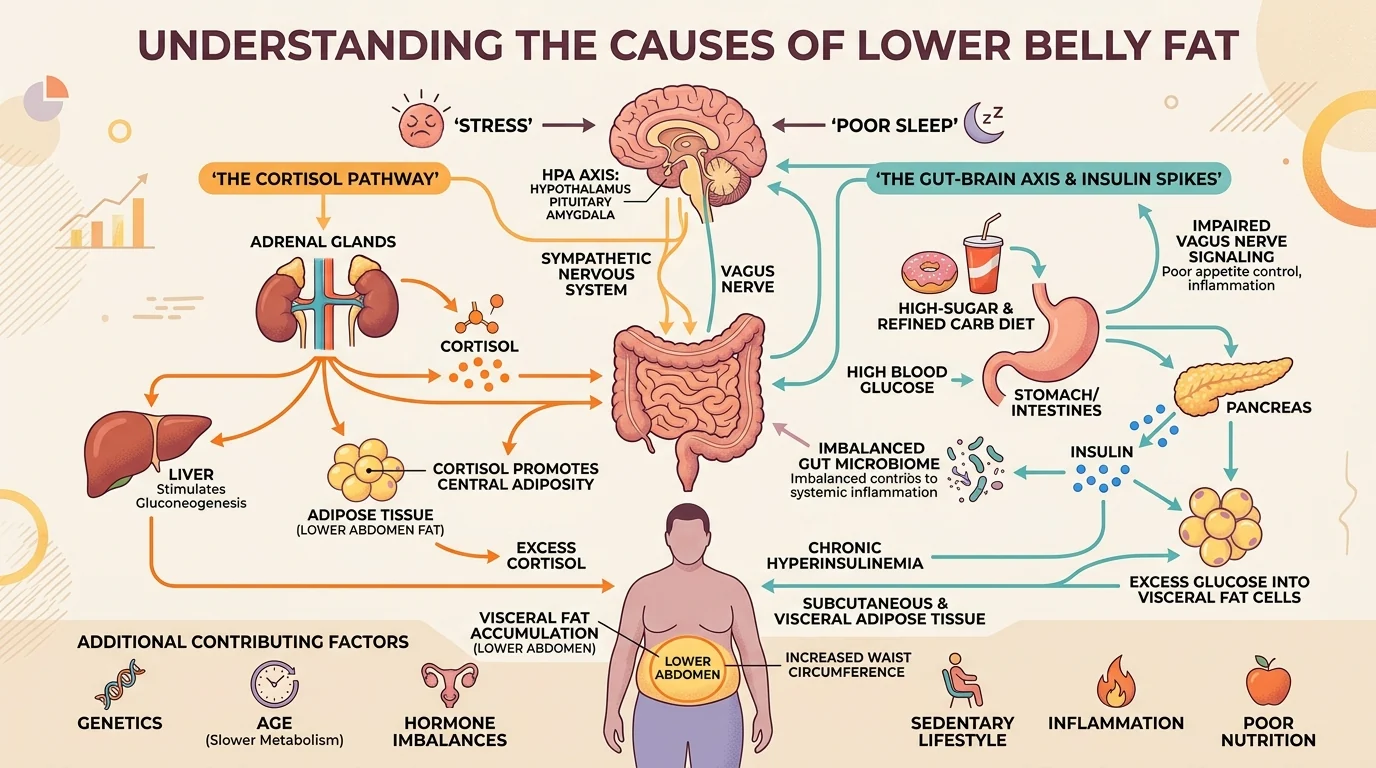
Among the strongest single explanations for a stubborn lower belly is the relationship between chronic stress, the hormone cortisol, and where the body prefers to store fat. Cortisol mobilizes energy for survival, but when it is frequently elevated, it favors fat deposition in the abdomen — particularly the deep visceral compartment.Epel ES, et al. (2000). Stress and body shape: stress-induced cortisol secretion is consistently associated with body fat distribution in women. Psychosomatic Medicine.
This is the same mechanism that connects stress with difficulty losing weight. Higher, flatter cortisol profiles across the day are associated with more central (belly) fat and a larger waist, independent of overall body weight in some analyses. So the belly can be a place where the body "parks" fat it was told to hold onto by chronic stress signals.
The practical implication is uncomfortable but useful: no amount of abdominal exercise alone will outrun a stress physiology that is continuously signaling storage. Stress regulation is a real lever for the lower belly — not because it burns fat, but because it changes the hormonal environment in which fat storage decisions are made.
Why the Lower Abdomen Is Often the Last to Change
Fat is lost from a body in a genetically influenced order, and for many people that order is the reverse of how it was gained. Because weight tends to accumulate centrally first (especially under stress), it is often released from the abdomen last.Vispute SS, et al. (2011). The effect of abdominal exercise on abdominal fat. Journal of Strength & Conditioning Research.
This "last to go" pattern has a real psychological cost: someone can be losing visceral fat (the part that matters for health) while the subcutaneous pouch barely moves, so the mirror suggests failure when the body is actually remodeling. Tracking progress on overall weight, weekly waist measurements, and clothing fit over months gives a truer picture than a daily glance in the mirror.
Genetics and Where Fat Prefers to Be
Two people can eat similarly, exercise similarly, and lose weight at similar rates — yet one loses belly fat easily while the other carries it to the end. Much of that difference is genetic: the number and size of fat cells, and the hormone receptors on them, differ between people and are inherited.Salans LB, et al. Critical review of methods to evaluate fat cell number and size — in Fat Distribution During Growth and Later Health Outcomes.
Genetics set the baseline, but they do not decide the outcome. The direction of change is still governed by energy balance and hormones. Genetics mostly explains why the lower belly is stubborn for you specifically — not whether it can change at all.
Posture, the Gut, and "Shape" Can Look Like Fat
Part of what reads as "lower belly fat" is not fat at all. Anterior pelvic tilt — a common posture pattern where the pelvis tips forward — can push the lower abdomen forward and make a flat stomach appear rounded. Bloating from gas, water retention, or slow digestion can create a temporary lower belly that has nothing to do with fat mass.
This makes it especially important to look at trends over time rather than a single measurement. If the lower belly fluctuates day to day with meals, digestion, salt, and sleep, the variation is largely fluid and gut content — not changes in fat. That is also why weight-loss attempts fail when they treat a single daily number as the truth.
Insulin and the Belly Loop
Visceral fat and insulin handling form a two-way loop. Excess visceral fat releases inflammatory signals and fatty acids into circulation, which can impair how muscles and the liver respond to insulin. In turn, poorer insulin sensitivity favors further central fat storage — a loop that keeps the belly stubborn.Kahn SE, et al. (2006). Mechanisms linking obesity to insulin resistance and type 2 diabetes. Nature.
The encouraging side is that this loop runs in reverse too. The same levers that improve insulin sensitivity — consistent eating patterns, regular movement, adequate muscle, and protected sleep — reliably reduce visceral fat. The belly responds to metabolic health, which is another way of saying it responds to the whole system and not to any single food or exercise "targeting" it.
Sleep, Appetite Hormones, and the Belly
Short or poor sleep shifts appetite hormones: hunger-signaling ghrelin rises and satiety-signaling leptin falls, increasing the drive to eat energy-dense food.Spiegel K, et al. (2004). Sleep curtailment in healthy young men is associated with decreased leptin levels, elevated ghrelin levels, and increased hunger and appetite. Annals of Internal Medicine. Sleep deprivation also raises stress hormones and is associated with greater overall and abdominal weight gain. This is the hidden mechanism behind poor sleep and weight gain.
For the lower belly specifically, protecting sleep is one of the least glamorous but most evidence-backed levers. It is not about "trying harder" at meals; it is about restoring the hormonal conditions under which consistent, moderate choices become the default.
Protein, Muscle, and Not Dieting Yourself into a Corner
A common mistake in "belly fat" plans is eating far too little, which triggers muscle loss. Because muscle is metabolically active, losing it lowers resting expenditure and makes fat loss harder to sustain.Paddon-Jones D, et al. (2008). Protein, weight management, and satiety. American Journal of Clinical Nutrition. Severe restriction also raises counter-regulatory biology, inviting rebound.
The better approach for the lower belly is a modest deficit that preserves muscle: adequate protein, resistance activity, and enough food to stay consistent. This changes what the weight loss is made of — favoring fat (including from the abdomen) over lean tissue — and it is far more sustainable.
Spot Reduction Is a Myth — Including Here
Exercises that "target" the lower belly — lower-ab crunches, leg raises, specific "lower tummy" routines — do not selectively remove fat from that region. Exercise builds muscle, but fat mobilization is whole-body and driven by hormones and energy balance, not by which muscle you contract.Vispute SS, et al. (2011). The effect of abdominal exercise on abdominal fat. Journal of Strength & Conditioning Research.
This does not make exercise useless. Whole-body activity and resistance training create the energy deficit and insulin improvements that actually reduce visceral fat. The value of exercise for the belly is systemic — not that the crunch "targeted" it, but that the movement and energy balance it created did.
Practical Protocol for the Stubborn Lower Belly
- Regulate stress. Cortisol favors abdominal storage; a few minutes of slow, controlled breathing a day changes the storage environment. See diaphragmatic breathing and vagal tone.
- Protect sleep. Sleep governs the appetite hormones and glucose handling that the belly responds to.
- Modest deficit, adequate protein. Preserve muscle so the loss is fat, not lean tissue.
- Whole-body movement. Activity and resistance work drive visceral fat loss better than targeted crunches.
- Track trends, not a single day. Waist and weight over weeks; ignore day-to-day bloating.
- Ignore "targeted" marketing. No wrap, cream, or device selectively removes lower belly fat.
Lower Belly Fat: Causes and the Levers That Matter
| Contributor | What It Does | Practical Lever |
|---|---|---|
| Cortisol / stress | Favors central and visceral fat storage | Stress regulation, breathing |
| Genetics | Sets which depot is lost last | Patience, multi-metric tracking |
| Insulin loop | Visceral fat worsens insulin handling | Consistent meals, movement, sleep |
| Sleep | Raises hunger hormones and stress | Protect 7-9 hours |
| Posture / gut | Pelvic tilt and bloat mimic fat | Measure trends, not a day |
| Muscle loss | Over-restriction lowers metabolism | Protein and resistance work |
Frequently Asked Questions
What causes stubborn lower belly fat in women?
The same drivers apply as in men — stress-derived cortisol, genetics, insulin handling and sleep — but hormonal transitions (such as perimenopause) can shift fat toward the abdomen and make the lower pouch more persistent. The response is still most reliable through whole-body energy balance, stress and sleep regulation, and muscle preservation.
Does stress alone cause lower belly fat?
Chronic stress is strongly associated with central fat accumulation, but it does not act alone; it combines with energy intake, genetics and activity. Stress is a real contributor to the lower belly and a genuine lever, not the entire cause.
Why won't my lower belly fat go away even though I lost weight?
Fat is often lost from the abdomen last, especially the subcutaneous layer above the waistband. You may be losing visceral (health-relevant) fat while the pouch lingers. Look at waist trends over weeks and metabolic markers rather than a single mirror view.
Are lower-ab exercises good for lower belly fat?
They strengthen the lower-abdominal muscles and improve posture, which can make the area appear flatter, but they do not selectively burn the fat over it. Fat loss is whole-body; systemic energy balance and activity are what reduce the fat.
Can bloating be mistaken for lower belly fat?
Yes. Gas, water retention and slow digestion create a temporary lower belly that fluctuates with meals, salt and sleep. Day-to-day variation is usually fluid and gut content, not fat; only trends over time indicate real fat changes.
How long does it take to lose lower belly fat?
Because the abdomen is often the last depot to change, visible lower-belly change typically takes weeks to months of consistent, moderate energy balance — longer than weight loss elsewhere. Focusing on waist trends over months gives an honest expectation.
Conclusion
Lower belly fat looks stubborn for real reasons: it sits where stress hormones prefer to store fat, it is often the last depot to be released, its timing is influenced by genetics, and — because part of it is visceral — it is metabolically active. None of this is a personal failure; it is normal physiology doing what it is wired to do.
The response is not to fight the region directly, but to work on the system that governs it — stress regulation, sleep, a modest muscle-preserving deficit, and whole-body activity — and to track progress the honest way, over weeks and months. In that context the lower belly responds: more slowly than we would like, but reliably, and with the rest of the body improving alongside it.
Educational content only. This article is for informational purposes and does not constitute medical advice. Fat distribution and weight are influenced by medical and hormonal conditions that may require evaluation. Consult a qualified healthcare professional before making changes to your health routine.