
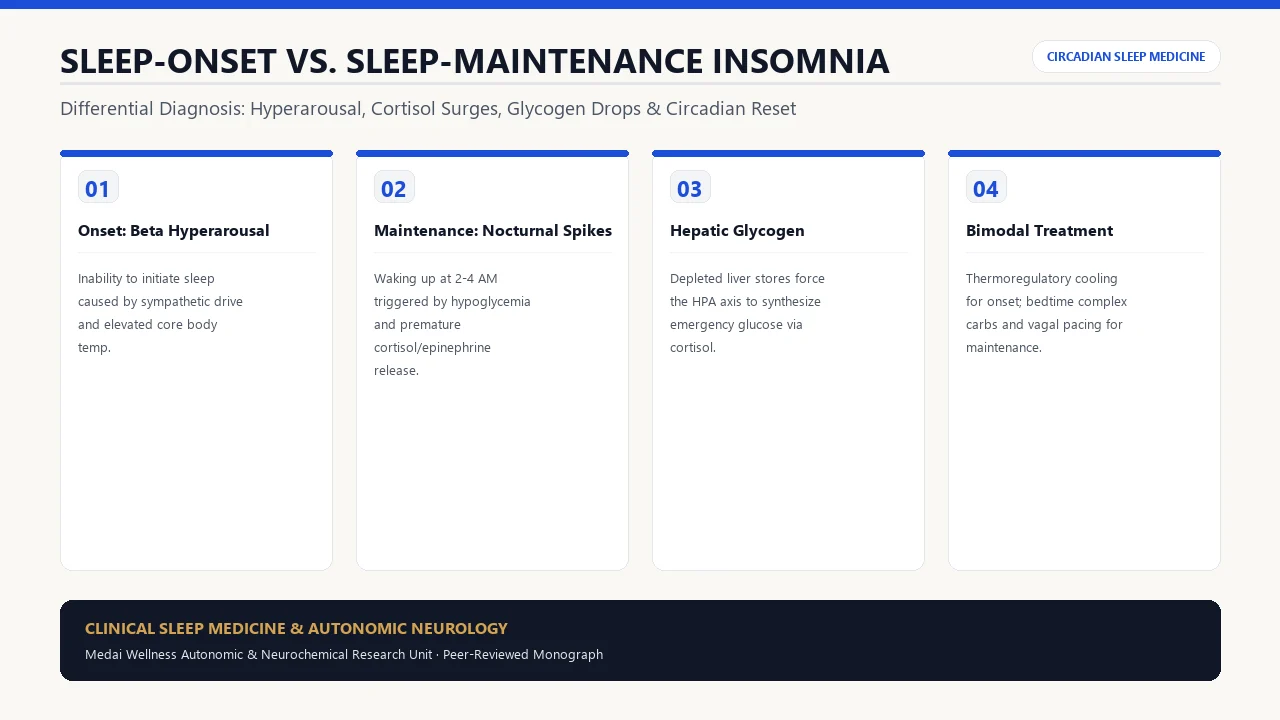
1. The Two Distinct Faces of Chronic Insomnia
Millions of adults are diagnosed with "insomnia," yet their clinical presentations could not be more polarized. Patient A lies in bed exhausted for two hours with a pounding pulse, racing thoughts, and warm extremities, unable to cross the threshold into sleep. Patient B falls asleep within five minutes of head-on-pillow, only to jolt wide awake at 3:18 AM with a surge of adrenaline, heart palpitations, and an overactive bladder, unable to fall back asleep for the rest of the night.
Treating both patients with the same generic sleep advice ("keep your bedroom cool and avoid screens") fails because sleep-onset insomnia and sleep-maintenance insomnia involve entirely different autonomic, metabolic, and neurochemical imbalances.
2. Neurobiology of Sleep-Onset Insomnia (The Racing Mind)
Normal sleep initiation requires the coordination of three physiological shifts:
- Thermoregulatory Drop: The core body temperature must fall by approximately 1°C (1.8°F), driven by peripheral vasodilation (blood vessels in the hands and feet dilating to dump heat).
- Vagal Dominance: Parasympathetic activity must ascend, slowing heart rate and inducing High-Frequency Heart Rate Variability (HF-HRV).
- Thalamocortical De-excitation: The thalamus must switch from fast desynchronized beta brainwaves (13–30 Hz) to synchronized alpha (8–12 Hz) and theta waves (4–8 Hz) via GABAergic signaling in the reticular thalamic nucleus.
In sleep-onset insomnia, persistent sympathetic overdrive keeps arterial blood pressure elevated, prevents peripheral vasodilation, and traps the prefrontal cortex in persistent rumination. If core temperature cannot drop, sleep spindles cannot form.
3. Why You Wake Up at 3:00 AM in Panic (Sleep Maintenance)
Waking up reliably between 2:00 AM and 4:00 AM is almost never an emotional issue; it is a metabolic alarm orchestrated by the autonomic nervous system:
- Hepatic Glycogen Depletion: The human brain consumes approximately 20% of the body's glucose even during sleep. The liver stores approximately 70–100 grams of glycogen. If liver glycogen runs out at 3:00 AM, blood glucose plummets.
- Emergency Adrenal Counter-Regulation: The brain senses hypoglycemia as an imminent neurological threat. To prevent coma, the adrenal glands release an emergency pulse of cortisol and epinephrine to stimulate hepatic gluconeogenesis and break down muscle protein.
- The 3:00 AM Adrenaline Shock: This hormone pulse immediately spikes heart rate, triggers perspiration, and awakens the cerebral cortex into full vigilance. The patient interprets this biochemical survival response as psychological anxiety or panic.
- Histamine Surges: Mast cells and histaminergic neurons in the tuberomammillary nucleus also peak around 3:00 AM in individuals with chronic gut permeability or histamine intolerance.
4. Clinical Comparison: Onset vs. Maintenance
| Clinical Parameter | Sleep-Onset Insomnia | Sleep-Maintenance Insomnia |
|---|---|---|
| Primary Symptom | Sleep latency > 30–60 minutes | Awakening between 2:00 AM – 4:00 AM with high alertness |
| Autonomic State | Bedtime sympathetic hyperarousal | Nocturnal parasympathetic withdrawal & adrenaline surge |
| Core Temperature | Failure of peripheral vasodilation to dump core heat | Premature morning temperature elevation |
| Endocrine Trigger | Delayed melatonin onset & elevated evening cortisol | Nocturnal hypoglycemia triggering cortisol/epinephrine spike |
| Associated Complaints | Restless legs, racing thoughts, sensory sensitivity | Night sweats, 3 AM bathroom urgency, heart palpitations |
5. Targeted Protocols for Sleep-Onset Insomnia
To eliminate sleep latency, interventions must accelerate core cooling and thalamocortical GABA inhibition:
- Hot Bath Peripheral Vasodilation: Take a hot shower or bath (40°C/104°F) 90 minutes before bed. This dilates cutaneous vascular beds, causing rapid core heat dissipation upon stepping out.
- Inhibitory Glycine Priming: 3 grams of pure glycine taken 45 minutes before sleep binds to NMDA receptors in the SCN, stimulating peripheral vasodilation and accelerating core body temperature reduction.
- Exhalation-Biased Vagal Pacing: Perform 10 minutes of 4-7-8 breathing or physiological sighs (two quick inhales through the nose, long slow exhale through the mouth) to activate cardiac vagal efferents.
- Digital Infrared & Blue Light Blockers: Eliminating 450–480 nm blue light at least 90 minutes before sleep permits endogenous pineal melatonin secretion.
6. Targeted Protocols for Sleep-Maintenance Insomnia
To prevent 3:00 AM adrenal awakenings, the metabolic supply of hepatic glucose must remain stable throughout the sleep cycle:
- Bedtime Glycogen Buffer: Consume 1 teaspoon of raw unprocessed honey or a small spoonful of almond butter with complex carbohydrates 30 minutes before sleep. Fructose is preferential for replenishing hepatic glycogen without spiking daytime insulin, keeping nocturnal blood sugar flat.
- Magnesium Glycinate or Threonate: 300–400 mg of bioavailable magnesium blocks NMDA excitotoxicity and smooths nocturnal autonomic transitions between slow-wave and REM cycles.
- Nocturnal Re-Settling Rule: If you awaken at 3 AM, do NOT look at a clock or smartphone. Checking the time activates the prefrontal cortex into mathematical calculation of remaining hours. Keep eyes closed, roll onto the left side (which reduces gastroesophageal reflux and heart strain), and perform slow diaphragmatic breathing.
- Evaluate Sleep Apnea / UARS: Frequent nocturnal awakenings accompanied by gasping or a dry mouth warrant evaluation for Upper Airway Resistance Syndrome (UARS) or obstructive sleep apnea.
Frequently Asked Questions
Why do I wake up at exactly 3:00 AM every single night?
Waking at exactly 3:00 AM is typically caused by the intersection of hepatic glycogen depletion triggering an adrenal glucose-rescue surge (cortisol and epinephrine) and the circadian transition into REM sleep cycles where autonomic stability is naturally more fragile.
Can an anxious nervous system cause both types of insomnia simultaneously?
Yes. Severe autonomic dysregulation can manifest as high bedtime hyperarousal (onset) combined with nocturnal hypoglycemia and excessive early morning cortisol surges (maintenance), fragmenting the entire sleep architecture.
Does taking melatonin fix sleep maintenance insomnia?
Standard immediate-release melatonin only assists sleep onset by signaling circadian night to the brain. It has a short half-life (20–40 minutes) and does not prevent metabolic or adrenal awakenings at 3:00 AM. In fact, excessive melatonin can cause vivid nightmares that trigger sympathetic awakenings.