
1. The Modern Neurological Magnesium Crisis
An estimated 68% of North American and European adults consume less than the Recommended Daily Allowance (RDA) of dietary magnesium. Decades of industrial agriculture, soil demineralization, municipal water filtration, and food processing have stripped this vital mineral from our daily diet.
Compounding this dietary deficit, chronic stress and high cortisol accelerate urinary magnesium wasting via the renal tubules. The result is a population living in chronic, low-grade neurological magnesium starvation, manifesting as muscle fasciculations, jaw clenching, brain fog, sensory hypersensitivity, and intractable anxiety.
2. The NMDA Gatekeeper: How Magnesium Shuts Down Brain Excitotoxicity
At the molecular level, magnesium is the central nervous system's master structural off-switch:
- The N-methyl-D-aspartate (NMDA) glutamate receptor is an ionotropic calcium channel that, when open, triggers excitatory neuronal firing.
- Under physiological conditions, an extracellular magnesium ion (\(Mg^{2+}\)) sits physically lodged within the channel pore, acting as a cork or plug.
- This "voltage-dependent magnesium block" prevents ambient glutamate from triggering uncontrolled calcium influx.
- When intracellular and extracellular magnesium levels drop, the plug disappears. Glutamate continuously hyper-stimulates the receptor, flooding the neuron with calcium and inducing chronic glutamate excitotoxicity and acute panic.
3. Magnesium L-Threonate: The MIT Brain Breakthrough
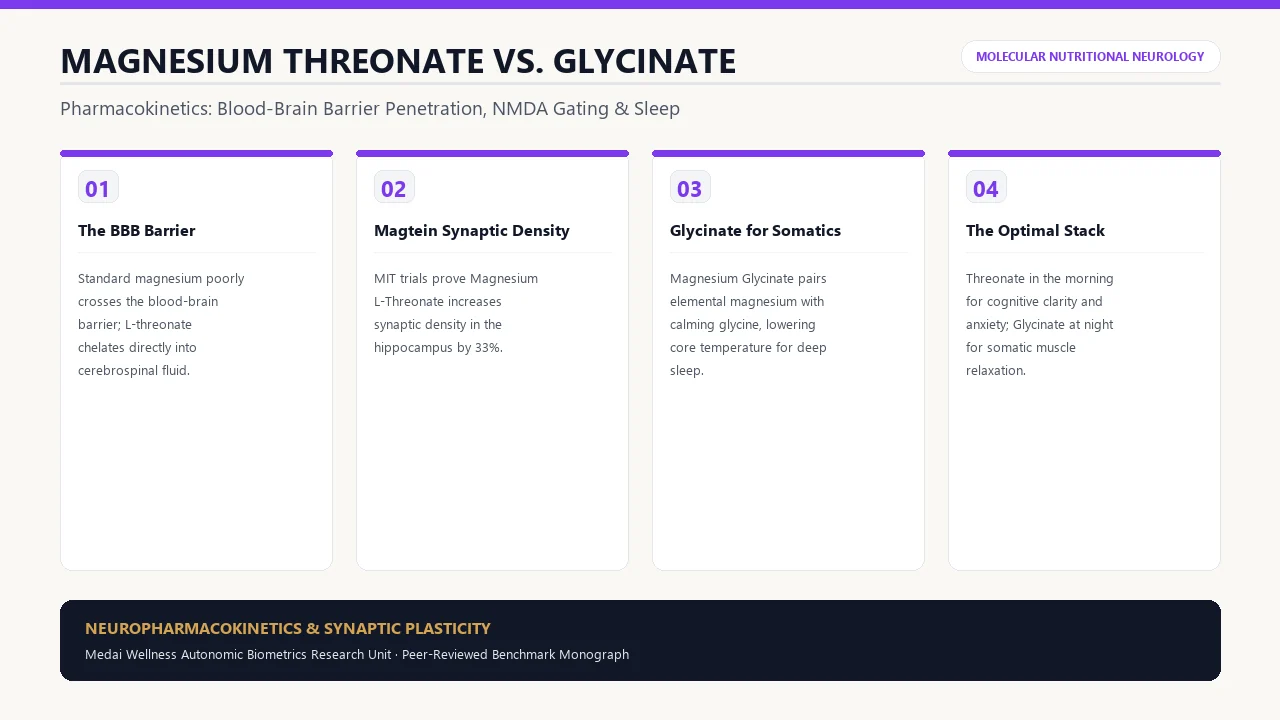
For decades, neuroscientists faced a pharmaceutical wall: administering high doses of oral magnesium sulfate, citrate, or chloride elevated serum blood magnesium, but barely moved magnesium concentrations within the cerebrospinal fluid (CSF) due to tight blood-brain barrier regulation.
In 2010, researchers at MIT led by Dr. Guosong Liu developed Magnesium L-Threonate (patented as Magtein). L-Threonate is a metabolite of vitamin C that binds to magnesium, enabling it to cross the blood-brain barrier via specialized monocarboxylate transporters.
Animal and human clinical trials demonstrated that Magnesium L-Threonate:
- Elevated CSF magnesium levels by 15% (where other forms produced 0% change).
- Increased the density of functional synaptic connections in the hippocampus and prefrontal cortex by 33%.
- Significantly accelerated fear extinction learning (helping the brain unlearn traumatic fear triggers).
- Improved working memory and executive task-switching scores in elderly adults with cognitive impairment.
4. Magnesium Glycinate: The Somatic Calming Powerhouse
Magnesium Glycinate (also known as magnesium bisglycinate) consists of one elemental magnesium atom covalently bonded to two molecules of the inhibitory amino acid glycine.
This dual formulation makes it an exceptional somatic medicine:
- Intestinal Tolerance: Bound to glycine, magnesium utilizes dipeptide absorption channels in the jejunum rather than competing for ion transporters, eliminating the diarrhea and GI distress common with citrate or oxide.
- Thermoregulatory Sleep Support: As detailed in our research on glycine neurobiology, 3 grams of glycine dilates peripheral blood vessels to dump core body temperature, triggering deep non-REM slow-wave sleep.
- Skeletal Muscle Relaxation: Highly bioavailable to peripheral neuromuscular junctions, it rapidly abolishes nighttime restless legs and muscle cramps.
5. Head-to-Head Comparison Table
| Pharmacological Feature | Magnesium L-Threonate (Magtein) | Magnesium Glycinate (Bisglycinate) |
|---|---|---|
| Blood-Brain Barrier Penetration | Exceptional / Proven in clinical trials | Moderate (primarily systemic & peripheral) |
| Primary Target Tissue | Hippocampus, prefrontal cortex, synapses | Skeletal muscle, peripheral nerves, cardiac muscle |
| Best For... | Brain fog, intrusive racing thoughts, PTSD, memory | Insomnia, physical muscle tension, restless legs, heart palpitations |
| Elemental Magnesium per Dose | Lower (~144 mg elemental per 2,000 mg Magtein) | Higher (~200–400 mg elemental per 1,500–3,000 mg) |
| Optimal Timing | Morning or early afternoon (can be stimulating) | Evening / 30–60 minutes before bedtime |
6. Clinical Timing and Stacking Protocol
Because these two chelates target different compartments of the nervous system, combining them provides complete central and somatic coverage:
- Morning Focus Protocol: Take 1,000–2,000 mg of Magnesium L-Threonate (providing ~144 mg elemental Mg) with breakfast. This protects synapses against daytime glutamate excitotoxicity and clears morning brain fog.
- Evening Sleep Protocol: Take 300–400 mg of elemental Magnesium Glycinate with dinner or 45 minutes before sleep. This relaxes the musculoskeletal frame, dumps core heat, and promotes restorative slow-wave sleep.
Frequently Asked Questions
Why does standard blood serum magnesium testing miss deficiency?
Only 1% of total body magnesium is stored in blood serum; 99% resides inside cells and bone matrix. The body tightly preserves serum levels at all costs by pulling magnesium out of organs. A normal serum magnesium lab can easily mask severe intracellular tissue depletion. Request a RBC Magnesium (Red Blood Cell) test for clinical accuracy.
Can Magnesium Threonate cause insomnia if taken at night?
Yes. Because Magnesium L-Threonate increases synaptic acetylcholine release and boosts mitochondrial ATP in cerebral neurons, approximately 15% to 20% of users experience heightened mental alertness or vivid dreams if taken immediately before sleep. Take it during the daytime.
Is Magnesium Citrate good for anxiety?
Magnesium citrate is an osmotic laxative. It draws water into the colon to induce bowel movements. While some magnesium is absorbed, its poor tissue retention and GI irritation make it inferior to glycinate or threonate for neurological calming.