
1. The Forgotten Inhibitory Neurotransmitter
When discussions of neuro-inhibition and anxiety relief occur, GABA almost exclusively steals the scientific spotlight. Yet in the brainstem and spinal cord, an equally vital inhibitory neurotransmitter operates quietly: Glycine.
Glycine is the smallest of the 20 proteinogenic amino acids, consisting of a single carbon atom bonded to an amino group, a carboxyl group, and a hydrogen atom. Despite its diminutive chemical structure, glycine exerts monumental control over thermoregulation, motor tone, sleep latency, and neuroprotection.
2. The Thermoregulatory Mechanism: Dumping Core Heat
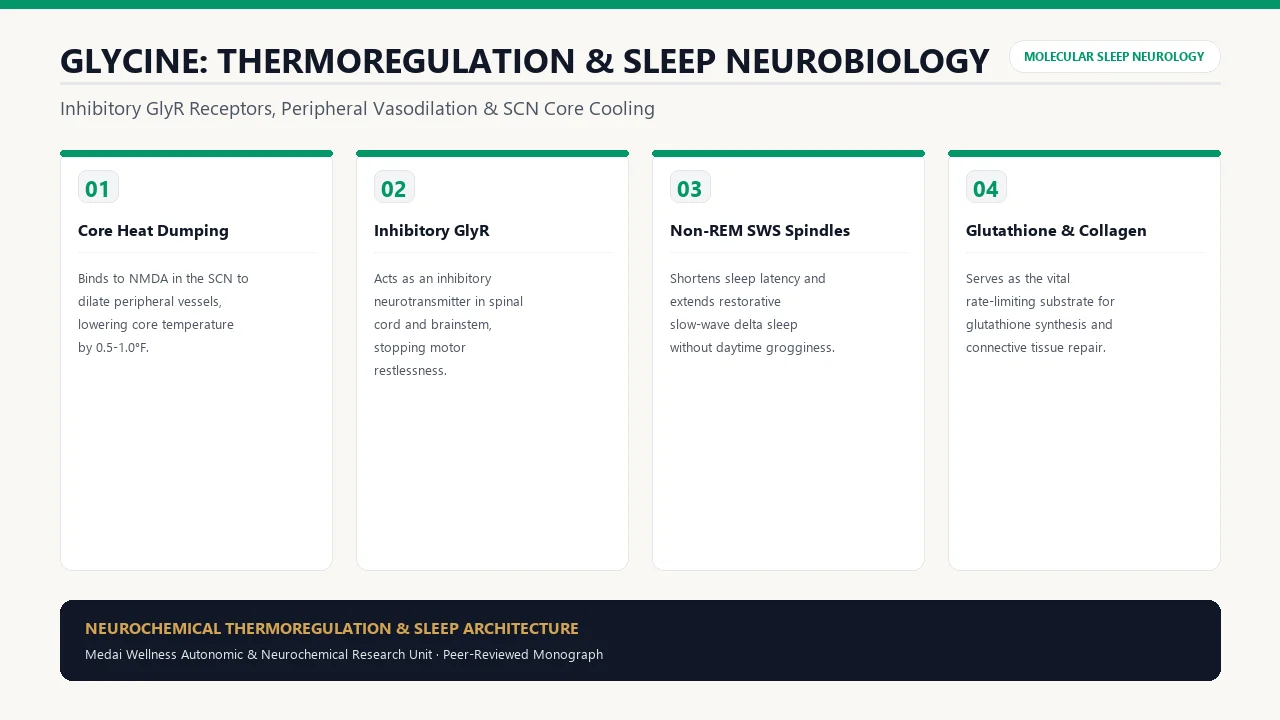
The primary reason millions of insomnia and anxiety sufferers cannot fall asleep is an inability to lower their core body temperature. In human circadian biology, the onset of sleep requires a drop in core temperature of 0.5°C to 1.0°C (1°F to 2°F). This drop is achieved not by sweating, but by peripheral vasodilation—opening the arteriovenous anastomoses in the palms of the hands, soles of the feet, and face to radiate central body heat into the ambient air.
Groundbreaking research conducted at the Ajinomoto Research Institute revealed how glycine unlocks this process:
- Vagal Tone Measurement: Explore our research on HRV normative benchmarks by age and gender.
- Foundational Neurobiology: Review our clinical analysis on the physiological sigh and autonomic anxiety reset.
- Oral glycine crosses the blood-brain barrier via the sodium-coupled neutral amino acid transporter 2 (SNAT2).
- In the suprachiasmatic nucleus (SCN) of the hypothalamus—the master circadian clock—glycine acts on the glycine-binding co-agonist site of NMDA receptors.
- This stimulation activates efferent autonomic pathways to increase cutaneous blood flow specifically in the paws and extremities, dumping central heat within 60 minutes of ingestion.
- As core temperature plummets, the brain switches off wake-promoting orexinergic neurons and initiates slow-wave sleep.
3. GlyR Inhibitory Receptors in the Spinal Cord and Brainstem
Beyond hypothalamic thermoregulation, glycine binds to post-synaptic strychnine-sensitive glycine receptors (GlyRs). GlyRs are ligand-gated chloride ion channels composed of alpha and beta subunits.
When glycine binds to GlyRs:
- Chloride ions rush down their concentration gradient into the neuron.
- The intracellular potential drops from -70 mV to -90 mV, hyperpolarizing the neuronal membrane.
- This hyperpolarization silences alpha motor neurons in the spinal cord, abolishing nocturnal muscle twitches, restless leg sensations, and jaw clenching.
4. The Landmark Clinical Evidence (Yamadera & Bannai Studies)
The clinical efficacy of glycine is established in human double-blind, placebo-controlled trials:
| Study & Reference | Sample & Methodology | Key Findings & Objective Metrics |
|---|---|---|
| Yamadera et al. (2007) Sleep & Biological Rhythms |
Polysomnography (EEG) on volunteers with poor sleep; 3g glycine vs. placebo. | Glycine significantly shortened sleep latency, increased slow-wave delta sleep (SWS), and stabilized sleep architecture with zero next-day daytime sleepiness. |
| Bannai et al. (2012) Frontiers in Neurology |
Sleep-restricted subjects evaluated for next-day daytime cognitive performance. | 3g glycine prior to sleep prevented daytime cognitive decline, reduced subjective fatigue, and improved psychomotor vigilance test (PVT) reaction speeds. |
| Inagawa et al. (2006) Sleep & Biological Rhythms |
Subjective sleep quality questionnaires (VAS and SMH). | Significant improvement in "satisfaction with sleep", "feeling refreshed on awakening", and reduction in morning grogginess compared to placebo. |
5. Beyond Sleep: Glutathione, Collagen, and Hepatic Detox
Glycine's clinical utility extends far beyond sleep architecture:
- Glutathione Synthesis: Glutathione is the master endogenous antioxidant, synthesized from glutamate, cysteine, and glycine. Cysteine was traditionally considered rate-limiting, but research shows elderly and chronically stressed adults are functionally glycine-depleted, crippling glutathione production.
- Extracellular Matrix: Glycine represents 33% of every collagen triple helix in human tendons, ligaments, and gut mucosal lining. Supplementation accelerates gut lining restoration and vascular elasticity.
- Phase II Liver Conjugation: In the liver, glycine conjugates with xenobiotics and bile acids, facilitating the safe excretion of environmental toxins.
6. Clinical Dosing and Synergistic Stacking
To replicate the clinical trials:
- Standard Dose: 3.0 grams of pure pharmaceutical-grade glycine powder dissolved in 4 oz of warm water or chamomile tea, taken 30 to 60 minutes before bedtime. Glycine has a naturally sweet, pleasant taste.
- The Thermoregulatory Sleep Stack: Combine 3g Glycine + 300 mg Magnesium Glycinate + 200 mg L-Theanine. This triple stack addresses core temperature dissipation, NMDA blockade, and alpha-wave generation simultaneously.
Frequently Asked Questions
Will taking glycine cause morning grogginess or dependence like sleeping pills?
No. Glycine does not act as a sedating hypnotic or allosteric GABAA modulator. Polysomnographic trials prove glycine leaves no residual hangover effect and has zero addiction or rebound withdrawal liability.
Can I get enough glycine from diet alone?
Most modern diets prioritize muscle meats (rich in methionine) and discard animal skins, bones, and cartilaginous cuts. The average human synthesizes only 3g of glycine and consumes 1.5–3g from diet, leaving an estimated 10g deficit relative to total metabolic requirements.
Is glycine safe for individuals taking prescription antidepressants?
Glycine is an endogenous amino acid with an exceptional safety profile up to 15–30g daily. However, because high doses can interact with NMDA receptor sites, individuals taking high-dose psychiatric medications should consult their physician before starting supplementation.