
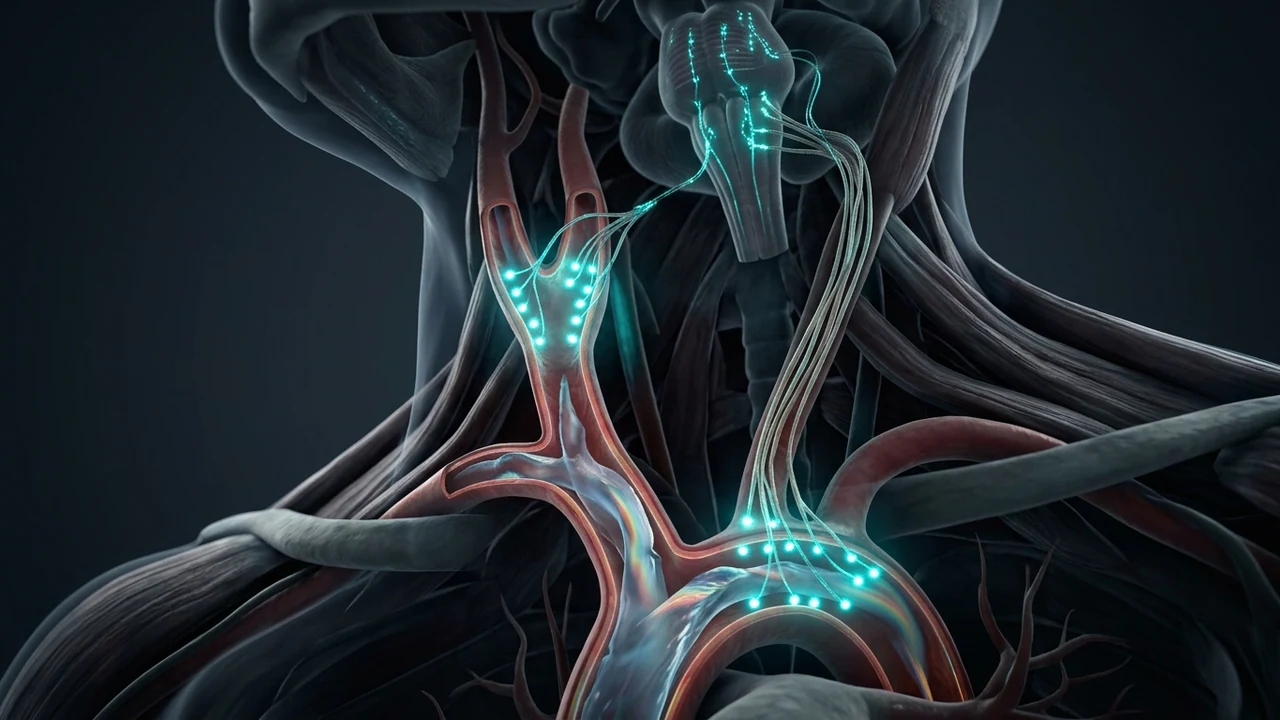
The Pharyngeal Plexus and Vagal Motor Innervation
The pharynx is an intricate muscular funnel responsible for the coordinated transit of air and food. Its motor control is governed by the pharyngeal plexus, formed primarily by the pharyngeal branches of Cranial Nerve IX (Glossopharyngeal) and Cranial Nerve X (Vagus), augmented by sympathetic fibers from the superior cervical ganglion.
Within this plexus, the vagus nerve provides the definitive motor innervation for nearly all muscles of the soft palate, pharynx, and larynx, including:
- Levator Veli Palatini: Elevates the soft palate to seal the nasopharynx during swallowing and vocalization.
- Superior, Middle, and Inferior Pharyngeal Constrictors: Execute sequential peristaltic contractions that squeeze the pharynx.
- Palatopharyngeus and Salpingopharyngeus: Elevate the pharynx and larynx during deglutition.
All motor axons supplying these muscles originate from cell bodies clustered within the Nucleus Ambiguus in the ventrolateral medulla. This is the exact same brainstem nucleus that contains the cardio-inhibitory preganglionic neurons that project to the cardiac sinoatrial node. Under Stephen Porges' Polyvagal Theory, these motor fibers form the core of the Ventral Vagal Social Engagement System, coordinating facial expression, vocal pitch, middle-ear hearing, and cardiac calming.
Gargling Biomechanics: Resistance Training for the Brainstem
Quiet, passive gargling (merely swishing water in the oral cavity) has zero neuromodulatory value. To activate the nucleus ambiguus, gargling must function as resistance training for the pharyngeal constrictors.
When you tilt the head back and vocalize against a mouthful of water, the pharyngeal constrictor muscles and levator veli palatini must contract forcefully and continuously to prevent fluid from aspirating into the larynx or entering the nasopharynx. At the same time, the vocal folds must remain tightly adducted while expiratory air bubbles through the fluid column. This creates a high-resistance, rhythmic oscillation of the pharyngeal walls that triggers massive proprioceptive and motor discharge along Cranial Nerve X.
| Exercise Modality | Target Cranial Nerves | Primary Brainstem Nuclei | Clinical Purpose |
|---|---|---|---|
| Aggressive Gargling | CN IX (sensory) & CN X (motor) | Nucleus Ambiguus & NTS | Ventral vagal motor strengthening, RSA elevation |
| Forceful Swallowing | CN IX, X, XII | Nucleus Ambiguus & Hypoglossal Nucleus | Dysphagia rehab, vagal motor tone activation |
| Tongue Depressor Reflex | CN IX (afferent) & CN X (efferent) | Solitary Tract & Nucleus Ambiguus | Acute diagnostic evaluation of reflex symmetry |
| Suboccipital Release | C1 - C3 Spinal & CN XI | Spinal Trigeminal & Cervical Plexus | Decompression of the jugular foramen exit zone |
The Gag Reflex Arc: Diagnostic Truth vs. Therapeutic Misconceptions
The gag reflex is an involuntary protective reflex designed to prevent foreign bodies from entering the trachea. The reflex arc consists of two distinct limbs:
- Sensory Afferent Limb: Mediated exclusively by the glossopharyngeal nerve (CN IX), which senses tactile contact on the posterior pharyngeal wall, tonsillar pillars, or base of the tongue, transmitting sensory signals to the NTS.
- Motor Efferent Limb: Mediated by the vagus nerve (CN X), which coordinates the sudden, spastic bilateral contraction of the pharyngeal constrictor muscles and elevation of the soft palate.
While some wellness protocols suggest inducing a daily gag reflex with a toothbrush to "stimulate the vagus," this practice is medically problematic. An acute gag triggers a sudden surge in intrathoracic and intracranial pressure, transiently excites the sympathetic nervous system, and can cause micro-tears in fragile esophageal tissues (Mallory-Weiss syndrome). Vigorous gargling provides all the motor benefits of gagging without the sympathetic panic and physical trauma.
Clinical Implementation Protocol: The 2-Minute Gargling Regimen
To safely condition the ventral vagal motor system, prescribe the following daily protocol:
- Fluid Volume: Take a moderate sip of water (approximately 2 to 3 tablespoons). Do not use an excessive amount that impairs breathing.
- Cervical Extension: Tilt the head back 45 degrees, maintaining gentle axial neck elongation. If cervical spine pain is present, consult our guide on cervical spine alignment and vagus nerve tension before proceeding.
- Continuous Loud Phonation: Gargle vigorously while humming or producing a loud, guttural vocal sound. The sound should not be a gentle trickle; it should sound like a roaring, churning engine in the throat.
- Duration: Sustain each gargle for 20 to 30 seconds until the back of the throat feels fatigued or tears begin to well up in the eyes (a sign of parasympathetic lacrimal gland stimulation).
- Dose: Repeat for 3 to 4 mouthfuls per session, once to twice daily. For patients looking to combine motor training with vocal resonance, see our clinical guide to vocal cord exercises and vagal activation.