
1. The Electrophysiology of Exercise: Sympathetic Acceleration
During physical exertion, the cardiovascular system undergoes massive neural and hemodynamic recalibration. Central motor command and peripheral muscle ergoreceptors trigger prompt parasympathetic withdrawal followed by intense sympathetic nervous activation. The adrenal medulla releases norepinephrine and epinephrine, stimulating cardiac beta-1 adrenergic receptors to increase chronotropy (heart rate) and inotropy (contractile force).
In a healthy individual, the intrinsic rhythm of the sinoatrial (SA) node accelerates dramatically, often reaching 150 to 180 beats per minute. Under normal physiological conditions, this rapid sinus rate serves as an electrical “overdrive suppressor,” preempting and drowning out any slower, dormant ectopic pacemakers in the atria or ventricles.
2. The Cool-Down Paradox: Why PVCs Cluster Post-Workout
Patients frequently note: “I felt completely fine while running at top speed, but the moment I stopped and sat on the bench, my heart started stumbling and fluttering wildly.” This phenomenon is known as the cool-down arrhythmic paradox.
The moment exercise abruptly ceases, two conflicting autonomic forces clash:
- Vagal Reactivation: The central autonomic network rapidly fires parasympathetic cholinergic impulses via the vagus nerve to decelerate the SA node and lower heart rate.
- Persistent Circulating Catecholamines: Unlike neural acetylcholine, which is hydrolyzed within milliseconds by acetylcholinesterase, circulating epinephrine and norepinephrine take several minutes to clear from systemic circulation.
As the SA node rapidly slows down under vagal influence, the ventricular myocardium remains bathed in high concentrations of excitatory adrenaline. Latent ectopic foci in the ventricles—supersaturated with cytosolic calcium—suddenly find a temporal window where the sinus rhythm is slow enough for them to fire premature depolarizations. The result is a brief cluster of post-exercise PVCs or PACs that typically self-resolves as catecholamines degrade.
Clinical Distinction: Exercise vs. Recovery PVCs
Cardiological exercise stress testing distinguishes between intra-exercise ectopy (PVCs that multiply at peak workload) and recovery-phase ectopy (PVCs appearing exclusively during cool-down). Decades of clinical literature, including large Framingham and Cleveland Clinic cohorts, confirm that isolated PVCs occurring strictly in recovery have an overwhelmingly benign course when the left ventricular ejection fraction and coronary anatomy are normal.
3. Heart Rate Recovery (HRR) as an Autonomic Health Biomarker
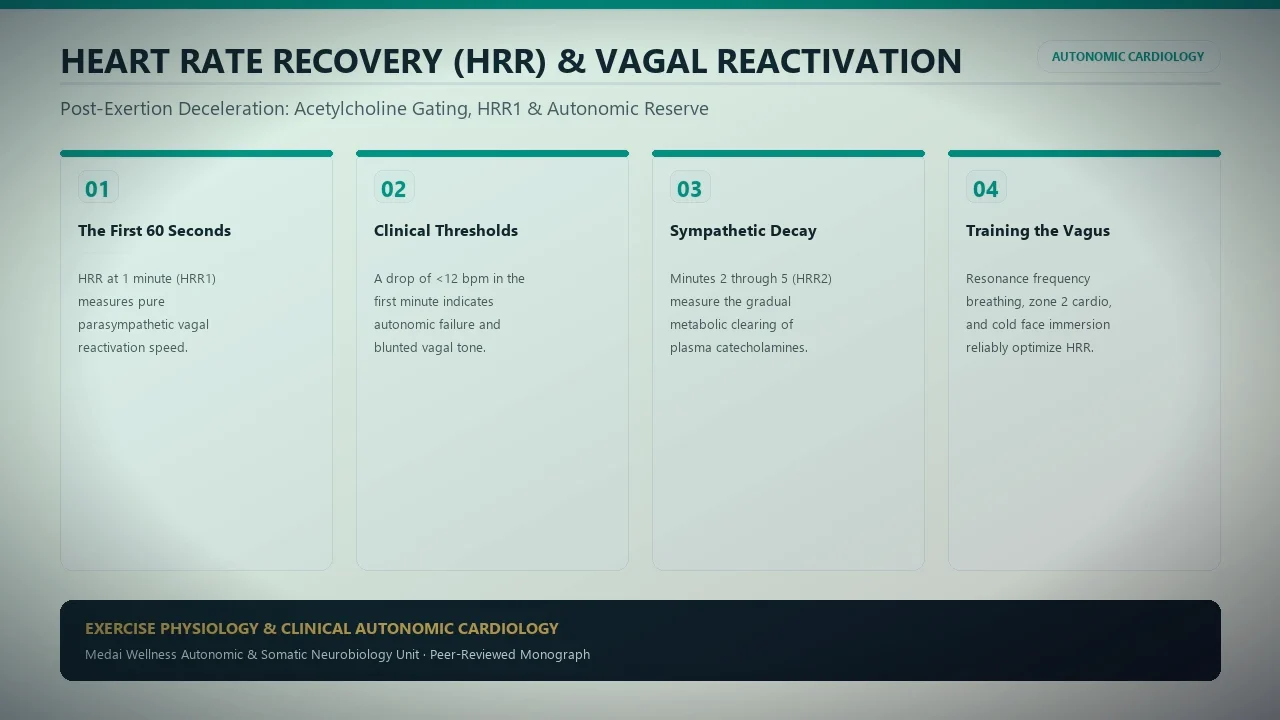
One of the most reliable clinical parameters derived from treadmill or cycle ergometry is Heart Rate Recovery (HRR). HRR measures how many beats per minute your heart rate decreases within the first 60 to 120 seconds after stopping peak exercise.
Because the initial 60 seconds of deceleration is mediated almost entirely by vagal nerve reactivations, an HRR decrease of greater than 12 beats per minute in an active cool-down (or greater than 18 bpm in a seated rest) reflects robust parasympathetic resilience. Paradoxically, athletes with exceptionally brisk vagal reactivation can experience more post-workout PVCs precisely because their sinus rate drops so rapidly while adrenaline remains elevated.
4. Clinical Stratification: When Ectopy Requires Investigation
While recovery flutters are common, medical evaluation ensures that post-exercise palpitations do not reflect underlying pathology such as arrhythmogenic right ventricular cardiomyopathy (ARVC), catecholaminergic polymorphic ventricular tachycardia (CPVT), or ischemic heart disease:
| Evaluation Metric | Benign Autonomic Recovery Ectopy | Suspicious / Pathological Pattern |
|---|---|---|
| Workload Behavior | Suppressed at peak heart rate, emerges during rest | Increases linearly with increasing exercise intensity |
| ECG Complexity | Monomorphic, single isolated ectopic beats | Polymorphic (multi-shape), couplets, triplets, non-sustained VT |
| Hemodynamic Symptoms | No dizziness, normal blood pressure response | Lightheadedness, syncope (fainting), exertional angina |
| Recovery Timeline | Tapers off completely within 5 to 15 minutes | Sustained ventricular runs lasting hours post-workout |
5. Post-Workout Palpitations, Anxiety, and Interoception
For individuals with health anxiety, the physical experience of heart rate recovery and post-exercise palpitations creates an immediate alarm reflex. When an athlete feels a hard thump while cooling down, the insular cortex interprets the sensation as catastrophic cardiac failure. This catastrophic appraisal fires a secondary surge of endogenous adrenaline from the adrenal glands, prolonging the ectopic episode.
Furthermore, vigorous exertion produces normal muscular soreness in the pectoralis major and intercostal muscles, which hypervigilant individuals easily conflate with anxiety-induced chest pain. Differentiating somatic thoracic fatigue from true angina is crucial for psychological and physical well-being.
6. Practical Protocols to Mitigate Post-Exercise Arrhythmic Irritability
Athletes and active individuals experiencing benign recovery ectopy can implement evidence-based physiological adjustments to smooth out sympathovagal transitions:
- Implement an Active, Graded Cool-Down: Never sit or lie down flat immediately after maximal exertion. Walking slowly for 5 to 8 minutes allows the muscle pump in the legs to sustain venous return and smooths out the adrenergic decline.
- Hydration and Mineral Salt Loading: Replacing sodium, potassium, and magnesium lost through sweat prevents the resting transmembrane voltage of myocardial cells from drifting toward spontaneous threshold depolarization.
- Lengthen the Exhalation Phase: While walking during cool-down, consciously breathe with a 4-second inhale and a 6-to-8-second nasal exhale. This gradual vagal stimulation prevents abrupt electrical mismatches.
- Moderate Pre-Workout Stimulant Intake: High-dose caffeine, pre-workout thermogenics, and synephrine heighten beta-receptor density and prolong catecholamine half-life, drastically increasing recovery ectopy.