
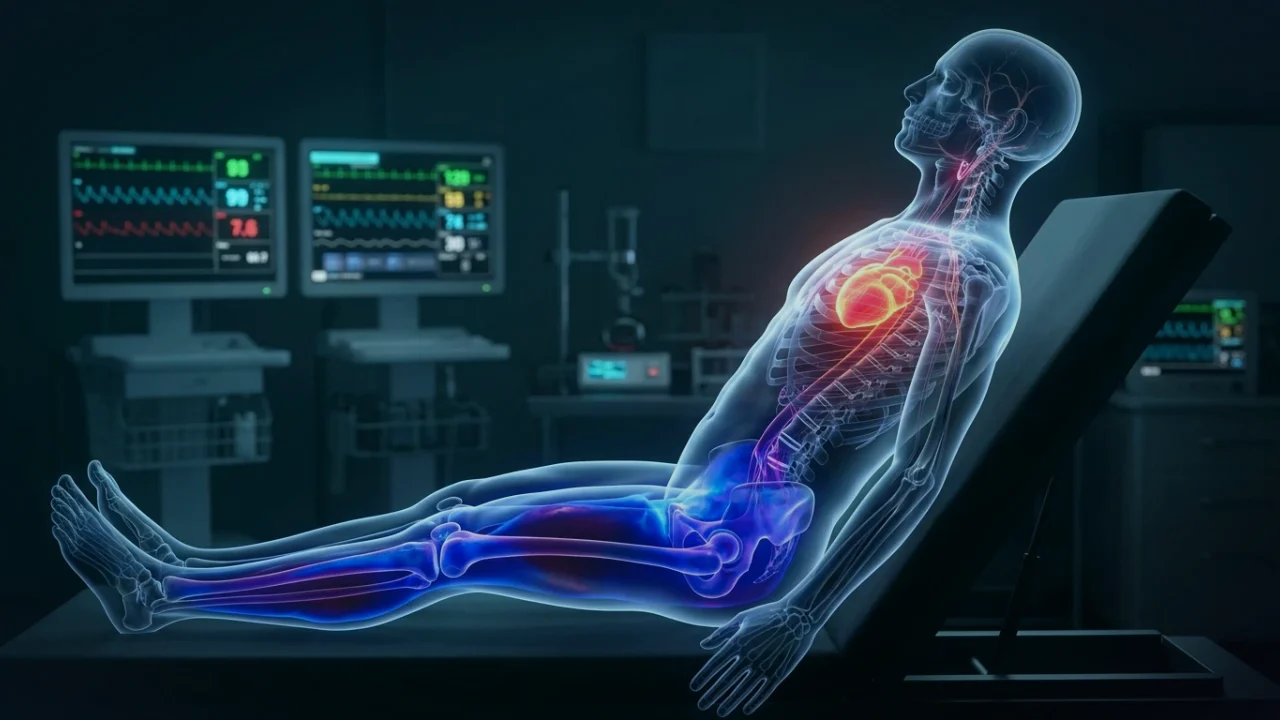
1. Hemodynamics 101: The Stroke Volume-Heart Rate Trade-Off
The human cardiovascular system is fundamentally a closed hydraulic circuit governed by a simple physiological equation:
Cardiac Output (CO) = Stroke Volume (SV) × Heart Rate (HR)
To sustain adequate cerebral and systemic perfusion, the body must maintain a relatively stable cardiac output. Stroke volume represents the volume of blood pumped from the left ventricle per beat, which depends directly on the amount of venous blood returning to fill the ventricles before contraction (preload).
When an individual is dehydrated, intravascular plasma volume contracts by 5% to 15%. This state of hypovolemia reduces venous return and ventricular end-diastolic volume. Because each contraction ejects a smaller volume of blood (decreased stroke volume), the heart has only one physiological mechanism to prevent a catastrophic crash in blood pressure: the sinoatrial node must beat faster. A resting heart rate that was previously 65 bpm can easily surge to 90 or 105 bpm simply to compensate for depleted fluid volume.
2. Baroreceptor Unloading: The Neural Response to Low Volume
How does the autonomic nervous system sense this fluid loss? Embedded within the walls of the carotid sinuses and the aortic arch are specialized mechanoreceptors known as arterial baroreceptors. These sensory terminals continuously fire inhibitory neural impulses to the nucleus tractus solitarius (NTS) in the brainstem in response to the stretch of arterial walls.
When blood volume decreases, arterial wall stretch declines. This phenomenon—known as baroreceptor unloading—relieves tonic inhibition on the rostral ventrolateral medulla (RVLM). The brainstem interprets low arterial stretch as a life-threatening hemorrhage or shock, immediately unleashing sympathetic adrenergic discharge while dampening cardioprotective vagal nerve firing. Sympathetic nerves release norepinephrine directly onto the SA node, ramping up heart rate and cardiac contractility.
3. The Endocrine Loop: Renin, Angiotensin II, and Aldosterone
While the baroreceptor reflex operates within seconds, hypovolemia simultaneously triggers a sustained, long-term neuroendocrine defense mediated by the kidneys:
- Renin Release: Reduced renal perfusion pressure is detected by the stretch-sensitive juxtaglomerular cells in the afferent arterioles of the kidneys, triggering the systemic release of the enzyme renin.
- Angiotensin II Synthesis: Renin converts liver-derived angiotensinogen into angiotensin I, which is rapidly cleaved by angiotensin-converting enzyme (ACE) into angiotensin II. Angiotensin II is a potent vasoconstrictor that also acts centrally on the hypothalamus and subfornical organ to stimulate systemic sympathetic nerve activity and provoke thirst.
- Aldosterone Secretion: Angiotensin II stimulates the adrenal cortex to secrete aldosterone, a steroid hormone that instructs renal distal convoluted tubules to reabsorb sodium and water while excreting potassium and hydrogen ions.
While this endocrine cascade prevents circulatory collapse, prolonged RAAS activation maintains high circulating sympathetic tone. Furthermore, urinary potassium wasting induced by aldosterone can induce mild hypokalemia, increasing cardiomyocyte resting membrane excitability and precipitating ectopic palpitations.
4. Interconnection: Dehydration, Electrolytes, and Racing Heart Rate
The link between fluid depletion and rhythm instability is especially profound in individuals already prone to anxiety. In our comprehensive review of dehydration, electrolytes, and racing heart rate, we document how subtle fluid deficits create a biological loop:
- Interoceptive Vigilance: A person senses their resting pulse elevated from hypovolemia. Unaware of the dehydration cause, they interpret the tachycardia as an impending panic attack or heart emergency, triggering an adrenaline surge that accelerates the heart even further.
- Electrolyte-Gated Arrhythmogenesis: Sweat loss without adequate sodium and magnesium replacement destabilizes myocardial transmembrane action potentials, transforming benign sinus tachycardia into bursts of PVCs.
- False Chest Tightness: Dehydration thickens salivary secretions and tightens respiratory musculature, creating sensations easily confused with chest tightness and palpitations.
5. Postural Tachycardia vs. Dehydration: Diagnostic Distinctions
Subclinical hypovolemia frequently mimics or exacerbates orthostatic disorders like Postural Orthostatic Tachycardia Syndrome (POTS). When a dehydrated individual transitions from lying to standing, gravity pools 500 to 800 mL of blood into the splanchnic circulation and lower limbs. Without sufficient plasma volume to overcome this hydrostatic pressure, heart rate spikes by 30 to 50 bpm within minutes of standing.
The "Water Bolus" Diagnostic Test
Autonomic testing centers often administer 500 mL (16 oz) of plain water consumed within 5 minutes. In hypovolemic patients, rapid gastric distension triggers an osmotic sympathetic portal reflex that raises peripheral vascular resistance and expands intravascular volume, typically dropping elevated standing heart rates by 15 to 25 beats per minute within 30 minutes.
6. Precision Rehydration: Restoring Intravascular Plasma Volume
Drinking plain tap water in massive volumes does not effectively expand intravascular plasma; without electrolytes, plain water simply dilutes extracellular osmolarity, prompting the kidneys to excrete the fluid rapidly. Effective plasma restoration requires an osmotic strategy:
- Sodium-Coupled Hydration: Sodium is the primary extracellular cation responsible for osmotic pressure. Consuming fluids containing 500 to 1,000 mg of elemental sodium (using World Health Organization oral rehydration formulas or quality electrolyte solutions) holds water inside the vascular compartment.
- Potassium and Magnesium Balance: Ensure concurrent intake of 200–400 mg potassium citrate and 150–200 mg chelated magnesium to support intracellular ion homeostasis and prevent cardiac ectopy.
- Morning Fluid Front-Loading: Humans lose approximately 500–800 mL of water overnight through respiration and perspiration. Drinking 500 mL of water with a pinch of sea salt upon waking curbs morning orthostatic tachycardia.