
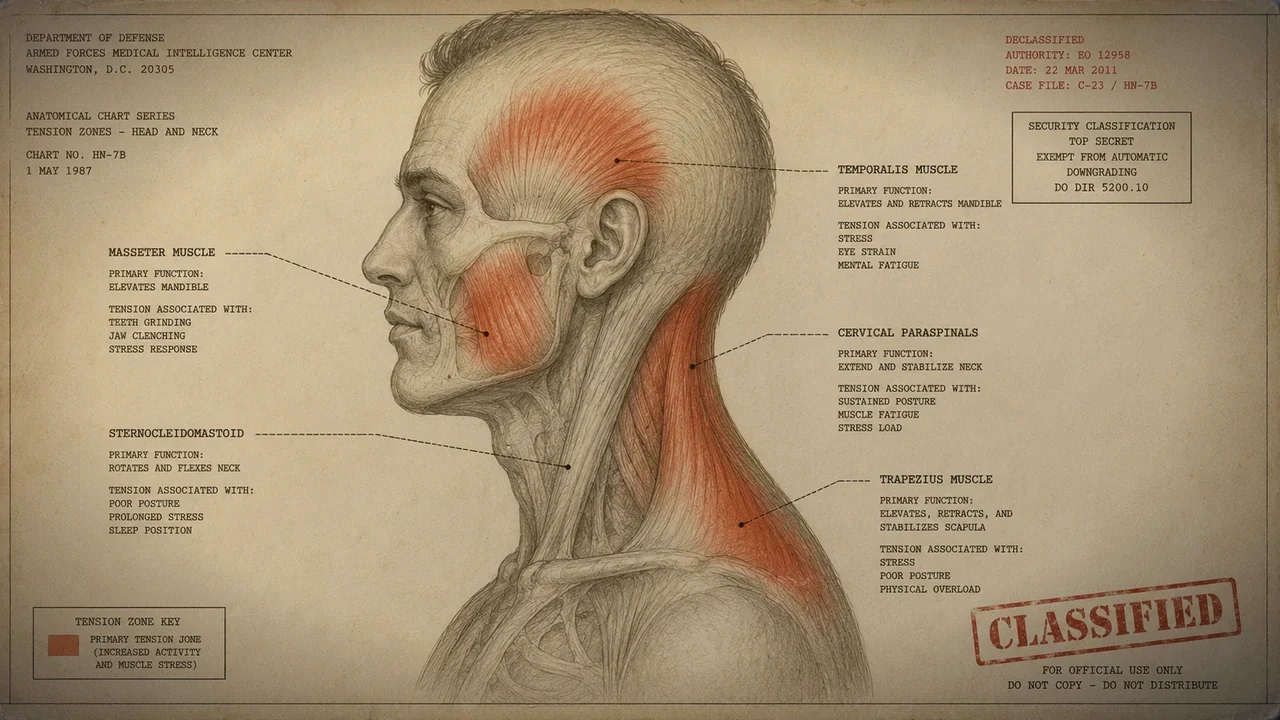
1. The Anatomical Secret: Cranial Nerve XI
To understand why the upper shoulders absorb stress faster than any other skeletal muscle group, one must examine neuroanatomy. Most skeletal muscles are innervated strictly by peripheral nerves emerging from the spinal cord. In contrast, the upper trapezius and sternocleidomastoid (SCM) muscles are primarily innervated by Cranial Nerve XI (the Spinal Accessory Nerve).
The nucleus of Cranial Nerve XI resides in the caudal brainstem in direct functional proximity to the nucleus ambiguus and dorsal vagal complex. When the amygdala and brainstem detect social, acoustic, or existential threat, Cranial Nerve XI discharges involuntary alpha and gamma motor neuron signals into the trapezius long before conscious volition can intervene. The shoulders hike toward the ears as an automatic reflex.
2. The Biological Armor: Why We Shield the Neck
From an evolutionary perspective, the human cervical spine and anterior neck represent the most vulnerable anatomical zone on the mammalian body. Housing the jugular veins, carotid arteries, trachea, and vagus nerves, the neck is the primary target for predators executing lethal biting strikes.
The mammalian startle reflex—conserved across hundreds of millions of years—consists of an instantaneous kinematic sequence: blinking, flexing the neck forward, hunching the thoracic spine, and elevating the shoulders. This posture forms a protective muscular collar around the carotid vasculature. When modern chronic stress keeps a person feeling on edge, this primitive armor remains permanently engaged, producing the distinct physiological causes of feeling constantly on guard.
Biomechanics Focus: The Forward Head Shift and Trapezius Overload
For every inch the human head moves forward from neutral alignment during hypervigilant posturing, the effective mechanical load supported by the upper trapezius and levator scapulae increases by approximately 10 pounds. A forward head posture of just 2 inches subjects cervical stabilizing muscles to 32 pounds of continuous tensile load.
3. The Suboccipital-Ocular Axis: How Eye Strain Freezes the Trapezius
Beneath the occiput lie the suboccipital muscles (rectus capitis and obliquus capitis groups). These small muscles possess an astonishing density of muscle spindles: up to 200 to 250 spindles per gram of muscle tissue, compared to roughly 16 spindles per gram in the gluteus maximus.
Through the tectospinal and vestibulospinal tracts, the suboccipitals are neurologically linked to the extraocular motor nuclei (Cranial Nerves III, IV, and VI). Every time your eyes dart across a screen or scan an environment for social danger, your suboccipital muscles fire micro-contractions to stabilize the skull. When hypervigilant scanning is chronic, suboccipital hypertonicity triggers reciprocal reflex contraction across the entire trapezius sheath, culminating in tension headaches and cervicogenic pain.
4. Why Stretching and Deep Tissue Massage Provide Only Temporary Relief
When a muscle is in protective reflex guarding, standard aggressive stretching activates the myotatic stretch reflex. Muscle spindles detect the passive lengthening as a danger of muscle tearing, prompting the spinal cord to fire an involuntary compensatory contraction to prevent injury. The patient leaves the stretching session feeling relaxed, only to have the muscle lock up tighter 4 hours later.
Similarly, aggressive deep tissue massage that causes sharp pain triggers defensive sympathetic arousal, reinforcing brainstem threat perception. True muscular release requires retraining the central nervous system's sensory-motor loop rather than forcing tissue compliance.
5. Physiological Causes of Feeling Constantly on Guard
Cervical muscle guarding creates a vicious somatic feedback loop. As tight muscles compress cervical vasculature and superficial nerves, they send continuous nociceptive and proprioceptive distress signals back to the thalamus. This confirms to the brain that the body is indeed under physical strain, reinforcing hypervigilance.
- Occipital Neuralgia: Compression of the greater and lesser occipital nerves produces shooting pain from the base of the skull over the crown of the head.
- Diaphragm-Scapular Synergies: Inability to breathe diaphragmatically forces the scalenes and upper trapezius to act as secondary accessory respiratory muscles, contracting up to 20,000 times per day just to breathe.
- Jaw Clenching (Bruxism): Trigeminal motor activation reflexively co-contracts the sternocleidomastoid and upper trapezius in a unified defensive facial-cervical complex.
6. Somatic Recalibration: Pandiculation and Vagal Release
To safely decouple Cranial Nerve XI from the startle reflex, clinicians employ pandiculation—the active, voluntary contraction of a muscle into its shortened state followed by extremely slow, conscious eccentric lengthening:
- Voluntary Scapular Pandiculation: Slowly shrug the shoulders toward the ears to 70% effort, hold for 3 seconds while breathing steadily, then spend a full 10 to 12 seconds smoothly lowering the shoulders millimeter by millimeter until complete relaxation is achieved.
- Suboccipital Eye-Neck Desensitization: Rest the head on a supportive surface and move the eyes left and right while consciously inhibiting any rotation of the cervical spine, uncoupling ocular tracking from neck spasm.
- Vagal Sound Resonance: Deep humming or vocal phonation stimulates the pharyngeal and laryngeal branches of the vagus nerve, calming the brainstem nuclei adjacent to Cranial Nerve XI.