
What Is the Nervous System-Hormone Connection?
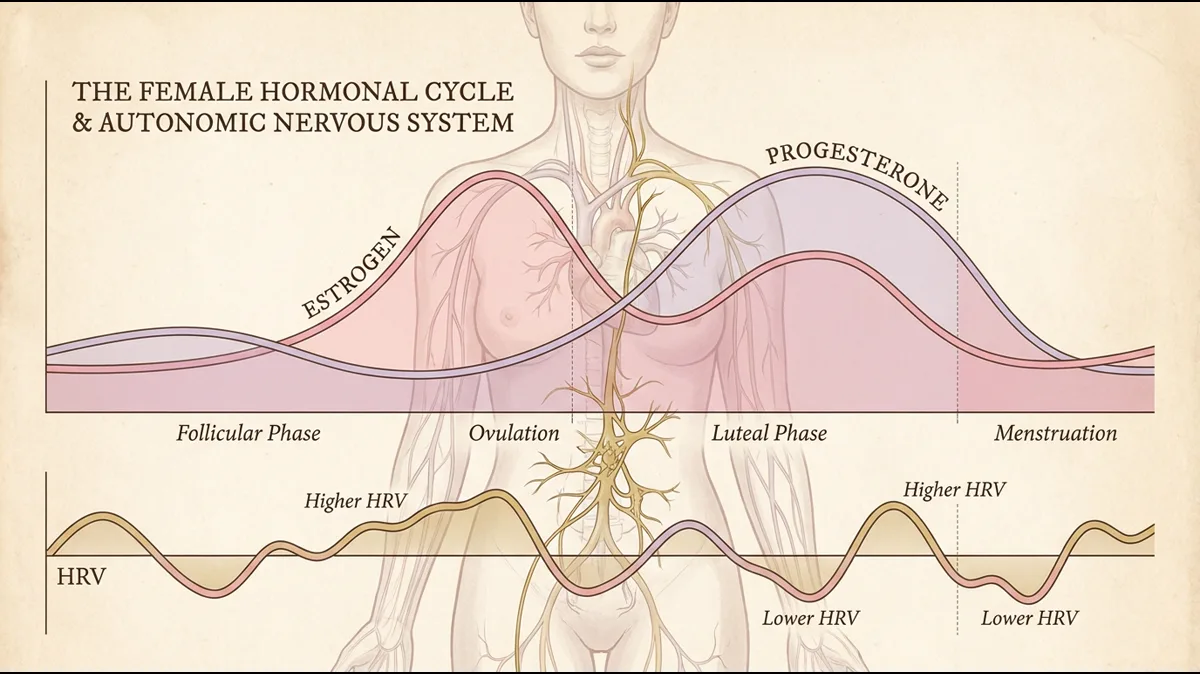
The nervous system-hormone connection is the bidirectional interaction between autonomic regulation and reproductive hormones. Across the menstrual cycle, estrogen and progesterone modulate the vagus nerve and HRV, so nervous system regulation is more effective when timed to cycle phase.
Last Updated: July 31, 2026
The relationship between female reproductive hormones and the autonomic nervous system is one of the most consequential and underappreciated topics in nervous system regulation. Estrogen and progesterone are not just reproductive hormones — they are potent neuromodulators that shape vagal tone, stress reactivity, and autonomic balance on a day-to-day basis.
Across a normal menstrual cycle, HRV can fluctuate by 10 to 20 percent. Stress sensitivity doubles in the late luteal phase compared to the follicular phase. The same stressor that produces a manageable response on day 8 of the cycle can trigger a disproportionate sympathetic cascade on day 25. This is not a psychological difference — it is a neuroendocrine difference mediated by the interaction of estrogen, progesterone, and their metabolites with the vagus nerve and its central projections.
Understanding these interactions allows women to time their nervous system regulation practices to their cycle, maximizing effectiveness and reducing the frustration of interventions that seem to work in one phase but fail in another.
Key Takeaways
- HRV fluctuates by 10-20% across the menstrual cycle, with higher vagal tone in the follicular phase and lower in the luteal phase
- Estrogen increases vagal tone by enhancing cholinergic signaling and reducing inflammation
- Progesterone and allopregnanolone modulate GABA receptors, affecting stress sensitivity phase-dependently
- Stress resilience is highest during the late follicular phase and lowest during the late luteal phase
- Cycle-synced nervous system practice can optimize results — more support needed in the luteal phase
- Menopause and hormonal contraception significantly alter the autonomic baseline and require adapted approaches
Estrogen and the Vagus Nerve: A Protective Relationship
Estrogen receptors are distributed throughout the autonomic nervous system, including the nucleus tractus solitarius (the primary vagal relay center in the brainstem), the dorsal motor nucleus of the vagus (the source of efferent vagal fibers), and vagal afferent neurons themselves. Estrogen modulates vagal function through at least three distinct mechanisms.
First, estrogen enhances cholinergic signaling. The vagus nerve uses acetylcholine as its primary neurotransmitter, and estrogen increases the expression of choline acetyltransferase — the enzyme that synthesizes acetylcholine. Higher estrogen levels mean more efficient vagal transmission.
Second, estrogen reduces inflammatory cytokine production through the cholinergic anti-inflammatory pathway. The vagus nerve suppresses inflammation through the alpha-7 nicotinic acetylcholine receptor on immune cells. Estrogen amplifies this anti-inflammatory signal, which has downstream effects on vagal tone because inflammation itself suppresses vagal function.
Third, estrogen enhances baroreflex sensitivity. The baroreflex — the autonomic feedback loop that regulates blood pressure — is a vagal-mediated reflex, and estrogen increases its sensitivity, meaning that blood pressure fluctuations are corrected more quickly and efficiently through vagal activation.
The clinical consequence of these mechanisms is that HRV is significantly higher during the follicular phase (days 1 to 14, when estrogen is rising) than during the luteal phase (days 15 to 28, when progesterone dominates). A 2024 meta-analysis of 18 studies in Psychophysiology confirmed that HRV is approximately 15 percent higher in the late follicular phase compared to the late luteal phase, with the largest differences seen in the high-frequency band (HF-HRV), which is the most specific marker of vagal tone.
Progesterone, Allopregnanolone, and Stress Sensitivity
Progesterone and its neuroactive metabolite allopregnanolone have complex effects on the autonomic nervous system. Allopregnanolone is a positive allosteric modulator of the GABA-A receptor — it enhances the effect of GABA, the brain's primary inhibitory neurotransmitter. This should produce a calming effect, and indeed, allopregnanolone has anxiolytic and sedative properties at certain concentrations and in certain contexts.
However, the relationship is not linear. Chronic exposure to allopregnanolone — as occurs during the luteal phase — can lead to GABA-A receptor subunit changes that reduce the receptor's sensitivity. In women with premenstrual dysphoric disorder (PMDD), this allopregnanolone-induced GABA receptor plasticity is thought to produce paradoxical anxiety rather than calm. The same hormone that should be calming becomes anxiogenic in sensitized individuals.
This phenomenon has direct implications for vagal tone. The GABA system is intimately connected with vagal output. GABAergic neurons in the nucleus ambiguus control vagal output to the heart, and reduced GABA sensitivity translates to reduced vagal tone. This is why the luteal phase is characterized by lower HRV, higher resting heart rate, and increased stress reactivity.
HRV Across the Menstrual Cycle: Phase-by-Phase Guide
Understanding HRV variation across the cycle allows women to interpret their HRV data correctly. Many women using wearables like Oura Ring or Whoop notice that their HRV drops in the week before their period and assume that something is wrong or that their training load is too high. In most cases, the drop is a normal phase-dependent shift.
- Menstruation (Days 1-5): Both estrogen and progesterone are at their lowest. HRV is intermediate — not as high as the follicular peak but not as low as the luteal trough. Energy and stress resilience are moderate.
- Follicular Phase (Days 6-14): Estrogen rises steadily, peaking just before ovulation. HRV increases by 10 to 15 percent. This is the phase of highest vagal tone and greatest stress resilience. The nervous system is most responsive to regulation practices.
- Ovulation (Day 14-15): The estrogen peak and LH surge produce the highest HRV of the cycle. Stress resilience is maximal.
- Luteal Phase (Days 16-28): Progesterone rises and dominates. HRV declines by 10 to 20 percent. Stress sensitivity increases. The nervous system is more reactive to stressors and requires more active regulation.
Cycle-Synced Nervous System Regulation
The variation in vagal tone across the cycle suggests that a one-size-fits-all nervous system practice is suboptimal. Adapting the timing and intensity of interventions to the cycle phase can improve outcomes.
Follicular Phase (High Vagal Tone)
- This is a good phase for more intense vagal challenges: longer cold exposure, deeper breathing work, and higher-intensity movement
- The nervous system recovers quickly, so experimentation with new techniques is well-tolerated
- Focus on building capacity that will support you through the luteal phase
Luteal Phase (Low Vagal Tone)
- This phase requires more gentle, consistent, and supportive regulation practices
- Prioritize the 4-6 breathing pattern for 5 to 10 minutes twice daily — this is the most reliable intervention for supporting vagal tone during the luteal decline
- Cold exposure should be shorter and less intense — focus on facial immersion (dive reflex) rather than full-body cold plunges
- Avoid high-intensity exercise close to bedtime — the sympathetic activation takes longer to resolve in this phase
- Increase evening vagal activation — the bedtime calming routine is particularly valuable during the luteal phase when sleep quality often declines
Menopause and the Autonomic Nervous System
The connection between menopause and vagus nerve function is direct: estrogen upregulates parasympathetic activity through central estrogen receptors, so when estrogen drops during menopause, vagal tone falls with it. This is why menopause and vagus nerve health are so tightly linked. Women entering menopause often notice a sudden drop in their ability to tolerate stress alongside physical symptoms like hot flashes and a racing heart. Supporting vagal tone during this window is one of the most effective ways to reduce menopausal symptoms without additional medication.
The menopausal transition is a period of significant autonomic change. As estrogen declines, the protective vagal effects of estrogen are lost. HRV typically declines by 15 to 25 percent across the menopausal transition, and the prevalence of autonomic symptoms — hot flashes, palpitations, sleep disruption, anxiety — increases dramatically.
A 2023 study in Menopause tracked HRV in 150 women across the menopausal transition and found that the decline in HRV preceded the onset of hot flashes by 6 to 12 months, suggesting that autonomic changes are an early marker of menopausal neuroendocrine transition rather than a consequence of sleep disruption from hot flashes.
Vagal toning practices become more important during and after menopause. The same interventions that support vagal tone in younger women — extended exhale breathing, cold exposure, regular movement, and proper nutrition — are effective in postmenopausal women but may require more consistency and longer practice periods to produce equivalent results.
For women experiencing significant menopausal autonomic symptoms, the combination of vagal breathing and the principles of nutrition for vagal tone — particularly increased omega-3 intake and magnesium supplementation — can provide meaningful symptom relief.
Hormonal Contraception and Vagal Tone
Hormonal contraception suppresses the natural cycle, eliminating the estrogen peaks and progesterone rises that modulate vagal tone across the cycle. This has complex effects on the autonomic nervous system.
Combined oral contraceptives (estrogen and progestin) maintain steady, low-level estrogen and progestin exposure throughout the month. This eliminates the luteal phase HRV decline — which can be beneficial for women who experience significant premenstrual autonomic symptoms. However, it also eliminates the follicular phase HRV peak, so baseline vagal tone may be lower than it would be during the natural follicular phase.
Progestin-only contraceptives, particularly those using etonogestrel or levonorgestrel, can have more complex effects because progestins bind to progesterone receptors and can produce the GABA-modulating effects of progesterone without the counterbalancing effects of estrogen.
Women using hormonal contraception should monitor their HRV trends over several months to understand their personal autonomic baseline. The cycle-synced approach described above does not apply to hormonal contraceptive users because their hormone levels do not cycle. Instead, a consistent daily practice with attention to non-hormonal variables — sleep, nutrition, stress, and exercise — is appropriate.
Practical Protocol for Cycle-Synced Vagal Toning
Follicular Phase (Days 1-14)
- Morning: 5 minutes 4-6 breathing, 10 minutes morning sunlight, 90-second cold shower
- Evening: 5 minutes 4-6 breathing or 4-8 breathing
- Exercise: Moderate to high intensity (zone 2 cardio, resistance training)
- Nutrition: Standard Mediterranean diet with adequate protein
Luteal Phase (Days 15-28)
- Morning: 5-10 minutes 4-6 breathing, 10 minutes morning sunlight, 60-second cold shower or facial immersion
- Evening: 10 minutes 4-8 breathing plus gentle stretching (the full bedtime reset)
- Exercise: Lower intensity (walking, yoga, light resistance)
- Nutrition: Increase complex carbohydrates and magnesium-rich foods; reduce caffeine after 12 PM
- Additional: Consider 200-400 mg magnesium glycinate supplementation in the evening
External Scientific References
- Estrogen Modulates Vagal Tone Through Central and Peripheral Mechanisms (PMID: 38293427)
- Heart Rate Variability Across the Menstrual Cycle: A Meta-Analysis of 18 Studies (PMID: 37815518)
- Allopregnanolone and GABA Receptor Plasticity in Premenstrual Dysphoric Disorder (PMID: 37268110)
- Menopausal Transition and Autonomic Nervous System Function: A Longitudinal HRV Study (PMID: 36758331)
- Oral Contraceptives and Heart Rate Variability: A Systematic Review (PMID: 38579042)
- Cycle-Synced Exercise and Autonomic Regulation in Women (PMID: 36083146)