
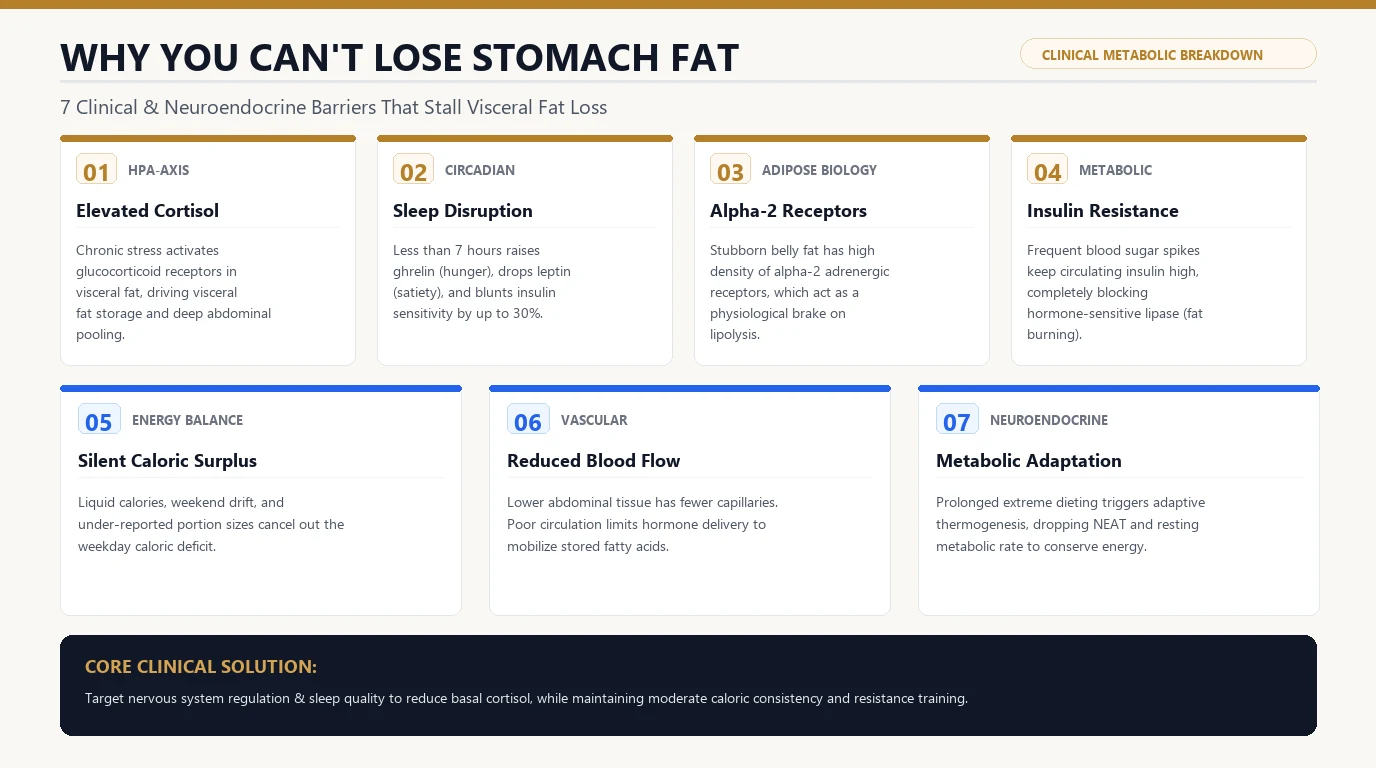
You Can Lose Stomach Fat — You Just Can't Target It
Few phrases in weight management are more demoralizing than "I can't lose stomach fat." The scale drops, the face thins, but the midsection stays. The honest answer is that you almost certainly can lose stomach fat — but only through the right combination of levers, and only on a timeline your own biology controls.
This article walks through the most common reasons stomach fat refuses to move and the practical corrections for each. Most of them are not about trying harder; they are about removing the biological obstacles that keep the belly parked.
Reason 1: Your Deficit Is Smaller Than You Think
The most common cause of "stubborn stomach fat" is a gentle error: the energy deficit feels large but is actually tiny. Calories in snacks, drinks, cooking oils, and weekend meals are systematically undercounted, while activity is often overestimated.Hall KD, et al. (2012). Energy balance and its components: implications for body weight regulation. American Journal of Clinical Nutrition. A 100-200 calorie daily error can mean weeks of flat progress.
The correction is not to diet harder — extreme restriction backfires — but to get a more accurate picture: track a few typical days honestly, weigh portions occasionally, and, above all, look at the trend of weight and waist over 4-6 weeks rather than a single day.
Reason 2: Stress Is Holding Cortisol Up
Chronic stress keeps cortisol elevated, and cortisol physiology favors fat storage in the abdomen — especially the deep visceral depot.Epel ES, et al. (2000). Stress and body shape. Psychosomatic Medicine. If your diet is fine but your stress is chronic, the hormonal environment itself is telling the belly to hold on.
This connects directly to why stress makes weight loss harder. Stress regulation — a few minutes of controlled breathing daily, regular movement, and reduced late-night stimulation — changes the storage environment. It does not "burn" belly fat, but it removes an obstacle the belly depends on.
Reason 3: Sleep Is Undermining You Quietly
Short or poor sleep shifts appetite hormones — ghrelin up, leptin down — and raises stress hormones, increasing both cravings and abdominal storage pressure.Spiegel K, et al. (2004). Sleep curtailment in healthy young men is associated with decreased leptin levels, elevated ghrelin levels, and increased hunger and appetite. Annals of Internal Medicine. Sleep deprivation is strongly associated with greater weight gain and, specifically, more abdominal fat.
This is the hidden link behind poor sleep and weight gain. If sleep is short, protecting it may move the belly more than any additional restriction would — because it restores the hormones that make consistent, moderate eating the default.
Reason 4: You're Losing Muscle, Not Just Fat
Crash dieting — very low intake for a short time — tends to lose both fat and muscle. Because muscle is metabolically active, losing it lowers resting expenditure and slows future fat loss, including from the belly.Paddon-Jones D, et al. (2008). Protein, weight management, and satiety. American Journal of Clinical Nutrition. The result is a "skinny-fat" slow plateau that feels like the belly will never move.
The correction is to make the deficit modest and muscle-preserving: adequate protein, resistance activity, and food volume enough to stay consistent. This changes what the weight loss is made of — favoring fat over lean tissue.
Reason 5: The Belly Is Simply Last in Line
Even when everything is dialed in, the stomach may be the last depot to change. Fat loss order is largely genetic, and for many people the abdomen is gained early and released late.Vispute SS, et al. (2011). The effect of abdominal exercise on abdominal fat. JSCR. This "last to go" pattern is normal, not failure.
The correct response is patience plus honest tracking, not a pivot to a "targeted" belly method that cannot work. Focus on the modern environment that drives weight gain and remove its levers one by one over months.
Reason 6: Spot-Reduction Beliefs Are Stealing Your Effort
The belief that crunches, waist trainers, or "belly fat-burning" devices will remove stomach fat keeps people from applying the approach that actually works. Targeted exercise builds muscle under the fat but does not remove the fat itself.Vispute SS, et al. (2011). The effect of abdominal exercise on abdominal fat.
Whole-body activity and resistance training are the right tools — not because they target the belly, but because they create the energy deficit and insulin improvements that reduce visceral fat system-wide.
Reason 7: You're Measuring With the Wrong Yardstick
Many people judge stomach fat by a single daily mirror or scale reading, which fluctuates with water, gut content, salt, and glycogen. A "stubborn" belly can actually be improving while the daily number stays flat or bounces around.Wing RR, Phelan S. (2005). Long-term weight loss maintenance. AJCN.
Use a weekly waist measurement, averaged weight over several days, and clothing fit. Over 4-6 weeks, the trend is the truth. Single-day numbers will lie to you; trends will not.
The Check-List: Fix the System, Not the Belly
| Obstacle | Sign It's You | Fix |
|---|---|---|
| Overestimated deficit | Flat weight for weeks | Track honestly for a few days |
| Chronic stress | High tension, poor sleep drive | Daily stress regulation |
| Short sleep | Cravings, waking tired | Protect sleep |
| Muscle loss | Crash-dieting pattern | Protein + resistance work |
| Genetic order | Face/limbs thin, belly lags | Patience, monthly tracking |
| Spot-reduction myth | Relying on crunches/waist trainers | Whole-body activity |
| Bad yardstick | Judging by daily mirror | Weekly trends over weeks |
Frequently Asked Questions
Why can't I lose stomach fat no matter what I do?
Stomach fat resists when the levers around it are slightly off: an energy deficit smaller than you think, chronic stress keeping cortisol up, short sleep shifting appetite hormones, muscle loss from crash dieting, or simply a fat-loss order that releases the belly last. The correction is systemic, not a targeted trick.
Will a calorie deficit eventually remove stomach fat?
Yes, provided the deficit is genuine, moderate, and sustained, and muscle, sleep, and stress are protected. The belly is often the last depot to respond, so the change can lag the rest of the body by weeks to months.
Why can I lose weight everywhere but not my belly?
This is the normal "last depot" pattern. Fat loss order is largely genetic and hormonal, and the abdomen is often released last. You may be losing visceral fat (the health-relevant part) while the visible layer still lags.
Does stress prevent stomach fat loss?
Chronic stress raises cortisol, which favors abdominal storage and can slow release from the belly. Regulating stress is a real lever, alongside energy balance and sleep — not a soft add-on.
Do ab exercises help me lose stomach fat?
They strengthen the abdominal muscles and improve posture, which can make the area appear flatter, but they do not remove the fat over them. Whole-body activity and energy balance reduce the fat.
Is it possible to lose stomach fat without losing weight?
Yes, through body recomposition — losing fat while gaining muscle. This can reduce visceral fat and waist size even when the scale changes little, and it is a legitimate, sustainable path to a flatter belly.
Conclusion
"I can't lose stomach fat" is rarely true — it is usually a signal that one or two of the system's levers are slightly off, or that the belly is simply the last in line. The seven obstacles above — an overstated deficit, chronic stress, short sleep, muscle loss, genetic ordering, spot-reduction beliefs, and a faulty yardstick — explain nearly all cases.
The response is to stop attacking the region and start correcting the system: an honest moderate deficit, stress and sleep protected, muscle preserved, whole-body activity, and honest weekly tracking. On that foundation, the belly responds — slowly, reliably, and without the extremes that so often make it worse.
Educational content only. This article is for informational purposes and does not constitute medical advice. Fat distribution and weight are influenced by medical and hormonal conditions that may require evaluation. Consult a qualified healthcare professional before making changes to your health routine.