
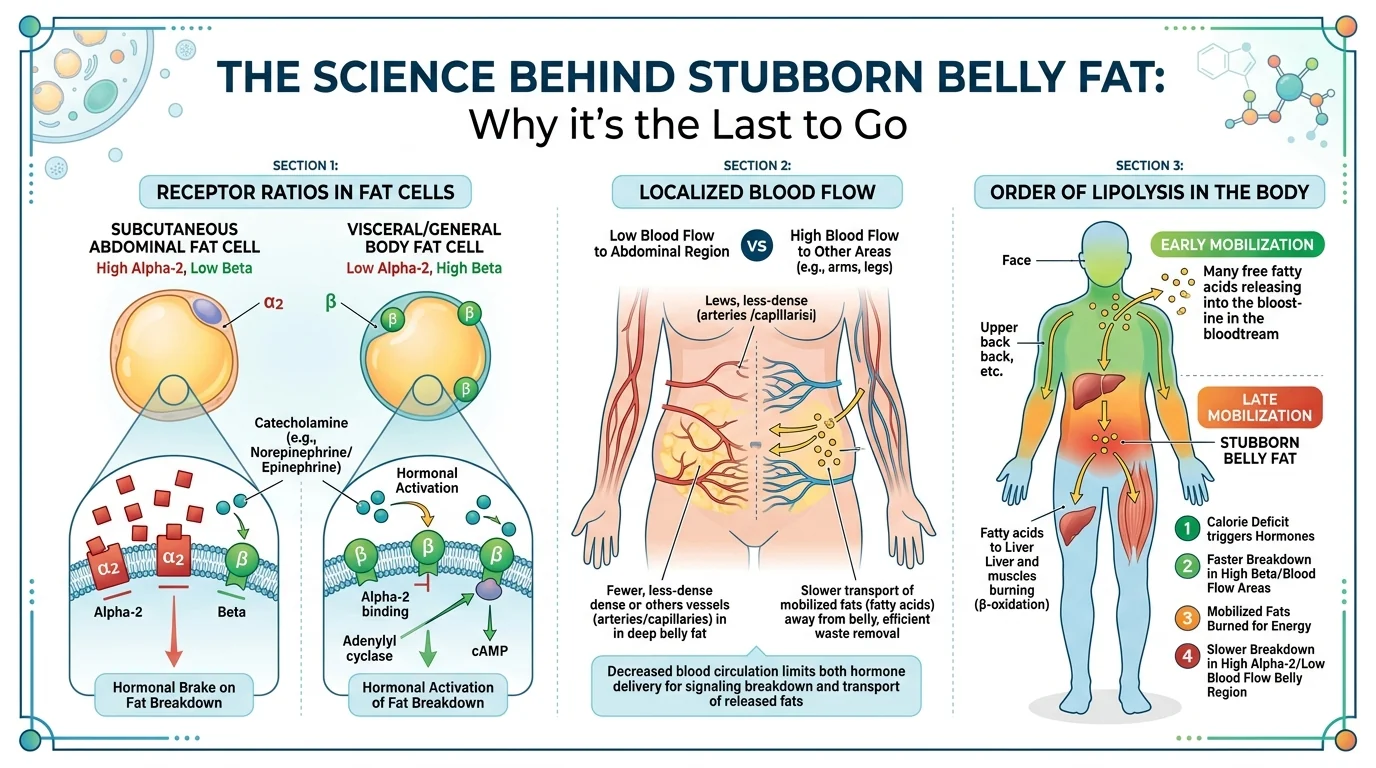
Why the Belly "Hangs On"
One of the most common frustrations in weight management is the feeling that the belly is the last place to change. The scale drops, pants fit differently through the thigh and face, and yet the midsection still looks unchanged. This is so common that weight-loss forums treat it as a universal rule.
The reason is not that the belly is "stubborn" in some magical sense. The order in which individual fat depots grow and shrink is largely set by genetics and hormones, and for many people the abdomen is both gained early and released late.Vispute SS, et al. (2011). The effect of abdominal exercise on abdominal fat. Journal of Strength & Conditioning Research. This article explains the biology of that order, why it feels slow, and — most importantly — how to measure progress honestly while it is happening.
Fat Loss Is Not Shared Equally
When the body is in a sustained energy deficit, it does not drain all fat stores evenly, like water leaving a tank. Instead, different depots respond at different rates, driven by the density of blood flow, hormone receptors, and the activity of fat cells in each region. The abdomen contains a mix of subcutaneous fat (the soft layer under the skin) and visceral fat (deep, around the organs), and each responds on its own timeline.Saad F, et al. (2005). Pathophysiology of sex hormones in men and their clinical U-shape curve. (visceral vs subcutaneous discussion) — Endocrine.
A useful surprise hides in this: visceral fat — the portion most associated with metabolic risk — is often among the most responsive to an energy deficit and physical activity. It can shrink well before the subcutaneous layer under the skin visibly changes. So a person can be making real, health-relevant progress on the belly while the mirror still shows the same pouch.
The "First On, Last Off" Pattern
Fat distribution follows a rough reverse pattern: the areas where weight was gained earliest and most readily tend to be the areas where it is released most slowly. The abdomen is a common site of first gain for both sexes under stress or surplus eating, which is why it frequently becomes the last depot to shrink.Epel ES, et al. (2000). Stress and body shape: stress-induced cortisol secretion is consistently associated with body fat distribution in women. Psychosomatic Medicine.
The psychological impact is real and often underestimated. When a person is eating well and losing weight everywhere except the belly, it is natural to assume the approach is "not working." That assumption is usually wrong — the approach may be working fine, and the belly is simply the last in line by design.
Cortisol and the Stubborn Midsection
Hormones play a starring role in why the belly resists. Chronic elevation of cortisol — the primary stress hormone — is associated with increased central fat storage, particularly in the deep visceral compartment.Epel ES, et al. (2000). Stress and body shape. Psychosomatic Medicine. Because abdominal fat cells are rich in cortisol receptors, the region is especially sensitive to a high-stress hormonal environment.
This creates a practical conclusion that is easy to skip: for the belly specifically, stress regulation is a genuine lever, not a soft add-on. Managing stress changes the hormonal environment in which the body decides where to store and release fat — which is why this pairs naturally with the broader link between stress and weight loss difficulty.
Why the Scale Can Be Flat While Fat Is Moving
During sustained weight loss, the body often recompenses: visceral fat decreases while water, glycogen, or lean tissue fluctuate in counterbalance. The result is a scale that stays flat for days or weeks even as the composition of the body genuinely improves.Wing RR, Phelan S. (2005). Long-term weight loss maintenance. American Journal of Clinical Nutrition. The belly can literally be improving while the mirror and the scale both suggest otherwise.
This is why single-metric tracking is a setup for quitting. If progress is measured only by today's waist measurement or daily weight, the normal plateaus and lag periods read as failure. Over weeks, the trend in several measures at once tells a far truer story than any single number.
The "Belly Fat Hard to Lose" Trap: Spot Reduction
Because the belly resists, many people reach for the myth of spot reduction — crunches, side planks, waist trainers, and "targeted" belly routines — hoping to force the region to shrink. The evidence is consistent that this does not work: exercising a specific muscle does not selectively remove the fat over it.Vispute SS, et al. (2011). The effect of abdominal exercise on abdominal fat. JSCR.
This is not bad news for exercise. Whole-body activity and resistance training create the energy deficit and insulin improvements that reduce fat — including the visceral fat that makes the belly matter for health. The difference is that the progress comes from the system, not from "targeting" the region.
Genetics Decide the Order, Not the Outcome
Two people can follow the same plan and lose the belly at very different times. That difference is largely genetic: the number and size of fat cells, and the hormone receptors on them, are inherited and influence both where fat is stored and the order in which it is released.Loos RJF, Yeo GSH. (2022). The genetics of obesity: from discovery to biology. Nature Reviews Genetics.
Genetics explains why the belly is last to go for you, but it does not decide whether it goes at all. The direction of change is still governed by sustained energy balance, hormones, and activity. The genetic contribution is timing, not destiny.
How Long Does It Take to See the Belly Change?
There is no universal number, but the honest expectation is that the belly changes on the order of weeks to months of consistent, moderate deficit — longer than weight loss in the face or limbs. Because the abdomen is often the last depot, visible waist change typically lags overall weight loss by a meaningful margin.Hall KD, et al. (2012). Energy balance and its components: implications for body weight regulation. American Journal of Clinical Nutrition.
Setting this expectation matters psychologically. People who know the belly will lag are far less likely to quit during the slow weeks — and consistency is the variable that determines whether the belly ultimately moves at all.
Better Ways to Track a Slower-Changing Belly
- Weekly waist measurement. The same time of day, after waking, tape parallel to the floor. Look at the trend over 4-6 weeks, not a single reading.
- Clothing fit. How a familiar pair of trousers fits is often more honest than a daily number.
- Weight trends. Average weekly weight (not daily), to filter water and gut fluctuation.
- Metabolic markers. Energy, glucose stability, and waist-to-height ratio track visceral-far changes that predate mirror-visible ones.
- Progress photos. Monthly, same position and light — a slow depot needs a long comparison window.
Practical Protocol While You Wait Out the Belly
- Stay in a moderate deficit. Extreme restriction triggers counter-regulatory biology and muscle loss, which slows the process further.
- Regulate stress. Cortisol favors abdominal storage; a few minutes of slow breathing daily changes the storage environment.
- Protect sleep. Sleep governs appetite hormones and glucose handling, both of which favor the belly when out of balance.
- Preserve muscle. Protein and resistance work keep the loss as fat, not lean tissue.
- Move whole-body. Systemic activity reduces the visceral fat that matters most, even when the mirror lags.
- Ignore "targeted" products. No wrap, cream, or device selectively removes belly fat.
Why the Belly Is Last to Go: Summary
| Factor | What It Does | Practical Lever |
|---|---|---|
| Genetic fat-loss order | Abdomen often released last | Patience, monthly tracking |
| Cortisol | Chronic stress favors central storage | Stress regulation, breathing |
| Visceral-first response | Health fat often shrinks before skin fat | Track waist-to-height + metabolic markers |
| Recomposition plateaus | Scale flat while composition improves | Multi-metric tracking over weeks |
| Spot-reduction myth | Targeted exercise does not remove belly fat | Whole-body activity |
| Slow timeline | Belly changes over weeks to months | Set honest expectations |
Frequently Asked Questions
Why is belly fat the last to go?
Fat depots shrink in a genetically and hormonally influenced order that is often the reverse of the order gained. For many people the abdomen is stored early and released late, so it lags behind the face, limbs, and overall weight even during effective weight loss.
Why is my belly fat not going away?
If you are losing weight but the belly looks unchanged, you are likely releasing visceral fat first — the deep portion that matters most for health but changes slowest in the mirror. Look at waist and fit trends over weeks, and confirm you are in a consistent, moderate deficit rather than an unsustainable crash.
Will belly fat eventually go away?
For nearly everyone, yes. As long as energy balance remains a sustained moderate deficit and muscle, sleep, and stress are protected, the belly — the last depot — will eventually respond. The timeline is weeks to months, longer than other areas, but the direction is reliable.
Does stress keep belly fat from leaving?
Chronic stress raises cortisol, which favors abdominal fat storage and can slow release from the belly specifically. Regulating stress changes the hormonal environment and is a genuine lever for a stubborn midsection, alongside energy balance and sleep.
Do ab exercises make belly fat go away faster?
They strengthen the abdominal muscles and improve posture, which can make the area appear flatter, but they do not selectively remove the fat over them. Fat loss is whole-body; systemic activity and energy balance reduce it.
How can I tell if belly fat progress is actually happening?
Track a weekly waist measurement, clothing fit, averaged weight, and metabolic markers over 4-6 weeks. Visceral fat often decreases before the skin layer changes, so multi-metric trends — not a single mirror view — are the honest measure.
Conclusion
The belly is often the last place to shrink for real, biological reasons: a genetically ordered fat-loss sequence, cortisol-driven central storage, a visceral depot that changes before the visible layer, and normal recomposition plateaus. None of it means the approach is failing.
The response is to work the system — a sustained moderate deficit, stress and sleep protected, muscle preserved, whole-body activity — and to track progress with several honest measures over weeks. Consistency, not any single day's number, is what eventually moves the last depot.
Educational content only. This article is for informational purposes and does not constitute medical advice. Fat distribution and weight are influenced by medical and hormonal conditions that may require evaluation. Consult a qualified healthcare professional before making changes to your health routine.