
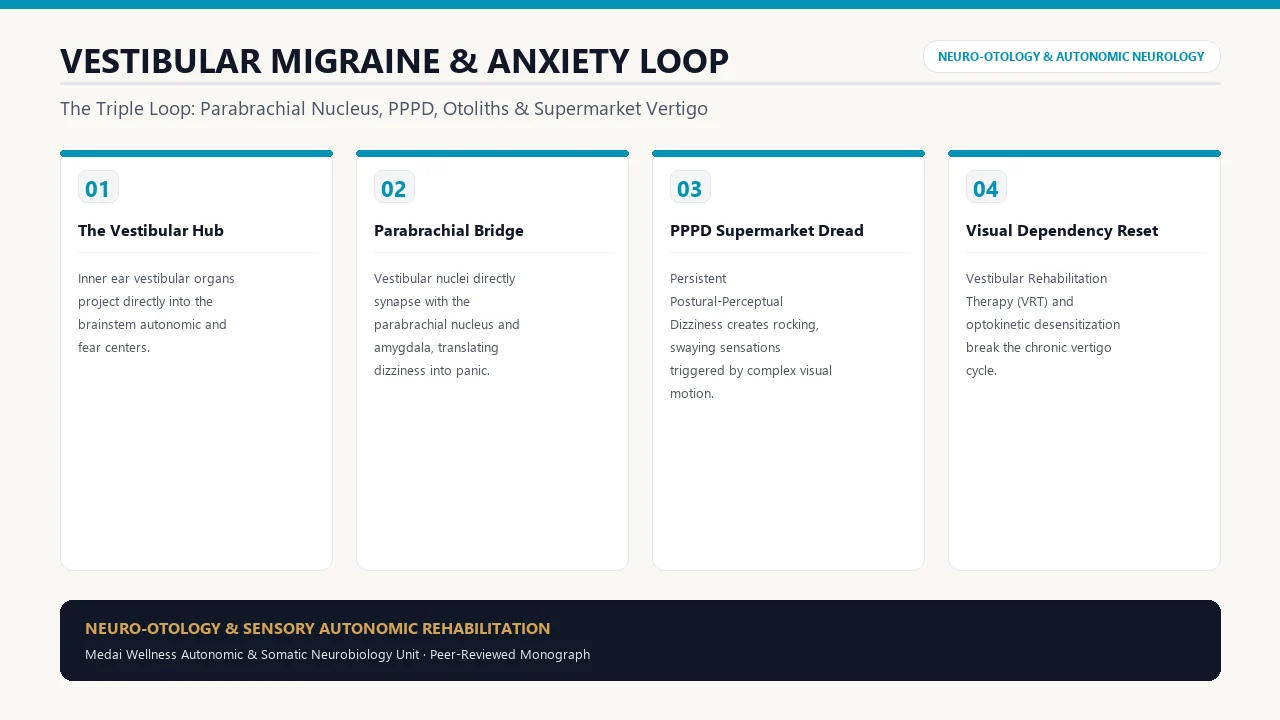
1. The Rocking Boat: Why Dizziness Triggers Terror
Imagine standing in a grocery store aisle. As you glance up at the towering shelves of colorful cereal boxes, fluorescent lights humming overhead, you suddenly feel as though the floor has turned into a waterbed. A sensation of rocking on a boat pulls at your balance. Within seconds, a wave of acute panic surges through your chest, your vision blurs, and you must grip your shopping cart with white knuckles to prevent collapsing.
When you visit an ENT or neurologist, your brain MRI is completely normal. Your ear canals are clean. You are told: "It is just anxiety. You had a panic attack."
This diagnosis reverses cause and effect. You did not become dizzy because you were anxious; you became anxious because your vestibular system misfired.
2. The Neuro-Anatomical Wiring: The Vestibular-Fear Highway
Evolutionarily, your brain prioritizes balance above almost every other sensory input. If an animal loses equilibrium, it falls from trees or becomes instant prey for predators.
To ensure immediate protective survival reflexes, nature hardwired the vestibular apparatus (the semicircular canals and otolith organs of the inner ear) directly into the limbic fear network:
- The Vestibuloparabrachial Pathway: Vestibular sensory nuclei in the rostral medulla project monosynaptic axons directly to the parabrachial nucleus (PBN).
- Locus Coeruleus Cross-Talk: The PBN directly stimulates the locus coeruleus—the central nervous system's primary noradrenaline engine—releasing bursts of norepinephrine throughout the brain.
- Direct Amygdala Gating: Vestibular signals bypass cognitive cortical evaluation and fire directly into the central nucleus of the amygdala.
Therefore, when inner ear otoliths transmit conflicting spatial coordinates, the brainstem does not quietly calculate the error—it sounds an immediate five-alarm fire bell: "We are falling! Activate emergency survival panic!"
3. PPPD and Supermarket Syndrome: Visual Over-Reliance
Following an initial acute vestibular event (such as vestibular neuritis, labyrinthitis, or a severe panic episode), approximately 25% of patients develop Persistent Postural-Perceptual Dizziness (PPPD).
In PPPD, the brain loses trust in its internal vestibular sensors and compensatory proprioceptive feedback from the feet. To compensate, the brain shifts into visual dependency—relying almost 100% on the eyes to know which way is up.
When the patient enters visually complex, high-motion environments (grocery store aisles, crowded shopping malls, moving traffic, or scrolling quickly on computer monitors), the visual system is overwhelmed with conflicting motion cues. The brain suffers a massive sensory mismatch, triggering the classic "supermarket syndrome": rocking vertigo, lightheadedness, and secondary panic.
4. Vestibular Migraine: The Silent Headache
A staggering percentage of patients diagnosed with intractable anxiety or panic actually suffer from Vestibular Migraine (VM). Crucially, up to 50% of vestibular migraine episodes occur with zero throbbing head pain.
Instead of a headache, the cortical spreading depression or trigeminovascular activation manifests as:
- Episodic spontaneous vertigo or rocking sensations lasting hours or days.
- Visual aura (sparkles, blind spots, or extreme sensitivity to fluorescent lighting).
- Cochlear fullness (a sensation of fluid or pressure in the ears with normal hearing tests).
- Acute motion sickness in cars or elevators.
5. Differential Diagnosis: BPPV vs. VM vs. PPPD vs. Panic
| Condition | Primary Sensation | Duration of Episode | Key Provoking Triggers |
|---|---|---|---|
| BPPV (Benign Paroxysmal Positional Vertigo) | Violent spinning room rotation (true vertigo) | Seconds (< 60 seconds) | Specific head position changes (rolling over in bed, tilting head up) |
| Vestibular Migraine (VM) | Internal rocking, tilting, swaying, sensory hypersensitivity | Minutes to 72 hours | Hormonal fluctuations, weather shifts, aged foods, lack of sleep |
| PPPD | Constant non-spinning unsteadiness, heavy head, floating feeling | Persistent (> 3 months, worse upright) | Complex visual patterns, supermarkets, screens, standing still |
| Isolated Panic Disorder | Hyperventilation, acute heart racing, fear of imminent death | Peaks in 10 minutes | Psychosocial stress, situational agoraphobia |
6. Evidence-Based Vestibular and Autonomic Rehabilitation
To recalibrate the vestibular-autonomic loop and eliminate dizziness-induced panic:
- Vestibular Rehabilitation Therapy (VRT): Perform specialized gaze stabilization exercises (VOR drills: focusing on a stationary target while slowly moving the head side-to-side and up-and-down for 60 seconds twice daily) to rebuild cerebellar confidence in vestibular signals.
- Optokinetic Desensitization: Gradually expose the visual system to moving stimuli (such as watching disco light videos or walking down quiet grocery store aisles for 3 minutes) to overcome visual over-reliance.
- Grounding Proprioception: When dizziness strikes, press your bare feet firmly into the floor, squeeze your quadriceps and glutes, and place both hands flat against a solid wall. Feeding strong somatosensory signals into the cerebellum suppresses false vestibular motion signals.
- Vagus Nerve Neuromodulation: Auricular vagal stimulation (aVNS) dampens vestibular-induced locus coeruleus hyperarousal, calming nausea and tachycardia.
Frequently Asked Questions
Why does vestibular dizziness cause derealization and brain fog?
The vestibular nuclei project directly to the parieto-insular vestibular cortex (PIVC) and hippocampus—the brain regions responsible for constructing your internal 3D map of reality and self-location. When balance signals are corrupted, your brain cannot ground your consciousness, inducing profound derealization.
Will taking motion sickness pills (like meclizine) cure PPPD?
No. Vestibular suppressants like meclizine or benzodiazepines blunt acute spinning during acute attacks, but if taken chronically, they prevent the brain from undergoing central neuroplastic compensation, prolonging PPPD indefinitely.
Why do my symptoms feel worse when I stand still than when I am walking?
This is a classic hallmark of PPPD. When you walk, dynamic muscle contractions and joint mechanoreceptors flood the brain with proprioceptive feedback, compensating for the faulty inner ear. When you stand still, proprioceptive input drops, leaving the brain alone with unstable vestibular signals.