
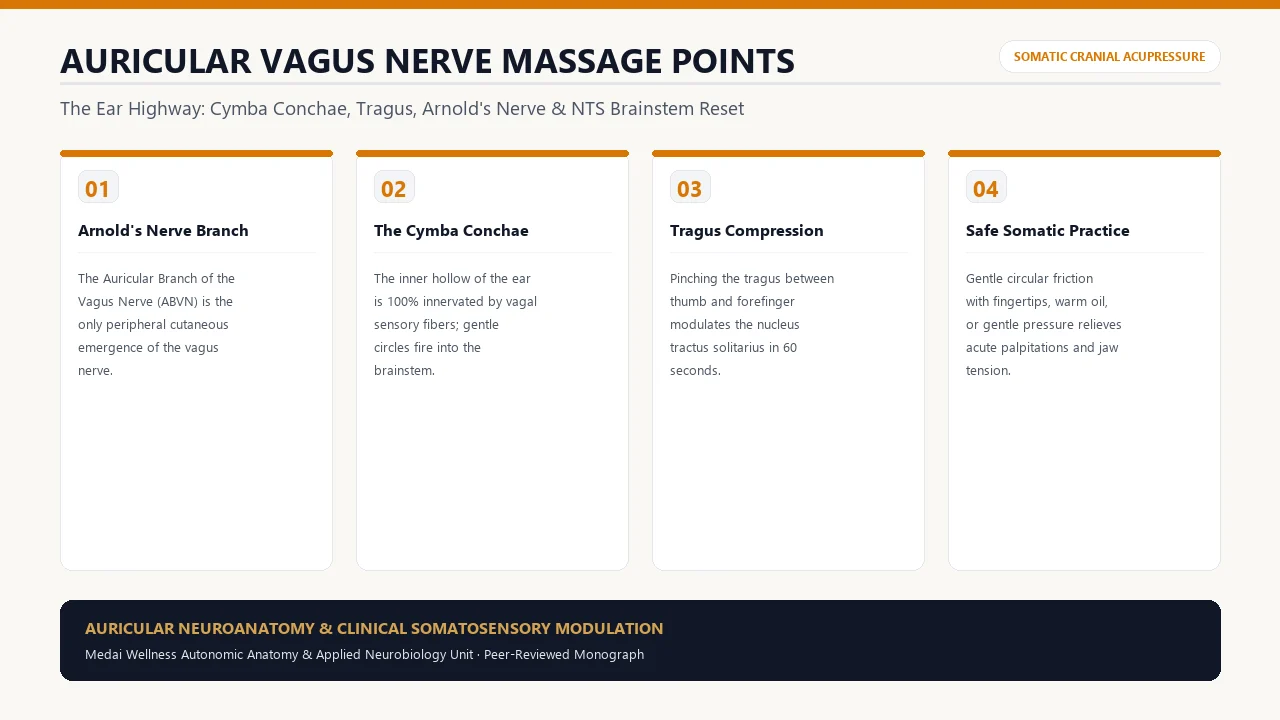
1. The Biological Window: Why the Ear Accesses the Vagus
The vagus nerve is famously a visceral nerve: it descends deep within the carotid sheath into the thorax and abdomen, wrapping around the heart, esophagus, lungs, stomach, and intestines. You cannot touch or massage your vagus nerve in your neck or chest without compressing dangerous carotid arteries.
Except in one extraordinary location: the external human ear.
During embryonic development, the auricular branch of Cranial Nerve X (ABVN) branches off the jugular ganglion, travels through the mastoid canaliculus, and surfaces on the skin of the outer ear. This anatomical quirk makes the ear the premier non-invasive gateway for transcutaneous vagus nerve stimulation (aVNS) and manual somatic acupressure.
2. Neuroanatomical Ear Map: Concha, Tragus, and Arnold's Nerve
To stimulate the vagus nerve effectively, you must understand the sensory innervation of the ear:
- Cymba Conchae (100% Vagal): The superior hollow of the ear, nestled just above the crus of the helix and below the antihelix. Research by Peuker and Filler demonstrated that this region is innervated almost exclusively (100%) by the auricular branch of the vagus nerve.
- Cavum Conchae (45% Vagal): The deeper bowl of the ear leading directly into the ear canal entrance. Features mixed innervation from the ABVN and the Greater Auricular Nerve (C2–C3).
- Tragus (45% Vagal): The small, rounded cartilaginous flap protruding over the opening of the ear canal. Innervated by both the auriculotemporal nerve (trigeminal V3) and the ABVN.
- Ear Lobe (0% Vagal): The soft, fleshy earlobe is innervated exclusively by cervical spinal nerves (C2/C3), not the vagus nerve. Massaging the earlobe will not activate vagal circuits.
3. The Brainstem Relay: How Ear Touch Calms the Amygdala
When you apply gentle pressure or circular massage to the cymba conchae or tragus:
- Low-threshold mechanoreceptors (Merkel discs and Meissner corpuscles) detect the mechanical stimulation.
- Action potentials travel along myelinated A-beta sensory axons of the ABVN into the jugular ganglion and enter the medulla.
- The signals synapse directly in the Nucleus Tractus Solitarius (NTS).
- The NTS immediately sends excitatory projections to the Nucleus Ambiguus (activating cardiac vagal braking) and inhibitory GABAergic projections to the locus coeruleus and central amygdala, blunting fear signaling and stopping panic in its tracks.
4. Step-by-Step Clinical Auricular Acupressure Protocol
To execute a clinical vagus nerve ear massage for acute anxiety relief:
- Step 1: Cymba Conchae Circles: Place the pad of your index finger into the hollow bowl of the ear, resting in the upper cymba conchae. Apply light, gentle pressure (no pain) and perform slow circular motions for 60 seconds. Breathe slowly through your nose.
- Step 2: Tragus Compression: Place your index finger inside the ear canal entrance (touching the inner surface of the tragus) and your thumb on the outer surface of the tragus. Gently pinch and roll the cartilaginous flap for 45 seconds.
- Step 3: Posterior Auricular Slide: Place two fingers behind the earlobe, right where the jaw meets the mastoid bone (the mastoid groove). Make gentle downward sweeping strokes along the neck for 30 seconds.
5. The "Arnold's Cough" Reflex: Proof of Vagal Wiring
Have you ever inserted a cotton swab into your ear canal and suddenly experienced a tickle in your throat followed by an involuntary dry cough?
This is Arnold's Ear-Cough Reflex. Because the auricular branch and the superior laryngeal branch belong to the exact same Cranial Nerve X, mechanical irritation of the ear canal tricks the brainstem into believing a foreign body is lodged in your vocal cords, triggering an automated cough reflex. This reflex is clinical proof of the ear's direct hardwired connection to your internal vagal pathways.
6. Daily 3-Minute Auricular Reset Routine
Incorporate this 3-minute protocol into your daily routine:
- Morning CAR Buffer (8:00 AM): 1 minute of bilateral tragus massage to buffer morning cortisol spikes (CAR).
- Afternoon Focus Reset (2:30 PM): 1 minute of cymba conchae circular acupressure to clear brain fog and reduce sympathetic desk tension.
- Pre-Sleep Wind-Down (10:00 PM): 1 minute of ear massage using a drop of lavender or chamomile oil to stimulate nocturnal parasympathetic slow-wave sleep.
Frequently Asked Questions
Can massaging my ears lower my blood pressure?
Yes. Functional MRI and hemodynamic trials demonstrate that auricular vagal stimulation increases baroreflex sensitivity, lowers systemic vascular resistance, and produces moderate reductions in both systolic and diastolic blood pressure within 10 to 15 minutes.
Should I massage one ear or both ears?
While the right vagus nerve primarily innervates the Sinoatrial node (heart rate) and the left vagus innervates the Atrioventricular node, bilateral massage (massaging both ears simultaneously) produces the most balanced, symmetric brainstem activation.
Can ear piercing (like a daith piercing) stimulate the vagus nerve?
A daith piercing passes through the crus of the helix, near the edge of the cymba conchae. While some migraine sufferers report anecdotal benefits, piercings can cause scar tissue and nerve fiber transection. Manual massage or electrical aVNS provides controlled, non-destructive neuromodulation.