
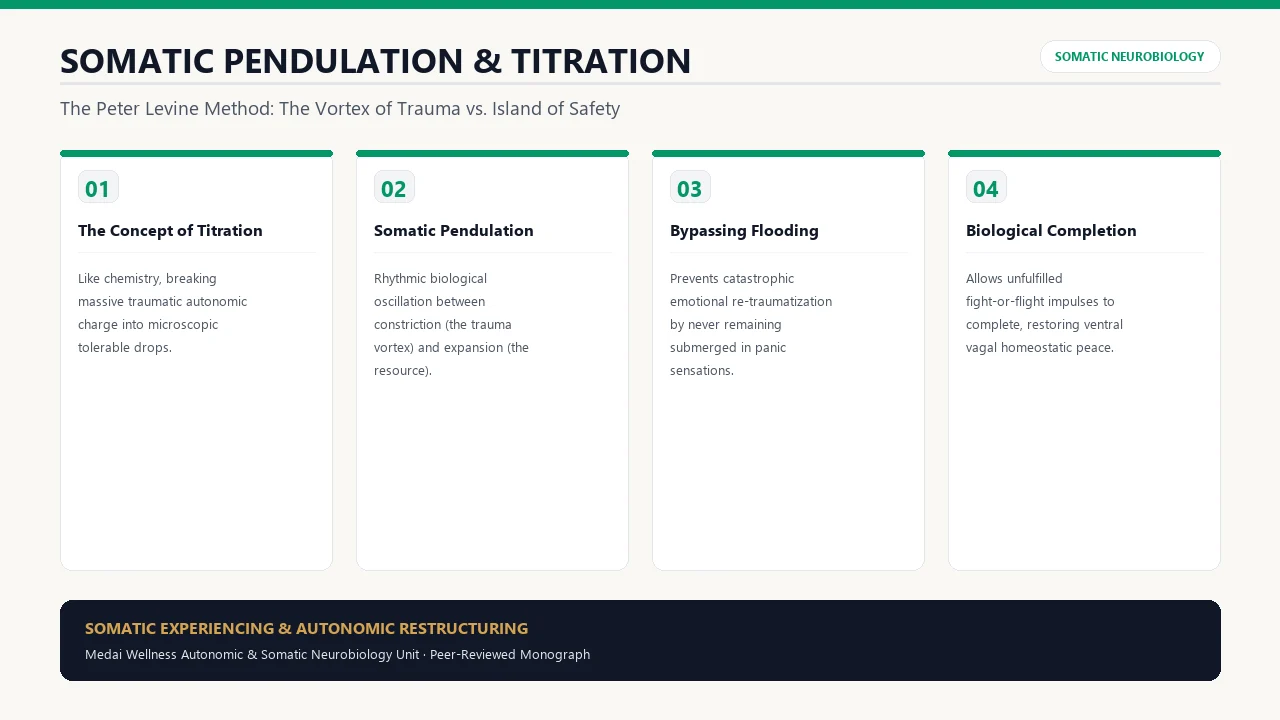
1. The Catharsis Myth: Why Diving Into Trauma Backfires
In classical psychotherapy, a long-held dogma proclaimed that to heal from severe anxiety, panic attacks, or post-traumatic stress, one must dive headfirst into the memory: vividly recounting every horrific detail, screaming into pillows, and experiencing full emotional catharsis.
For millions of patients with sensitized nervous systems, however, this technique causes catastrophic deterioration. Plunging into raw traumatic sensations overwhelms the prefrontal cortex, floods the bloodstream with toxic surges of adrenaline and cortisol, and re-engraves the trauma deeper into the neural pathways of the amygdala. This is known clinically as flooding or re-traumatization.
Dr. Peter Levine recognized that wild animals do not heal through emotional catharsis; they heal through tiny, progressive, somatic discharges. To safely heal an inflamed nervous system, two somatic tools are mandatory: Titration and Pendulation.
2. The Chemistry of Titration: Breaking the Drops Down
In chemical laboratory science, if you pour a beaker of concentrated hydrochloric acid directly into a beaker of sodium hydroxide, you cause a violent exothermic explosion. But if you take a burette and introduce the acid one single drop at a time, the reaction proceeds smoothly, dissipating heat safely until the solution reaches neutral equilibrium.
This is Somatic Titration:
- Instead of trying to process an entire panic attack or traumatic memory all at once, you touch only the smallest conceivable fraction of the physical sensation.
- If your chest feels like a crushing iron vise, you do not focus on the entire chest. You zoom in on one tiny edge—perhaps a 1-millimeter border near the left collarbone where the sensation is slightly less intense.
- By experiencing that single micro-drop of sensation while keeping your breathing slow and eyes open, your autonomic nervous system proves to itself that it can tolerate the sensation without collapsing or dying.
3. Pendulation: Nature's Homeostatic Pendulum
All biological life exists in a state of rhythmic oscillation. The heart contracts (systole) and relaxes (diastole); the lungs expand and contract; cells polarize and depolarize. Nothing in nature remains permanently frozen in one state.
Pendulation is the natural, involuntary swinging of the nervous system between two physiological poles:
- Constriction: The pole of tension, narrowing, coldness, pain, and sympathetic arousal.
- Expansion: The pole of openness, relaxation, warmth, safety, and parasympathetic settling.
When an individual develops panic disorder or trauma, the pendulum becomes frozen at the pole of constriction. Somatic pendulation restores the pendulum's swing by rhythmically moving your awareness between the constriction and an island of physiological safety.
4. The Trauma Vortex vs. The Counter-Vortex of Resource
| Characteristic | The Trauma Vortex (Constriction) | The Counter-Vortex / Resource (Expansion) |
|---|---|---|
| Somatic Sensations | Chest tightness, throat constriction, racing pulse, knot in gut | Warm palms, heavy relaxed feet on floor, soft shoulder blades, steady breath |
| Autonomic State | Sympathetic hyperarousal or dorsal vagal freeze | Ventral vagal social engagement and somatic homeostasis |
| Attentional Bias | Tunnel vision, catastrophic future forecasting, hyper-focus on doom | Peripheral vision, grounded in current room, sensory presence |
| Clinical Objective | Touch briefly for 5 to 10 seconds via titration | Anchor into for 30 to 60 seconds to replenish autonomic reserve |
5. Step-by-Step Clinical Practice Guide for Anxiety Panic
If you are experiencing rising internal anxiety or somatic panic:
- Step 1: Locate an Internal or External Resource: Scan your body for any region that feels neutral, comfortable, or stable. It does not have to feel blissful; it can simply be your left earlobe, the backs of your knees, or your feet touching the firm floor. If your entire body feels chaotic, choose an external resource: a soft pillow, a tree outside the window, or a pet.
- Step 2: Anchor in the Resource: Spend 30 seconds resting your attention on this safe island. Notice its qualities: is it warm? Cool? Heavy? Steady? Feel your nervous system settle slightly.
- Step 3: Titrate Toward the Constriction: Gently move your attention toward the periphery of the anxious sensation (e.g., the edge of the knot in your stomach). Stay there for only 5 to 10 seconds. Describe the sensation neutrally without judgment: "There is a fluttering sensation here."
- Step 4: Pendulate Back to Safety: Before panic escalates, intentionally pivot your awareness completely back to your resource (your feet on the floor or the soft pillow). Rest here for 30 to 45 seconds until your pulse stabilizes.
- Step 5: Repeat the Cycle: Oscillate back and forth 3 to 5 times. With each swing, the traumatic constriction softens, releases its grip, and shrinks in diameter.
6. Somatic Discharge Signs: Yawning, Tremors, and Warmth
When pendulation successfully unlocks bound autonomic energy, the body releases physical discharge markers:
- A spontaneous, involuntary deep breath or sigh.
- A wide yawn accompanied by watering eyes.
- Gastrointestinal gurgling or borborygmi (signaling the resumption of parasympathetic digestion).
- Gentle neurogenic tremors or twitching in the extremities.
- A pleasant wave of warmth spreading across the chest, face, or hands as peripheral blood vessels dilate.
Frequently Asked Questions
What if I cannot find a single spot in my body that feels safe?
This is extremely common in severe panic states. In this case, never use the body as a resource. Use external sensory anchors: the solid support of a heavy wooden chair beneath you, holding a cup of hot herbal tea, touching an ice cube, or looking at a calming piece of art.
How is pendulation different from exposure therapy?
Traditional exposure therapy often relies on prolonged habituation—keeping the patient exposed to high distress until exhaustion sets in. Pendulation never allows the patient to become flooded; it moves rhythmically between distress and safety, retraining autonomic flexibility.
Can I practice pendulation while driving or at work?
Yes. Micro-pendulation is exceptionally discreet. You can keep one part of your awareness anchored on the firm steering wheel beneath your hands while letting another small part observe a sensation of flutter in your stomach, pendulating back and forth as you drive safely.