
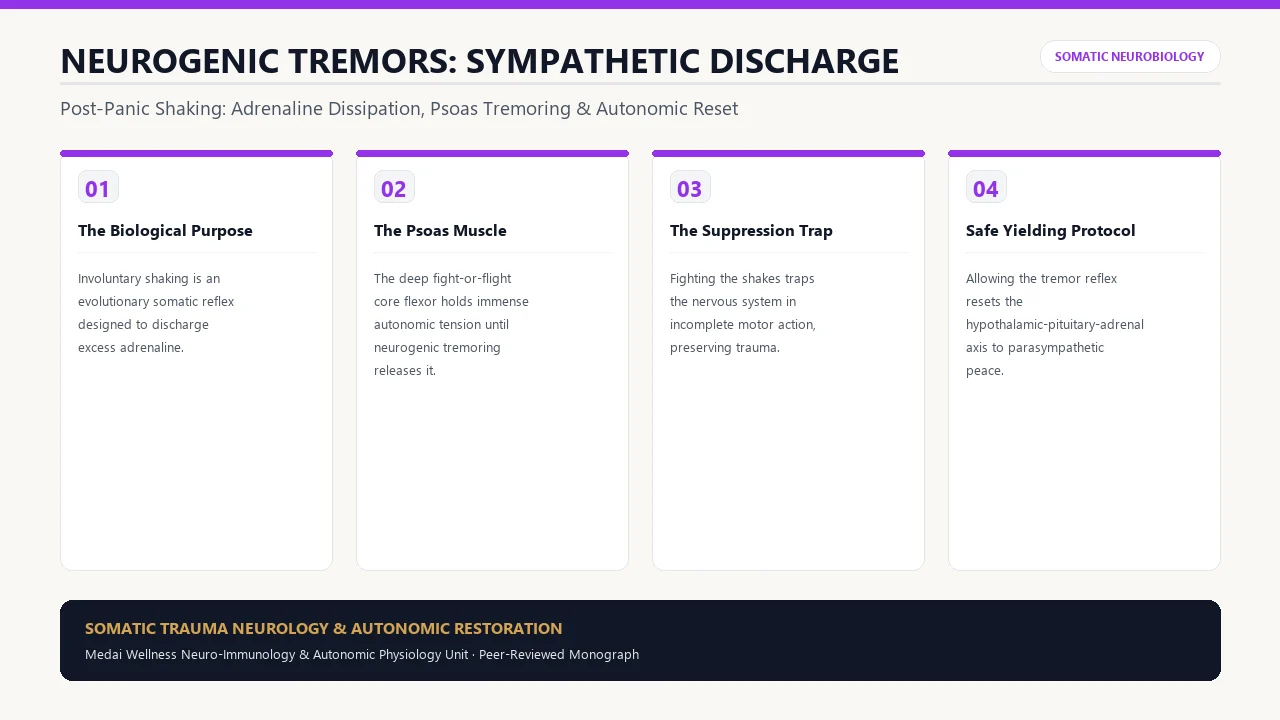
1. The Post-Panic Shiver: Fear vs. Physiology
You have just survived a peak panic attack. Your heart rate is beginning to decelerate, your breathing is returning to baseline, and the immediate terror is receding. But suddenly, your knees begin to knock together. Your hands vibrate with uncontrollable tremors, your teeth chatter as though you were standing naked in the Arctic, and violent shudders ripple through your abdominal core.
To the uninformed patient, this post-panic shaking feels like a secondary crisis: "Am I having a seizure? Am I losing control of my motor system? Is another panic wave coming?"
In truth, the opposite is occurring: your nervous system is performing its most ancient, brilliant self-correcting function: Neurogenic Discharge.
2. The Evolutionary Biology of Shaking in Mammals
In the wild, prey animals frequently face mortal peril. Consider a gazelle chased across the savannah by a cheetah. If the gazelle escapes by dodging into brush, what does it do the moment the predator retreats?
It stands still, drops its head, and begins to shake violently from head to flank for 90 to 120 seconds. It trembles with enormous intensity, takes a deep diaphragmatic sigh, shakes its coat, and immediately resumes peacefully grazing with its herd.
Wild animals rarely suffer from long-term post-traumatic stress disorder (PTSD), generalized anxiety disorders, or chronic somatic fibromyalgia. Why? Because they instinctively allow their neuro-fascial system to discharge the massive reservoir of survival energy mobilized for flight or fight.
3. Brainstem Central Pattern Generators & Catecholamine Burn
During a panic attack, the sympathetic adrenal medullary (SAM) axis floods the bloodstream with immense concentrations of epinephrine (adrenaline) and norepinephrine. Heart rate doubles, peripheral vasculature constricts, and skeletal muscles are charged with glycogen and calcium ions, primed to sprint at 25 miles per hour or fight for survival.
However, when a modern human experiences a panic attack—sitting in an office chair, driving on a highway, or lying in bed—no actual physical sprint occurs. This leaves the neuromuscular system saturated with unused kinetic energy and high catecholamine levels.
To safely metabolize this chemical charge, the brainstem activates Central Pattern Generators (CPGs). These rhythmic neuronal circuits in the medulla and spinal cord initiate high-frequency oscillatory contractions across large skeletal muscle groups. This rapid twitching metabolizes excess lactic acid, consumes circulating epinephrine, and discharges trapped fascial tension.
4. The Psoas Muscle: The Core Battery of Fight-or-Flight
The epicenter of neurogenic tremoring is the iliopsoas muscle complex. Connecting the lumbar vertebrae (L1–L5) through the pelvis to the lesser trochanter of the femur, the psoas is the primary flexor of the human trunk.
Whenever the amygdala registers a threat, the psoas reflexively contracts to curl the body into a protective fetal posture, shielding the vulnerable visceral organs in the abdomen. When a panic attack resolves, the psoas must uncoil. Because it holds the deepest visceral survival tension, releasing this muscle manifests as intense pelvic, thigh, and abdominal tremoring.
5. The Danger of Suppressing the Tremor Reflex
In modern culture, shaking is incorrectly perceived as a sign of weakness, hysteria, or pathology. Consequently, when people begin to tremble after a panic attack, they violently resist it:
- They stiffen their limbs, clench their jaws, grip countertops, and hold their breath to "stop the shaking."
- By forcibly suppressing the tremor reflex, the patient interrupts the natural autonomic discharge cycle.
- The residual fight-or-flight energy remains bound within the fascial and muscular matrix, shifting the nervous system into a chronic state of incomplete motor action or sliding into a functional dorsal vagal freeze.
6. Clinical Protocol: How to Safely Allow Neurogenic Discharge
Pioneered by somatic clinicians like Dr. Peter Levine (Somatic Experiencing) and Dr. David Berceli (Trauma Releasing Exercises / TRE), learning to welcome the shake is transformative:
- Step 1: Cognitive Reframing: Remind yourself aloud: "My body is not broken. My body is discharging adrenaline so I can return to baseline. This shaking is my medicine."
- Step 2: Safe Reclining: Lie flat on a bed or soft carpet with knees bent, feet flat on the floor hip-width apart (the constructive rest position). Wrap a warm blanket over yourself, as adrenaline drop causes a mild sensation of cold.
- Step 3: Loosen the Jaw: Allow your mouth to fall slightly open. Unclench your teeth and allow your tongue to rest on the floor of your mouth. The jaw and pelvis share reciprocal neurological reflex arches.
- Step 4: Yield and Encourage: Allow your knees to gently bounce or tremble. Do not try to make it happen, and do not try to stop it. Let the vibration ripple through your legs, pelvis, ribs, and shoulders.
- Step 5: The Completion Sigh: After 3 to 10 minutes, the shaking will naturally subside on its own. It is almost always accompanied by a deep, spontaneous exhalation or yawn. You will feel an overwhelming wave of warmth, softness, and peaceful exhaustion.
Frequently Asked Questions
How can I tell the difference between neurogenic tremors and a neurological seizure?
During neurogenic tremors, you remain 100% conscious, alert, and capable of speech. You can voluntarily stop the shaking at any second simply by standing up or changing posture. In contrast, an epileptic seizure involves altered consciousness, involuntary eye deviation, inability to interrupt the movement, and post-ictal confusion.
How long does the post-panic shaking typically last?
If allowed to proceed without cognitive resistance, neurogenic discharge typically peaks and completes within 3 to 10 minutes, leaving the patient deeply relaxed and ready for restorative sleep.
Why do my teeth chatter even when the room is warm?
Teeth chattering after panic is not driven by hypothermia; it is mediated by the motor division of the trigeminal nerve discharging tension from the masseter and temporalis muscles as autonomic arousal recedes.