
1. The Diagnostic Trap: Lazy, Depressed, or Paralyzed?
You sit on the edge of your bed staring at your phone for four hours. You have a mountain of urgent emails to answer, bills to pay, and a messy kitchen. You want desperately to stand up and take action. Yet your limbs feel like solid concrete. Your mind is blank, your emotions are muted behind a thick wall of fog, and a heavy numbness weighs down your chest.
You tell yourself: "I am lazy. I have no discipline. I must be profoundly depressed."
When you visit a conventional practitioner, you are diagnosed with Major Depressive Disorder and prescribed an SSRI or a stimulant. Yet weeks pass, and you feel worse. Why? Because you are not clinically depressed—you are trapped in a Functional Freeze.
2. The Polyvagal Hierarchy: Ventral, Sympathetic, and Dorsal
Developed by Dr. Stephen Porges, Polyvagal Theory identifies three phylogenetically distinct autonomic subsystems that operate hierarchically:
- Ventral Vagal Complex (Social Engagement): Phylogenetically the newest system (mammalian). Myelinated fibers promote calm social communication, heart rate variability, eye contact, and emotional safety.
- Sympathetic Nervous System (Mobilization): Spinal thoracolumbar chains fire fight-or-flight energy: high heart rate, vigilance, and aggressive defense.
- Dorsal Vagal Complex (Immobilization & Shutdown): The most primitive evolutionary system (reptilian). Unmyelinated fibers originating in the Dorsal Motor Nucleus of the Vagus (DMNX) project below the diaphragm. When threat becomes overwhelming and impossible to escape, the DMNX triggers profound bradycardia, visceral shutdown, numbness, and metabolic conservation.
3. The Physiological Paradox: Gas and Brake Simultaneous Activation
The defining characteristic of a "Functional Freeze" is that it is a hybrid autonomic state:
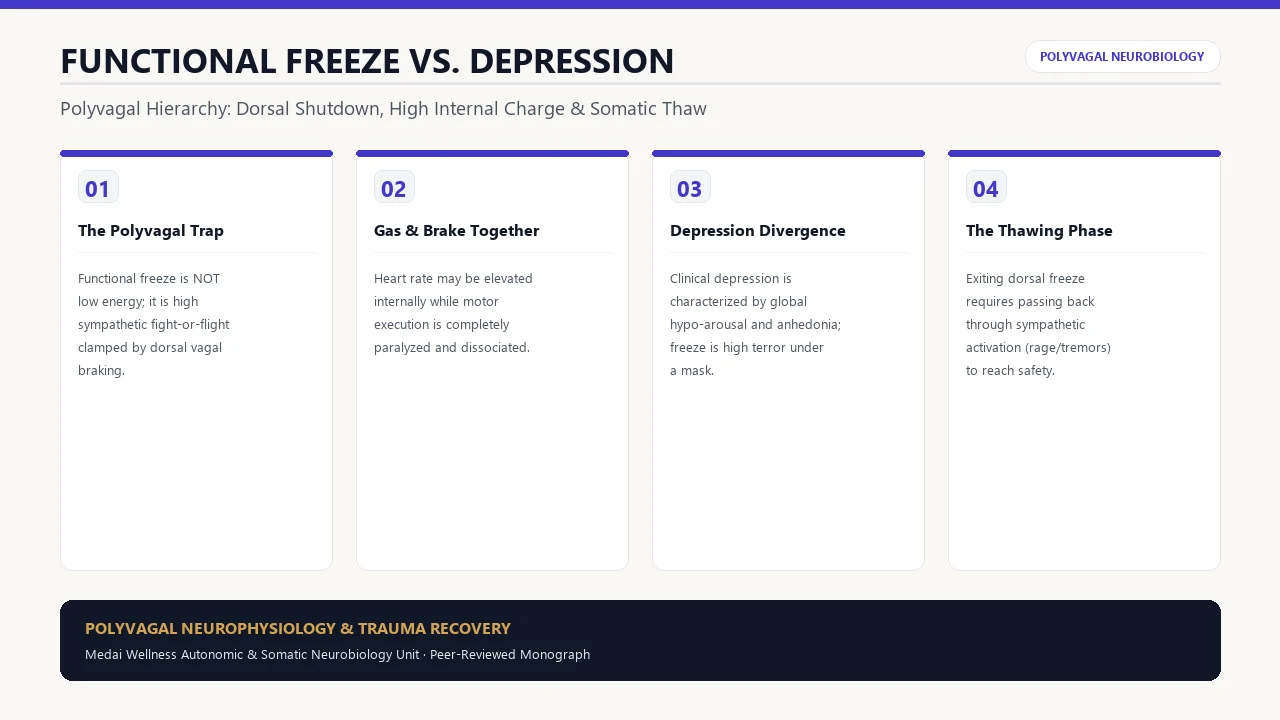
In true pure dorsal vagal collapse (such as playing dead or fainting), sympathetic tone drops completely. But in a functional freeze, your sympathetic nervous system is screaming at 120 mph (adrenal activation, elevated basal pulse, internal catastrophic terror), but your dorsal vagus slams down the emergency emergency brake to prevent systemic cardiac failure.
You are trapped with the accelerator and the brake mashed to the floor simultaneously. The engine is redlining internally, but the car cannot move an inch.
4. Clinical Comparison: Functional Freeze vs. Clinical Depression
| Clinical Parameter | Functional Freeze (Dorsal Shutdown) | Major Depressive Disorder (Depression) |
|---|---|---|
| Internal Physiological State | High internal sympathetic terror clamped by dorsal vagal brake | Global systemic hypo-arousal and low autonomic reactivity |
| Basal Heart Rate | Frequently elevated (85–105 bpm) despite physical immobility | Normal or low heart rate with flat autonomic variability |
| Emotional Quality | Severe panic locked behind a wall of numbness; high dread | Pervasive anhedonia, sadness, emptiness, lack of desire |
| Desire for Action | Frustrated desire to move; feeling "locked in" or paralyzed | Absence of motivation; belief that nothing matters |
| Treatment Response | Worsens with aggressive stimulants; heals with somatic titration | Responds to psychotherapy, behavioral activation, and pharmacotherapy |
5. Somatic Manifestations of Dorsal Vagal Shutdown
Individuals locked in functional freeze experience distinctive somatic symptoms:
- Hypoalgesia: Reduced perception of physical pain; feeling disconnected from bodily sensations.
- Visceral Stasis: Severe gastroparesis, chronic constipation, and bloating (dorsal vagal fibers inhibit digestive peristalsis during shutdown).
- Perceptual Dissociation: Seeing the world as though through dirty glass, flat two-dimensional screens, or feeling that one's body belongs to a stranger (derealization).
- Cold Extremities: Severe vasoconstriction in fingers and toes due to sympathetic clamping.
6. The Somatic Thawing Protocol: How to Exit Freeze Safely
The critical clinical rule of Polyvagal Theory is that you cannot jump directly from dorsal shutdown into ventral vagal social calm. You must travel backward along the evolutionary path:
Dorsal Shutdown (Freeze) → Sympathetic Mobilization (Heat, Shakes, Anger) → Ventral Vagal Safety (Calm)
To safely navigate this thaw without triggering full-blown panic attacks:
- Micro-Movements: Do not try to clean the entire house. Begin by simply wiggling your toes or rotating your wrists. Small motor inputs signal the brainstem that movement is safe.
- Orienting Reflex: Slowly rotate your head and neck 180 degrees. Let your eyes scan the room and land on five non-threatening objects. Identifying safety in the immediate physical environment cues the ventral vagal circuit.
- Expect the Sympathetic Surge: As the freeze melts, you will feel a sudden wave of heat, trembling, rage, or rapid heart rate. Do NOT fear this; it is the trapped sympathetic mobilization breaking free. Shake your hands, stomp your feet, or perform neurogenic tremors to allow the charge to discharge.
Frequently Asked Questions
Why do stimulant medications make functional freeze worse?
Stimulants pump more dopamine and norepinephrine into an already redlining sympathetic system. When the brain senses this increased adrenergic charge as a higher survival threat, the dorsal vagus clamps down the emergency brake even harder, worsening paralysis.
How long does a functional freeze state typically last?
Without somatic awareness, individuals can remain in functional freeze for months or years, surviving in an "autopilot" state where they work and perform basic tasks but feel completely emotionally disconnected from life.
Can functional freeze cause digestive problems?
Yes. The dorsal vagus nerve directly innervates the subdiaphragmatic visceral organs. Massive dorsal firing shuts down digestive enzyme secretion, stomach acid, and colonic motility, leading to severe chronic constipation, SIBO, and reflux.