
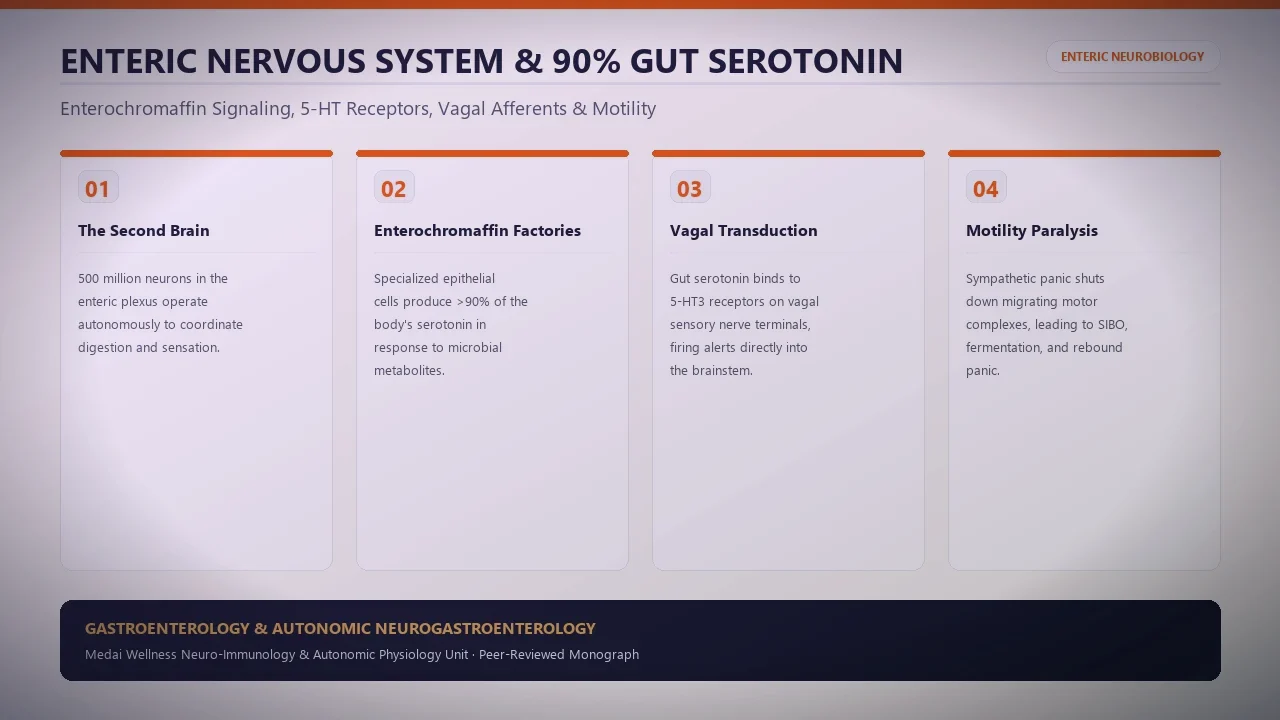
1. The Enteric Nervous System: The Intelligent Second Brain
Embedded within the walls of the gastrointestinal tract—from the middle esophagus down to the internal anal sphincter—lies the Enteric Nervous System (ENS). Organized into two concentric networks of ganglia and interconnecting fiber tracts:
- The Myenteric (Auerbach’s) Plexus: Sandwiched between the longitudinal and circular smooth muscle layers, controlling peristaltic wave propagation, contractile velocity, and sphincter tone.
- The Submucosal (Meissner’s) Plexus: Located in the submucosa adjacent to the mucosal lining, regulating local mucosal blood flow, glandular secretion, and water/electrolyte transport.
The ENS utilizes more than 30 distinct neurotransmitters identical to those found in the central brain, including acetylcholine, dopamine, substance P, VIP, and gamma-aminobutyric acid (GABA). Remarkably, if the vagus and splanchnic nerves are completely severed, the gut continues to digest, segment, and absorb nutrients autonomously.
2. The Serotonin Engine: Enterochromaffin Cells and Motility
While mainstream psychiatry focuses heavily on serotonin within the central brain, more than 90% to 95% of the body's serotonin (5-hydroxytryptamine, 5-HT) is synthesized within the gut by specialized mucosal endocrine cells called enterochromaffin (EC) cells.
EC cells act as physical and chemical pressure transducers. When a food bolus distends the intestinal lumen or when psychological stress unleashes sympathetic catecholamines, EC cells discharge serotonin into the lamina propria. Serotonin binds to specific receptor subtypes:
- 5-HT1P & 5-HT4 Receptors: Stimulate intrinsic primary afferent neurons (IPANs) to drive rhythmic peristaltic propulsion and secretion.
- 5-HT3 Receptors: Located on extrinsic vagal and spinal sensory afferents; excessive serotonin stimulation on 5-HT3 receptors triggers nausea, vomiting, abdominal cramping, and urgent diarrhea.
3. Enteric Glial Cells: The Immune-Neural Sentinels
Outnumbering enteric neurons by four to sevenfold, Enteric Glial Cells (EGCs) form an extensive, interconnected cellular network in the gut wall that mirrors the astrocytes of the central nervous system. EGCs express glial fibrillary acidic protein (GFAP) and S100-beta, maintaining the mechanical and chemical integrity of the intestinal epithelial barrier.
Breakthrough studies reveal that under chronic psychological stress, elevated levels of corticotropin-releasing factor (CRF) and systemic lipopolysaccharide (LPS) convert resting enteric glia into an aggressive reactive glial phenotype. Reactive glia secrete pro-inflammatory cytokines (IL-6, TNF-alpha) and nitric oxide, breaking down the tight junctions of enterocytes (inducing "leaky gut") and hypersensitizing adjacent enteric neurons.
4. The 80/20 Vagal Asymmetry: Why the Gut Controls the Mind
In popular culture, the brain is assumed to be the master commander commanding the gut. In our foundational guide to gut-brain axis autonomic signaling, the anatomical reality is precisely the opposite:
80% to 90% of all Vagus Nerve Fibers are SENSORY AFFERENTS (Gut → Brain)
Only 10% to 20% of vagal fibers are motor efferents carrying instructions from the brain downward to the gut. The overwhelming majority are sensory afferents carrying continuous status reports on microbial metabolites, inflammation, stretch, and chemical composition directly into the nucleus tractus solitarius (NTS) in the brainstem.
From the NTS, these signals project directly to the locus coeruleus (the brain's norepinephrine factory), the amygdala, and the anterior insular cortex. When the gut is inflamed, hypertonic, or in spastic distress, it sends an unrelenting broadcast of alarm signals to the brain. Even if an individual has zero stressful thoughts, a dysregulated gut will actively force the conscious mind into feelings of dread, vulnerability, and acute panic.
5. Decoupling the Somatic Gut-Brain Trauma Loop
For individuals with chronic anxiety, the nervous stomach becomes an interoceptive echo chamber. The sequence typically unfolds in a vicious circle:
- An emotional trigger releases stress hormones, slowing gastric motility and speeding up colonic transit.
- The gut cramps, twists, or feels nauseated.
- Vagal afferents project these distressing visceral sensations straight into the insular cortex.
- The patient consciously notices the stomach ache and catastrophizes: “Something is terribly wrong with my health.”
- Catastrophic thinking fires a secondary surge of adrenal catecholamines, intensifying gut spasms.
The Visceral Sensation vs. Threat Reality
The breakthrough in treating the nervous stomach occurs when a patient realizes that visceral gut distress is a somatic reflex of the enteric nervous system, NOT an indicator of physical catastrophe. Treating the sensation as a false sensory alarm interrupts the catastrophic appraisal cycle immediately.
6. Somatosensory Gut Recalibration: Evidence-Based Protocols
Calming the second brain requires targeted somatic and neuro-biochemical interventions:
- Visceral Somatic De-Armoring (Heat & Proprioception): Placing a warm castor oil pack or hot water bottle across the solar plexus and epigastrium for 20 minutes triggers cutaneous thermoreceptor activation, reflexively dilating mesenteric blood vessels and suppressing splanchnic sympathetic tone.
- Gut-Directed Relaxation Hypnosis: Clinical trials at the University of North Carolina confirm that standardized gut-directed hypnotherapy protocols alter central insular processing, dampening the brain's reactivity to visceral sensations and normalizing motility.
- Targeted Psychobiotics (B. longum 1714 & L. rhamnosus JB-1): Specific probiotic strains produce GABA and stimulate vagal sensory pathways, significantly reducing cortisol responses and visceral hypersensitivity.
- Low-FODMAP Short-Term Elimination: Temporarily reducing fermentable oligosaccharides, disaccharides, monosaccharides, and polyols prevents excessive osmotic water retention and gas expansion in the lumen, giving sensitized enteric nerves a rest window to recalibrate.