
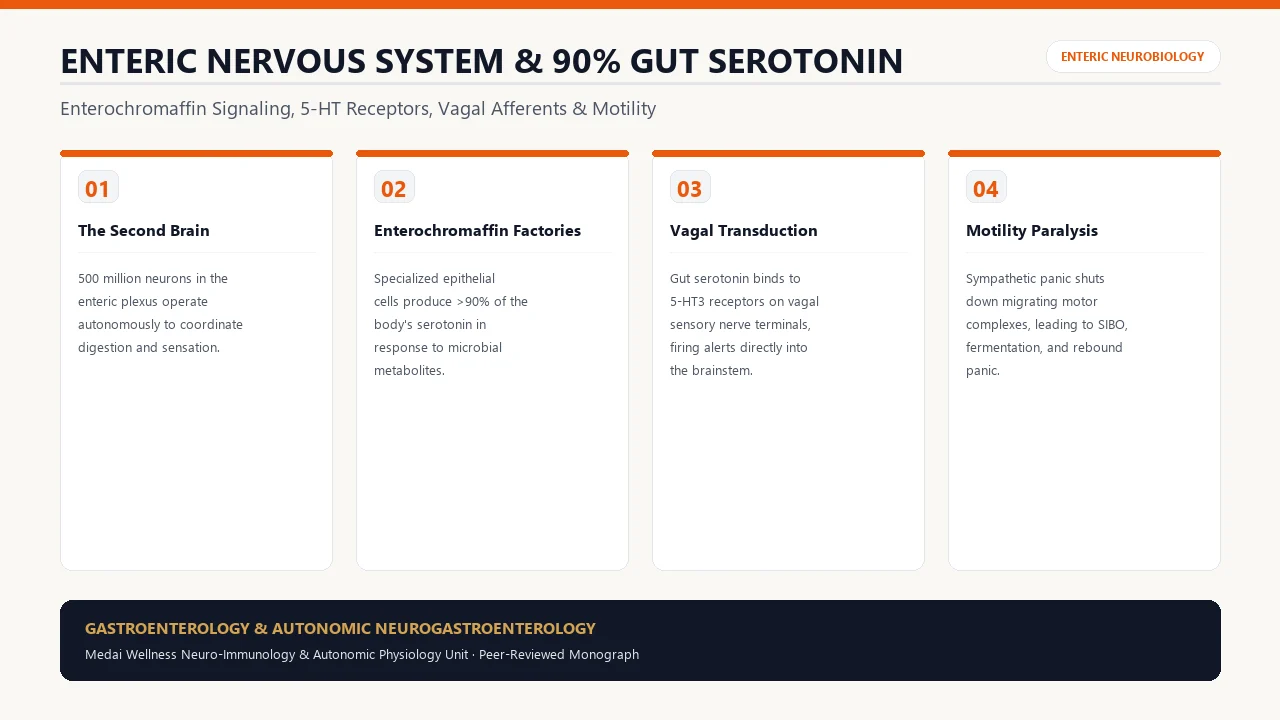
1. The Second Brain: Architecture of the Enteric Nervous System
Embedded within the walls of the human gastrointestinal tract from the esophagus to the rectum lies a network of more than 500 million neurons—more neurons than are found in the entire spinal cord. This is the Enteric Nervous System (ENS), frequently termed the "second brain."
Organized into two major plexuses—the Myenteric (Auerbach's) plexus governing motor peristalsis and the Submucosal (Meissner's) plexus controlling glandular secretions and local blood flow—the ENS can function entirely independently of the central nervous system, even if the vagus nerve is surgically severed.
2. Enterochromaffin Cells: The Body's True Serotonin Factories
A widespread misconception is that serotonin is predominantly a "brain chemical." In truth:
- Approximately 90% to 95% of the body's total serotonin is synthesized in the gut by specialized neuroendocrine cells known as Enterochromaffin (EC) cells.
- Another 5% is sequestered in blood platelets for coagulation and vascular repair.
- Only a tiny fraction—less than 2% to 3%—is synthesized in the raphe nuclei of the brainstem.
EC cells act as mechanical and chemical sensors in the gut lumen. When stimulated by mechanical stretch (food passing), microbial short-chain fatty acids, or bacterial toxins, EC cells release serotonin into the lamina propria, sparking peristaltic reflexes and firing sensory warnings.
3. 5-HT Receptor Subtypes: Motility vs. Nausea vs. Pain
The gut expresses multiple distinct serotonin receptor subtypes, each governing a unique physiological function:
| 5-HT Receptor Subtype | Primary Anatomical Location | Physiological Action & Clinical Anxiety Impact |
|---|---|---|
| 5-HT3 Receptors | Vagal afferent nerve endings & chemoreceptor trigger zone | Ligand-gated ion channels. Excessive release triggers acute nausea, visceral hypersensitivity, and panic arousal. |
| 5-HT4 Receptors | Enteric motor neurons & circular smooth muscle | G-protein coupled. Accelerates peristalsis and Migrating Motor Complex (MMC) housekeeping waves. |
| 5-HT1A Receptors | Myenteric plexus interneurons | Inhibitory feedback; dampens excessive smooth muscle spasms and visceral pain transmission. |
| 5-HT2B Receptors | Longitudinal smooth muscle layers | Coordinates contraction phases during digestion and colonic mass movements. |
4. Vagal Afferent Wiring: How the Gut Talks to the Brain
Because peripheral serotonin cannot cross the blood-brain barrier, how does gut serotonin dictate brain state? Through vagal sensory afferents:
The vagus nerve is an asymmetric communication superhighway: 80% to 90% of its fibers are afferent (carrying sensory information from the viscera upward to the brain). Only 10% to 20% are efferent (signals traveling down).
When gut EC cells secrete serotonin, it binds directly to 5-HT3 receptors located on the subepithelial endings of the vagus nerve. This fires action potentials directly into the nucleus tractus solitarius (NTS) in the brainstem. From the NTS, signals project immediately to the amygdala, locus coeruleus, and insula. Thus, gut inflammation or irritation is translated instantly into feelings of impending doom, generalized dread, and panic.
5. Motility Paralysis: Why Panic Freezes Digestion and Causes SIBO
During acute sympathetic activation (fight-or-flight):
- Splanchnic sympathetic nerves release norepinephrine, shutting down blood flow to the mesenteric vasculature.
- The Migrating Motor Complex (MMC)—the electrical sweeping wave that cleans the small intestine between meals—is completely paralyzed.
- Stagnant digestive matter ferments in the small intestine, enabling colonic bacteria to migrate upward into the jejunum and ileum, creating Small Intestinal Bacterial Overgrowth (SIBO).
- Bacterial endotoxins (LPS) irritate EC cells, causing massive erratic serotonin dumps that trigger alternating constipation, explosive diarrhea, and intense panic attacks.
6. Restoring the Enteric-Serotonergic Axis
To rehabilitate the second brain and calm vagal afferent alarms:
- Support MMC Motility: Utilize standardized ginger extract (gingerols bind to 5-HT3 receptors as natural prokinetics) and 5-HTP (50–100 mg) taken on an empty stomach before bed to stimulate nocturnal MMC sweeps.
- Stimulate Vagal Tone with aVNS: Re-establish parasympathetic dominance through auricular vagus stimulation (aVNS) to restore mesenteric arterial perfusion.
- Targeted Probiotic Strains (Psychobiotics): Lactobacillus rhamnosus (JB-1) and Bifidobacterium longum (1714) have been demonstrated in clinical trials to normalize central GABA and reduce stress-induced visceral hyperalgesia via vagal pathways.
Frequently Asked Questions
Why do SSRI antidepressants often cause severe nausea and diarrhea during the first two weeks?
Because 90% of the body's serotonin receptors reside in the gut. When an SSRI blocks the serotonin transporter (SERT) systemically, serotonin levels in the gut skyrocket, over-stimulating mucosal 5-HT3 and 5-HT4 receptors and triggering cramping, diarrhea, and nausea until receptors downregulate.
Can gut health issues like SIBO cause panic attacks?
Yes. Microbial overgrowth produces high amounts of hydrogen, methane, and hydrogen sulfide gases, alongside lipopolysaccharides (LPS). These trigger massive local serotonin release from EC cells, firing continuous alarms up the vagus nerve directly into the amygdala.
Does taking tryptophan increase gut or brain serotonin?
Tryptophan is absorbed in the small intestine and distributed systemically. In the gut, it serves as the substrate for EC cell serotonin synthesis. However, circulating tryptophan that crosses the blood-brain barrier via large neutral amino acid transporters (LNAAT) synthesizes central brain serotonin.