
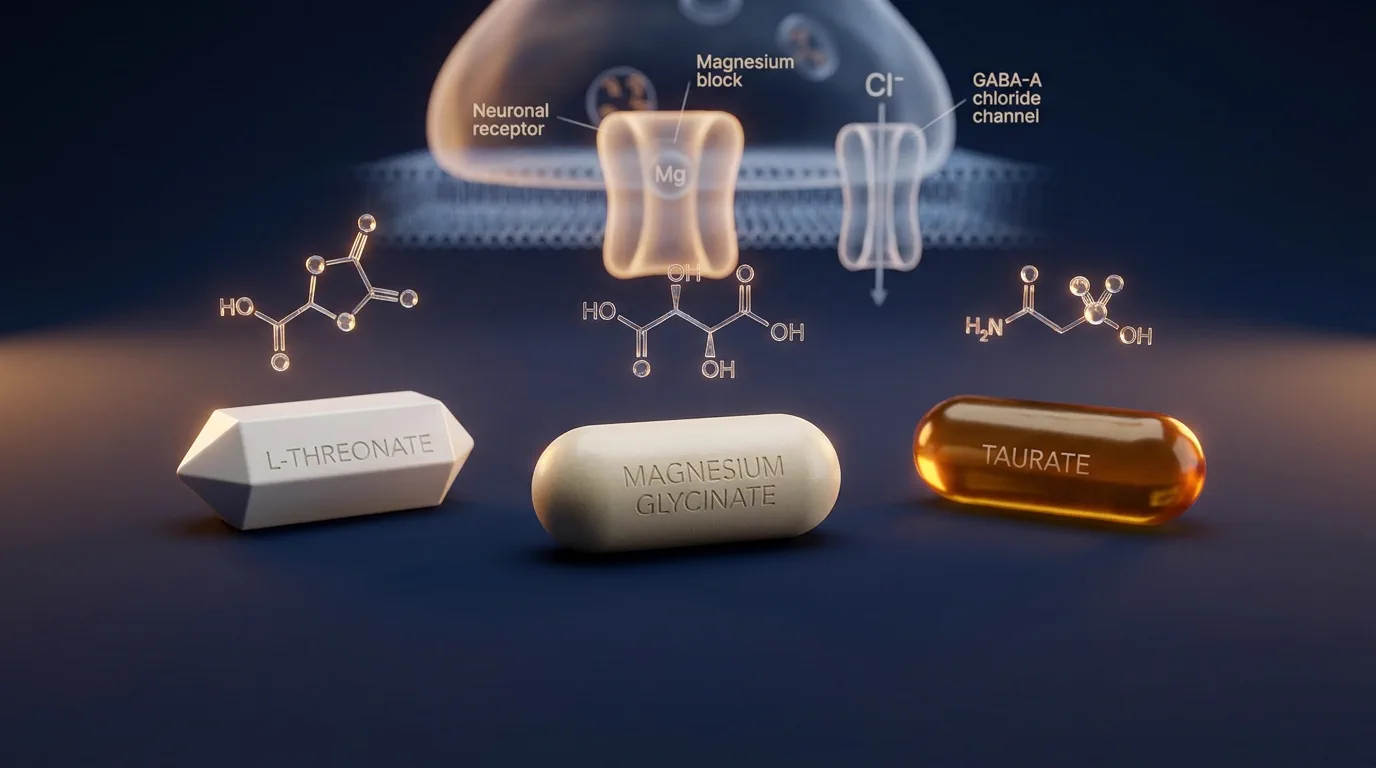
Not all magnesium forms are created equal. Bioavailability, blood-brain barrier penetration, and co-factor synergy (especially with glycine) determine whether a supplement meaningfully shifts autonomic tone or simply produces expensive urine. This guide provides the complete scientific framework for selecting, dosing, and stacking magnesium for anxiety.
The Neurobiology: How Magnesium Calms Anxiety
Magnesium exerts anxiolytic effects through four primary mechanisms:
- NMDA Receptor Antagonism: Magnesium sits in the NMDA receptor channel, preventing excessive calcium influx from glutamate excitotoxicity. Low magnesium = hyperexcitable neurons = anxiety. This is a voltage-dependent block: at resting potential, Mg²⁺ blocks the channel; depolarization displaces it.
- GABA Synthesis Support: Magnesium is a cofactor for glutamate decarboxylase (GAD), the enzyme that converts excitatory glutamate into inhibitory GABA. It also enhances GABA-A receptor sensitivity.
- HPA Axis Modulation: Magnesium reduces ACTH-driven cortisol release from the adrenal cortex and enhances hippocampal glucocorticoid receptor (GR) sensitivity, restoring negative feedback.
- Vagal Tone Enhancement: Magnesium improves heart rate variability (HRV) by facilitating acetylcholine release at cardiac synapses and reducing sympathetic outflow.
The Magnesium-Calcium Balance
Magnesium and calcium are physiological antagonists. Calcium promotes excitation, contraction, and coagulation; magnesium promotes relaxation, dilation, and anticoagulation. The ideal dietary Ca:Mg ratio is 1:1 to 2:1; modern diets average 5:1 to 10:1, creating a functional magnesium deficit even with "adequate" intake.
| Magnesium Form | Elemental Mg % | Bioavailability | BBB Penetration | Best For | GI Tolerance | Cost/Value |
|---|---|---|---|---|---|---|
| Magnesium Glycinate (Bisglycinate) | ~14% | High (dipeptide transport) | Moderate | Anxiety, sleep, muscle tension | Excellent (no laxative) | High |
| Magnesium L-Threonate (Magtein®) | ~7% | High | High (crosses BBB) | Cognitive anxiety, brain fog, memory | Good | Premium |
| Magnesium Taurate | ~9% | High | Moderate | Cardiac palpitations, BP, GABA support | Good | Moderate |
| Magnesium Malate | ~11% | High | Low | Fibromyalgia, fatigue, mitochondrial | Good | Moderate |
| Magnesium Citrate | ~16% | Moderate | Low | Constipation, acute Mg repletion | Poor (osmotic laxative) | Low |
| Magnesium Oxide | 60% | Very Low (~4%) | Negligible | Not recommended for anxiety | Poor | Very Low |
| Magnesium Orotate | ~6% | Moderate | Low | Cardiac energy, athletic recovery | Good | Premium |
| Magnesium Acetyl Taurate | ~8% | High | High (taurine carrier) | Neuroprotection, seizure threshold | Good | Premium |
Top 3 Evidence-Based Forms for Anxiety
1. Magnesium Glycinate (Bisglycinate) — Gold Standard for Anxiety
Chelated with the amino acid glycine, this form offers superior intestinal absorption via dipeptide transporters (PEPT1), bypassing competitive mineral channels. Glycine itself is an inhibitory neurotransmitter that potentiates GABA-A receptors and lowers core body temperature for sleep initiation.
A 2017 randomized trial in PLOS ONE found that 300mg/day magnesium glycinate for 6 weeks significantly reduced GAD-7 scores vs. placebo (p<0.01). A 2021 meta-analysis in Nutrients confirmed glycinate's superior tolerability and anxiolytic effect size (g = 0.58) vs. other forms.
2. Magnesium L-Threonate — Best for Cognitive Anxiety & Brain Fog
Developed at MIT, Magtein® (magnesium L-threonate) uniquely crosses the blood-brain barrier via the SLC41A1/3 transporters, elevating brain magnesium concentrations by ~15% in rodent models. Human trials (Liu et al., 2016; Journal of Alzheimer's Disease) demonstrate improved executive function, working memory, and reduced subjective anxiety in older adults.
Key advantage: Direct CNS delivery without requiring high systemic doses. Limitation: Lower elemental magnesium (7%) means less peripheral benefit (muscle, cardiac, metabolic).
3. Magnesium Taurate — Best for Cardiac Symptoms (Palpitations, Hypertension)
Taurine is a conditionally essential amino acid that stabilizes cell membranes, modulates GABA receptors, and supports cardiac electrophysiology. The magnesium-taurine combination is synergistic for stress-induced arrhythmias and blood pressure lability. Taurine also enhances GABA synthesis and inhibits NMDA receptors independently.
Emerging form: Magnesium Acetyl Taurate (ATA Mg) — acetyl group enhances BBB penetration via taurine transporters. Preclinical data shows superior neuroprotection and anxiolytic effects vs. standard taurate.
Dosing Protocol: How Much, When, and How
Elemental Magnesium Target: 300–400mg daily (RDA: 310–420mg). Most adults need 400mg for repletion, then 200–300mg maintenance.
| Protocol Phase | Form | Dose (Elemental Mg) | Timing | Duration | Expected Effects |
|---|---|---|---|---|---|
| Acute Repletion (Weeks 1–4) | Glycinate | 400mg (split 200mg AM / 200mg PM) | With meals | 4 weeks | Restore intracellular stores; reduce cramps, improve sleep |
| Maintenance (Week 5+) | Glycinate or Threonate | 200–300mg | PM (1h before bed) | Ongoing | Sustain stores; optimize sleep architecture |
| Cognitive Focus Stack | Threonate AM + Glycinate PM | 144mg Threonate (2g Magtein) AM / 200mg Glycinate PM | Split | As needed | Brain Mg elevation + peripheral relaxation |
| Cardiac/Palpitations | Taurate (or Acetyl Taurate) | 200–400mg | Split AM/PM | Ongoing | Stabilize rhythm; reduce ectopic beats |
| Fibromyalgia/CFS | Malate + Glycinate | Malate 600mg AM / Glycinate 200mg PM | Split | Ongoing | Mitochondrial ATP + nervous system calm |
Titration Strategy to Avoid GI Distress
- Week 1: 100mg elemental Mg at dinner (glycinate)
- Week 2: 200mg at dinner
- Week 3: 200mg AM + 200mg PM (split dose improves absorption)
- Week 4: 300–400mg total daily (adjust to bowel tolerance)
Red flag: Loose stools = reduce dose by 100mg. This indicates saturation of intestinal absorption.
Synergistic Co-Factors for Maximum Effect
Magnesium does not work in isolation. These co-factors are essential for cellular uptake, enzymatic function, and clinical effect:
| Co-Factor | Role | Dose | Form | Timing |
|---|---|---|---|---|
| Vitamin B6 (P5P) | Required for Mg cellular uptake; GABA synthesis cofactor | 10–25mg | Pyridoxal-5-Phosphate | With Mg |
| Vitamin D3 + K2 | Mg required for Vit D activation; D enhances Mg absorption | D3 2000–5000 IU + K2 100mcg | D3 + MK-7 | Morning with fat |
| Zinc (Picolinate/Glycinate) | Synergistic for NMDA modulation, hippocampal neurogenesis | 15mg | Zinc Picolinate | With dinner |
| Taurine | GABA modulator, membrane stabilizer, enhances Mg retention | 500–1000mg | Free-form Taurine | With Mg |
| Glycine | Inhibitory neurotransmitter, sleep onset, collagen synthesis | 3g | Free-form Glycine | Bedtime |
Signs You Need Magnesium Repletion
- Neuromuscular: Muscle fasciculations (eyelid twitching, calf cramps), hyperreflexia, tremor
- Sensory Gating: Sound/light sensitivity (startle easily), misophonia, tactile defensiveness
- Cardiac: Palpitations, ectopic beats (PVCs/PACs), tachycardia at rest
- Sleep: Insomnia with racing thoughts, unrefreshing sleep, nocturnal bruxism
- Vascular: Cold hands/feet (impaired microcirculation), Raynaud's phenomenon
- Metabolic: Chocolate cravings (cacao is high Mg), carb cravings, afternoon fatigue
- Psychiatric: Anxiety, panic attacks, irritability, noise sensitivity, "wired but tired"
Testing Magnesium Status: Beyond Serum Magnesium
Serum magnesium is a poor marker—it represents only 1% of total body magnesium and is tightly homeostatically controlled. Better markers:
| Test | What It Measures | Optimal Range | Clinical Utility |
|---|---|---|---|
| RBC Magnesium | Intracellular Mg in erythrocytes (3-month window) | 6.0–6.5 mg/dL (lab ref often 4.2–6.8) | Best widely available marker |
| Ionized Magnesium | Free Mg²⁺ in serum (biologically active) | 0.55–0.65 mmol/L | Gold standard; limited availability |
| EXA Test (Buccal) | Intracellular Mg in sublingual epithelial cells | 35–45 mEq/L | Non-invasive; good correlation |
| Magnesium Load Test | 24-hr urinary excretion after IV/bolus Mg | <80% excretion = deficiency | Functional assessment; invasive |
Contraindications & Drug Interactions
- Renal impairment (eGFR <30): Risk of hypermagnesemia. Use only under nephrology supervision.
- Heart block / Bradycardia: Magnesium enhances AV node conduction delay.
- Myasthenia Gravis: Magnesium exacerbates neuromuscular junction weakness.
- Antibiotics (fluoroquinolones, tetracyclines, aminoglycosides): Chelation reduces absorption. Separate by 4 hours.
- Bisphosphonates: Chelation. Separate by 2+ hours.
- Diuretics (loop/thiazide): Increase Mg excretion. Monitor and supplement.
- PPIs (long-term): Impair Mg absorption via reduced gastric acidity. Monitor RBC Mg.
Medical Disclaimer: Individuals with kidney disease (eGFR < 30), heart block, or on potassium-sparing diuretics should consult a physician before magnesium supplementation. This article is not medical advice. Supplement interactions with psychiatric medications require prescriber oversight.