
The Lower Belly in Women: More Than a Mirror Issue
The lower belly is one of the most common specific frustrations women bring to weight management. It is not simply a cosmetic complaint: the pattern has real biological drivers that differ, in degree, from men's. What feels like "a belly that won't move" often reflects hormonal changes interacting with stress, sleep, and the body's normal fat-loss order.
This article separates the science from the marketing, explains why the lower belly in women is persistent, and gives an evidence-based plan that respects hormone changes instead of fighting them.
Hormones and Fat Distribution in Women
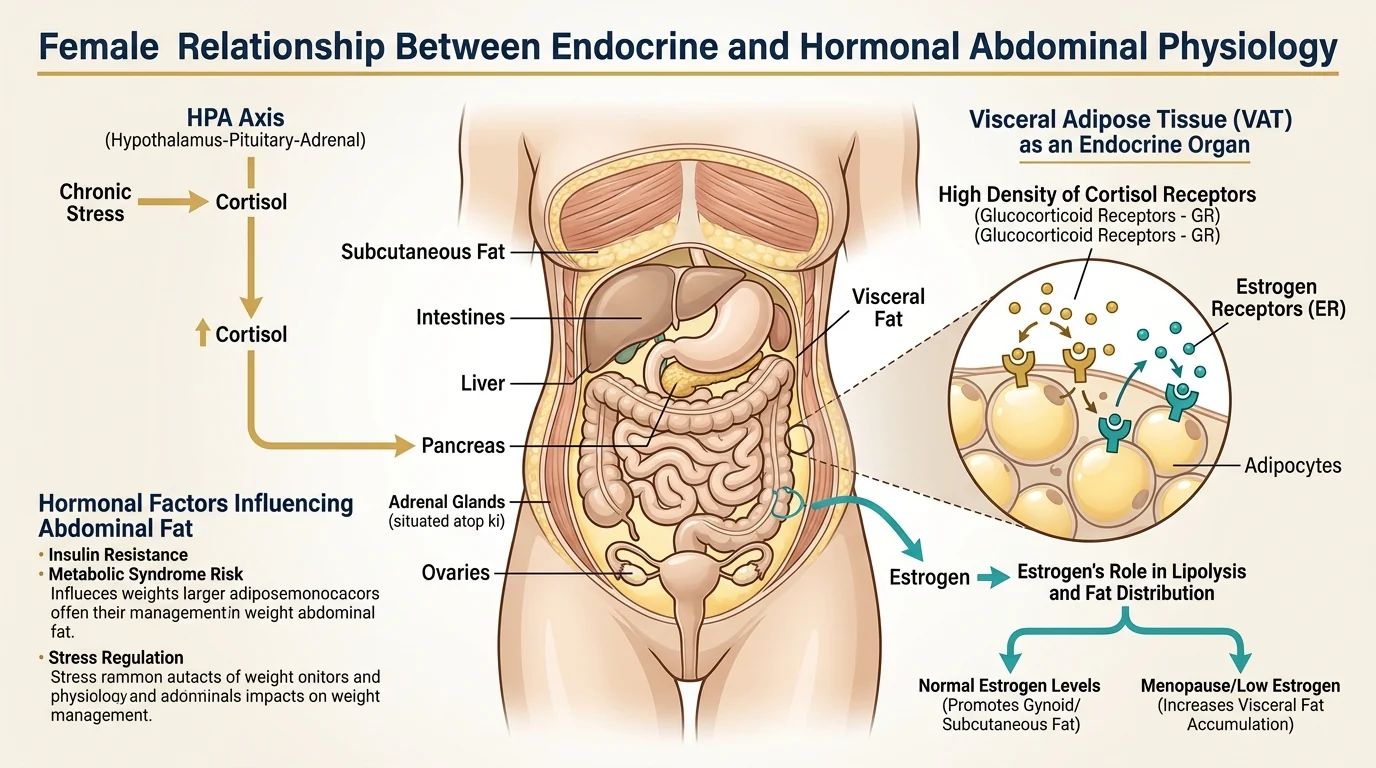
Estrogens and progesterone shape where the female body prefers to store fat. During the reproductive years, fat tends to be stored more on the hips, thighs, and lower body — a pattern linked to reproductive role. As estrogens decline, fat distribution shifts centrally, and the abdomen begins to hold a larger share.Toth MJ, et al. (2000). Effect of menopausal status on body composition and abdominal fat distribution. International Journal of Obesity.
The practical takeaway: the lower belly can become more prominent as hormones change, even when total weight is stable. Understanding that some of this is hormonal — not behavioral — sets a more realistic, kinder expectation.
Menopause, Estrogen, and the Belly Shift
The menopausal transition is a key window where abdominal fat tends to increase. Declining estrogen is associated with a redistribution of fat toward the trunk and an increase in visceral fat, independent of total body weight in some studies.Toth MJ, et al. (2000). Effect of menopausal status on body composition and abdominal fat distribution.
This matters because the same intake and activity that previously held the waist steady may now produce central gain, and because visceral fat is metabolically active, this pattern has health implications as well as aesthetic ones. The response is not to blame the mirror — it is to adapt the levers under your control.
Cortisol, Stress, and the "Hormone Belly"
Alongside estrogens, cortisol—the primary stress hormone—plays a strong role in the lower belly. Chronic stress keeps cortisol elevated, and cortisol physiology favors fat storage in the abdomen, particularly the deep visceral compartment.Epel ES, et al. (2000). Stress and body shape. Psychosomatic Medicine. Stress also raises cravings for energy-dense food, compounding the effect.
For women juggling work, caregiving, and daily demands, stress can be as influential as diet on where the belly sits. Regulating stress — a few minutes of slow breathing daily, regular movement, and protected boundaries — changes the storage environment. This is why the stress-weight link shows up so often in the midsection.
Sleep, Appetite Hormones, and the Belly
Short or poor sleep raises hunger-signaling ghrelin, lowers satiety-signaling leptin, and increases stress hormones — a triple effect that favors both eating more and storing centrally.Spiegel K, et al. (2004). Sleep curtailment in healthy young men is associated with decreased leptin levels, elevated ghrelin levels, and increased hunger and appetite. Annals of Internal Medicine. For women whose sleep is disrupted by hormonal cycles or caregiving loads, this is a quiet but powerful lever.
Protecting sleep does more than improve mood: it restores the hormones that make consistent, moderate eating the default, which is exactly what the last depot needs to move. It is the hidden mechanism behind poor sleep and weight gain.
Genetics, Muscle, and the "Last Depot"
Fat-loss order is largely genetic, and for many women the lower abdomen is gained early and released last.Loos RJF, Yeo GSH. (2022). The genetics of obesity: from discovery to biology. Nature Reviews Genetics. On top of this, crash dieting tends to lose muscle, and because muscle is metabolically active, losing it slows future fat loss.Paddon-Jones D, et al. (2008). Protein, weight management, and satiety. AJCN.
The combination explains the classic experience: scale falls, face and limbs thin, but the lower belly lags. This is normal, not failure — and it responds to patience plus a muscle-preserving approach rather than to ever-harsher restriction.
The "Hormone Belly" vs. The Belly That Responds
A useful mental model: the lower belly responds to the whole system, not to any single food or exercise. Hormones influence where fat prefers to sit, but the direction of change is still set by sustained energy balance, activity, sleep, and stress. Estrogen does not make the belly impossible to change; it changes the timeline and the effort required.
This is why so-called "hormone belly cures" — teas, creams, and supplements that promise to "balance hormones" — rarely deliver. They ask you to skip the actual levers. The reliable path is the unglamorous one: consistent deficit, preserved muscle, protected sleep, and regulated stress, measured honestly over months.
Practical Plan for the Stubborn Lower Belly
- Modest, sustainable deficit. Extreme restriction backfires by driving muscle loss and rebound biology. A small, consistent deficit wins over months.
- Regulate stress. Cortisol favors abdominal storage; daily slow breathing or movement changes the environment.
- Protect sleep. Sleep governs the appetite hormones and glucose handling the belly responds to.
- Preserve muscle. Adequate protein and resistance work keep the loss as fat, not lean tissue.
- Adapt to hormone shifts. Around menopause, accept a slower timeline and measure waist trends over weeks, not days.
- Ignore "hormone-balancing" marketing. No tea, wrap, or supplement selectively removes lower belly fat.
Lower Belly Fat in Women: Drivers and Levers
| Driver | What It Does | Practical Lever |
|---|---|---|
| Hormone shifts | Estrogen decline redistributes fat centrally | Adapt expectations, measure trends |
| Cortisol / stress | Chronic stress favors abdominal storage | Stress regulation, breathing |
| Short sleep | Raises hunger hormones and stress | Protect sleep |
| Genetics | Belly often the last depot | Patience, monthly tracking |
| Muscle loss | Crash dieting slows metabolism | Protein + resistance work |
| Spot-reduction myth | Targeted exercise does not remove belly fat | Whole-body activity |
Frequently Asked Questions
Why do women carry more fat in the lower belly?
Estrogens and progesterone shape female fat distribution, and as hormone levels change — especially through the menopausal transition — fat tends to shift from the hips and thighs toward the abdomen. This hormonal influence combines with stress-derived cortisol, sleep, genetics, and energy balance to make the lower belly a common stubborn area.
Is "hormone belly" a real thing?
Yes, in the sense that hormone changes genuinely alter where fat prefers to accumulate. But the belly still responds to the same systemic levers — sustained energy balance, activity, sleep, and stress. There is no special product that "balances hormones" enough to remove it; adaptation beats gimmicks.
How long does it take to lose lower belly fat in women?
Because the belly is often the last depot and hormone shifts can slow the timeline, visible change typically takes weeks to months of consistent, moderate deficit. Around menopause, allow an even longer window and judge progress by waist trends over weeks, not single days.
Does menopause make belly fat permanent?
No. Menopause changes the fat-loss timeline and effort required, but it does not remove the response to energy balance and activity. With a sustainable deficit, preserved muscle, protected sleep, and stress regulation, the belly can still change.
Do ab exercises target the lower belly in women?
They strengthen the lower-ab factor and improve posture and core support, but they do not selectively remove the fat over it. Whole-body activity and energy balance reduce the fat.
Can stress cause belly fat specifically in women?
Yes. Chronic stress raises cortisol, which favors abdominal storage, and many women carry high daily stress loads. Regulating stress is a genuine, evidence-backed lever for the belly, alongside diet and sleep.
Conclusion
The lower belly in women is persistent for real reasons: hormone-driven fat distribution, stress-derived cortisol, short sleep, genetics, and a fat-loss order that often releases the abdomen last. None of this is a personal failure — it is normal biology responding to estrogen, cortisol, and energy balance.
The response is to respect the hormones and work the system: a modest sustainable deficit, muscle preserved, sleep and stress protected, and honest weekly tracking. The lower belly changes more slowly and takes more patience than elsewhere, but it responds — reliably, when the system is right.
Educational content only. This article is for informational purposes and does not constitute medical advice. Fat distribution and weight are influenced by medical and hormonal conditions that may require evaluation. Consult a qualified healthcare professional before making changes to your health routine.