
1. The Biliary Tree: Anatomy and the Enterohepatic Circulation
The human liver continuously synthesizes approximately 500 to 1,000 mL of bile daily. Primary bile acids (cholic acid and chenodeoxycholic acid) are conjugated with glycine or taurine to form amphipathic bile salts, which are secreted through the hepatic ducts and stored in the gallbladder.
Within the gallbladder, bile is concentrated up to tenfold through epithelial water absorption. In healthy humans, 95% of secreted bile salts are actively reabsorbed in the terminal ileum via the apical sodium-dependent bile acid transporter (ASBT) and returned to the liver via the portal vein—a closed circuit known as the enterohepatic circulation that recirculates the body's bile pool 4 to 12 times per day.
2. The Vagal-CCK Synergy: How the Gallbladder Squeezes
Postprandial gallbladder emptying is an exquisite neuro-hormonal ballet. When dietary lipids and peptides enter the duodenum, mucosal enteroendocrine I-cells release cholecystokinin (CCK).
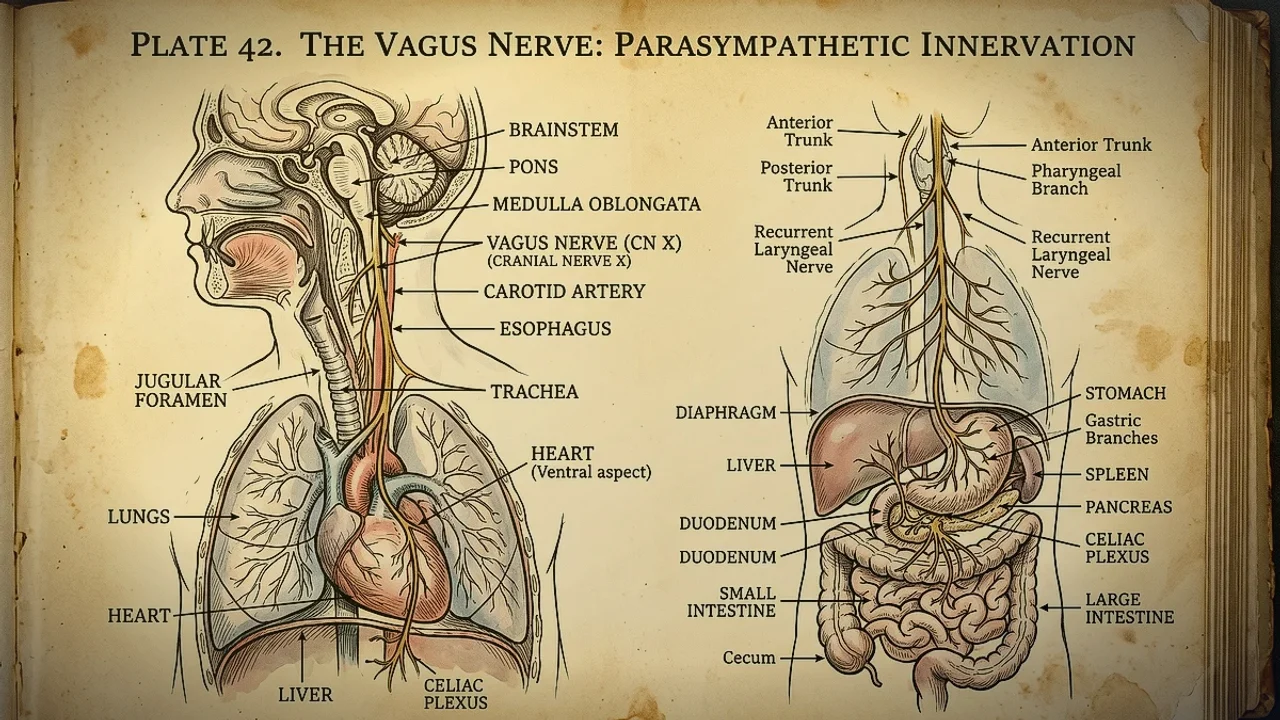
However, CCK does not act alone; it functions in obligatory synergy with the parasympathetic nervous system. CCK stimulates nodose ganglion vagal afferents, activating a vago-vagal reflex through the dorsal motor nucleus of the vagus:
- Efferent Cholinergic Drive: Vagal efferents release acetylcholine directly onto muscarinic M3 receptors on gallbladder smooth muscle cells, triggering forceful muscular contraction.
- Simultaneous Sphincter Relaxation: Vagal postganglionic NANC neurons release nitric oxide (NO) and VIP onto the sphincter of Oddi at the ampulla of Vater, causing the sphincter to open smoothly and allow concentrated bile to gush into the duodenum.
3. Sphincter of Oddi Dysfunction: The Autonomic Spasm
In our clinical examination of vagal control of bile release and digestion, we observe how autonomic stress disrupts this delicate coordination. When sympathetic adrenergic tone spikes, high circulating norepinephrine stimulates alpha-1 receptors on the sphincter of Oddi, while inhibitory nitric oxide release collapses.
The sphincter of Oddi enters sustained, hypertonic spasm. Even as the gallbladder contracts against food, the exit gate remains sealed shut. High-pressure bile backs up into the common bile duct and pancreatic duct, producing intense, stabbing right-upper-quadrant or epigastric pain that perfectly mimics gallstones (biliary colic), accompanied by transient liver enzyme elevations without any mechanical obstruction.
4. Bile Acid Malabsorption (BAM): The Chemical Diarrhea Trigger
When autonomic dysregulation causes erratic, sluggish gallbladder emptying, bile is released at the wrong physiological moments—often hours after food has already cleared the duodenum. This uncoordinated dumping overwhelms the active reabsorption capacity of the terminal ileum:
- Colonic Bile Spillover: Excess dihydroxy bile acids (chenodeoxycholic acid and deoxycholic acid) pour across the ileocecal valve into the colon.
- Adenylate Cyclase Activation: Free bile acids bind to TGR5 receptors on colonic enterocytes, stimulating cyclic AMP (cAMP) and activating the CFTR chloride channel.
- Secretory Osmotic Flush: Water and electrolytes are forcibly pulled into the colonic lumen, producing severe, watery, urgent, and often yellowish or burning diarrhea within 30 to 60 minutes after eating. Up to 30% of patients diagnosed with diarrhea-predominant IBS (IBS-D) actually have undiagnosed Bile Acid Malabsorption.
5. The HIDA Scan: Diagnosing Functional Gallbladder Disease
Because biliary dyskinesia is a functional motor disease rather than a structural lesion, abdominal ultrasounds are uniformly normal. Definitive diagnosis requires cholescintigraphy with CCK infusion (HIDA scan):
- A radiolabeled tracer (technetium-99m mebrofenin) is injected intravenously, taken up by hepatocytes, and secreted into the biliary tree and gallbladder.
- Synthetic CCK (sincalide) is slowly infused over 30 to 45 minutes to stimulate gallbladder contraction.
- The gamma camera calculates the Gallbladder Ejection Fraction (GBEF): a GBEF below 35% to 38% confirms hypokinetic biliary dyskinesia, while a GBEF exceeding 80% with severe pain indicates hyperkinetic gallbladder dysfunction.
6. Restoring Biliary Dynamics: Choleretics, Binders, and Vagal Reset
Resolving functional biliary and bile acid disorders involves multi-modal autonomic and biochemical interventions:
- Bile Acid Sequestrants (For BAM / Diarrhea): Cholestyramine, colestipol, or colesevelam binds free bile acids in the intestinal lumen, preventing them from irritating the colonic mucosa and stopping secretory diarrhea within 48 hours.
- Herbal Choleretics & Cholagogues: For hypokinetic biliary dyskinesia without diarrhea, herbs like artichoke leaf (cynarin), milk thistle (silymarin), and taurine stimulate liver bile production and promote smooth gallbladder contraction.
- Phosphatidylcholine & Taurine: Supplying the essential biochemical building blocks for bile salt conjugation thins viscous bile and prevents crystal formation in sluggish gallbladders.
- Sympathovagal Balancing at Meals: Slow, diaphragmatic breathing with deep exhalations for 3 minutes before eating downregulates splanchnic sympathetic tone, preventing sphincter of Oddi spasms.