
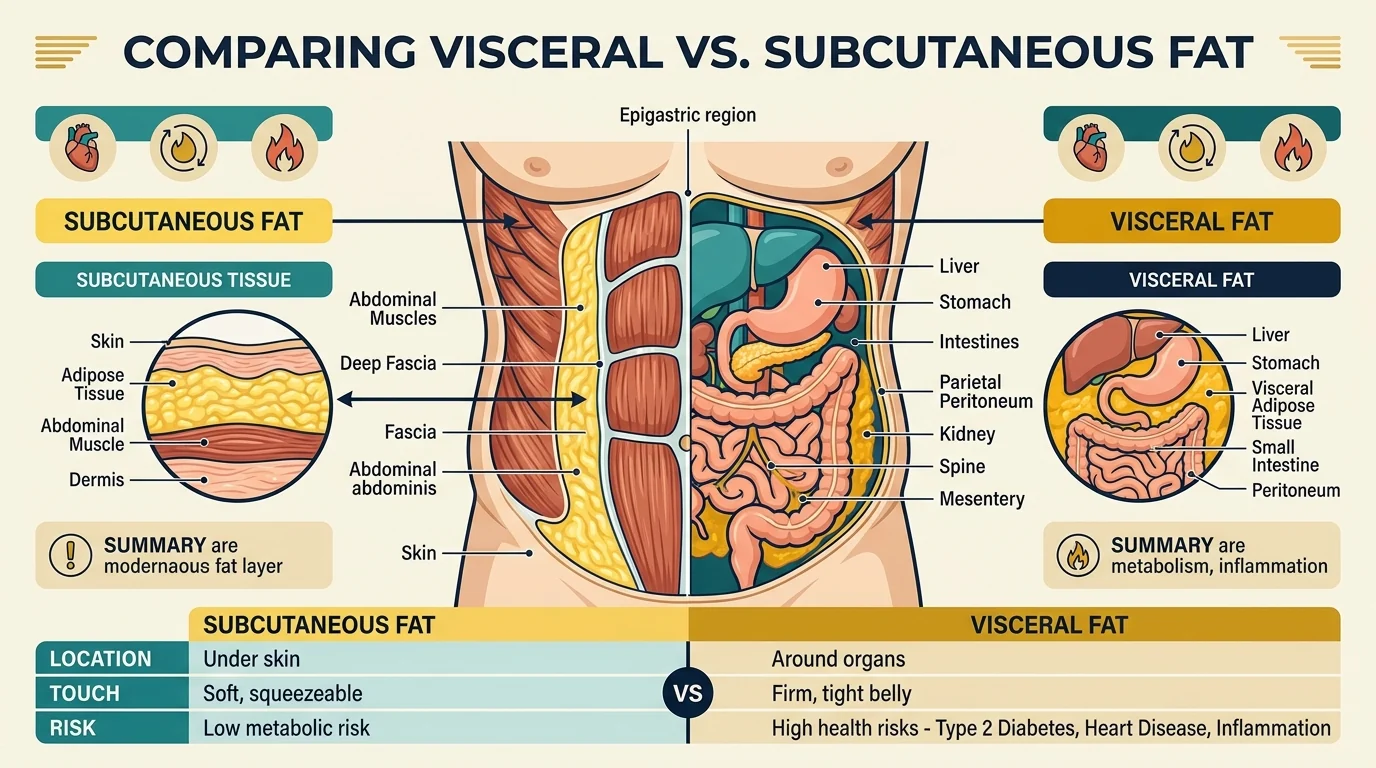
Not All Fat Behaves the Same
From the outside, all fat looks alike. That is misleading. Human fat is stored in at least two compartments that behave very differently, and the belly contains the metabolically active one. Understanding the difference between "belly fat" and "regular fat" explains a great deal about health and about why the waist responds the way it does.
This article compares the two, in plain language, and connects the difference to the larger picture of how the modern environment drives weight gain.
Subcutaneous Fat: The "Regular" Kind
Subcutaneous fat sits under the skin, across the thighs, arms, hips, and much of the body. It stores energy relatively calmly, releases fatty acids slowly, and is comparatively inert metabolically. Excess of it is a cosmetic and mobility concern, but it carries markedly less metabolic risk than the deep-abdominal kind.
Because it is less metabolically active, subcutaneous far can feel "stubborn," but it is also the kind that poses less immediate threat to metabolic health. It is the layer you can pinch on the thigh or the outer belly.
Visceral Fat: The "Belly-Deep" Kind
Visceral fat wraps around the organs — the liver, intestines, and pancreas. It is metabolically active: it releases inflammatory signals and fatty acids, and it is closely associated with metabolic risk, insulin resistance, and conditions like nonalcoholic fatty liver disease.Kahn SE, et al. (2006). Mechanisms linking obesity to insulin resistance and type 2 diabetes. Nature. Its fatty acids drain directly into the portal circulation to the liver, which is why it has outsized effects.
This is what makes "belly fat" different in substance from "regular fat": it is not a different molecular species, but its location and activity give it a different metabolic role. This is why waist circumference is used clinically as a risk indicator even in people of normal weight.
Why the Belly Holds More of the "Active" Kind
The abdomen is a common site for visceral fat, especially under chronic stress. Cortisol—the primary stress hormone—favors fat storage in the deep abdominal compartment.Epel ES, et al. (2000). Stress and body shape. Psychosomatic Medicine. Genetics also influence how much visceral versus subcutaneous fat a person stores and where.Loos RJF, Yeo GSH. (2022). The genetics of obesity: from discovery to biology. Nature Reviews Genetics.
The practical consequence: when people talk about losing "belly fat" for health, they almost always mean visceral fat. The good news is that visceral fat is among the most responsive to energy balance and physical activity — often shrinking before the subcutaneous layer the mirror shows.
Spot Reduction: A Case of Confusing the Two
The spot-reduction myth is partly a confusion between the two compartments. Crunches and "targeted" belly work build the muscle under the fat but do not selectively reduce the visceral or subcutaneous layer over it.Vispute SS, et al. (2011). The effect of abdominal exercise on abdominal fat. JSCR. Fat mobilization is whole-body, driven by hormones and energy balance.
That does not make exercise useless. Whole-body activity and resistance training create the deficit and insulin improvements that specifically reduce visceral fat. The value is systemic; the "targeting" is in the physiology, not in which muscle you contract.
Sleep and the Two Compartments
Short or poor sleep shifts appetite hormones and raises stress hormones, and it is associated with both greater overall weight gain and a larger waist — meaning the active (visceral) compartment is especially sensitive.Spiegel K, et al. (2004). Sleep curtailment in healthy young men is associated with decreased leptin levels, elevated ghrelin levels, and increased hunger and appetite. Annals of Internal Medicine. Protecting sleep is therefore a disproportionate lever for the belly.
This is the hidden axis behind poor sleep and weight gain. When sleep is short, both intake and central storage pressure rise; restoring sleep removes that pressure.
Which Kind Should You Care About?
The answer depends on your goal and your waistline. For cosmetic concerns, both kinds matter. For metabolic health, visceral fat is the priority. A rough, practical screen is waist-to-height ratio: a waist under roughly half your height correlates with lower metabolic risk. Regular exercise, a modest deficit, protected sleep, and managed stress all push visceral fat down first.
Belly Fat vs. Regular Fat: The Comparison
| Feature | Visceral (belly-deep) | Subcutaneous (regular) |
|---|---|---|
| Location | Deep, around organs | Under the skin |
| Metabolic activity | High — inflammatory, hormone-responsive | Low — relatively inert |
| Health association | Strong (insulin resistance, liver fat) | Weak metabolic risk |
| Response to training | No spot reduction; whole-body | No spot reduction; whole-body |
| Response to deficit | Often shrinks first | Often the slow, last layer |
| Main lever | Energy balance, activity, stress | Patience and consistency |
Frequently Asked Questions
Is belly fat the same as regular fat?
Biochemically it is the same stored energy, but it behaves differently by location. Deep visceral belly fat is more metabolically active and more closely associated with metabolic risk than subcutaneous (under-the-skin) fat, which is why waist circumference matters.
Why is belly fat more dangerous?
Visceral fat sits around the organs and drains fatty acids into the portal circulation to the liver, releasing inflammatory signals that are linked to insulin resistance and fatty liver. Subcutaneous fat is comparatively inert metabolically.
Can you turn belly fat into regular fat?
No — the compartments are distinct and neither converts into the other. But both respond to the same systemic levers (energy balance, activity, sleep, stress), and visceral fat typically shrinks first during weight loss.
Is losing visceral fat harder than subcutaneous fat?
Often the opposite. Visceral fat is generally among the most responsive to an energy deficit and physical activity, so it can decrease before the more stubborn subcutaneous layer visually changes.
Does exercise burn belly fat specifically?
No exercise selectively removes visceral or subcutaneous fat. Whole-body activity and resistance training create the deficit and insulin improvements that reduce visceral fat systemically — the question is the energy balance, not the target muscle.
How do I know if my belly fat is visceral?
Visceral fat is invisible from the outside; waist measurement is the practical proxy. A waist-to-height ratio below about 0.5 correlates with lower metabolic risk. Imaging, if needed, is done only under medical advice.
Conclusion
"Belly fat" and "regular fat" store the same energy, but their location changes their behavior. Deep visceral fat is metabolically active, closely tied to health risk, and — encouragingly — among the most responsive to energy balance; the subcutaneous layer is calmer, slower, and more stubborn.
For both kinds, the answer is the same systemic approach: a modest, sustainable deficit; preserved muscle; protected sleep; managed stress; and honest, multi-metric tracking over weeks. The belly responds to the system — whether you weigh it, measure it, or judge it by how your clothes fit.
Educational content only. This article is for informational purposes and does not constitute medical advice. Fat distribution and weight are influenced by medical and hormonal conditions that may require evaluation. Consult a qualified healthcare professional before making changes to your health routine.