
1. The Unique Pharmacology of Green Tea's Calm Molecule
For centuries, Zen Buddhist monks consumed bowls of matcha green tea before twelve-hour meditation vigils. They observed a distinct cognitive phenomenon: the beverage fostered sharp mental clarity and steady attention without the jittery palpitations or crash associated with other caffeinated drinks.
In 1949, Japanese scientists identified the molecular agent responsible for this paradox: L-theanine (gamma-glutamylethylamide). Unlike typical synthetic anxiolytics that indiscriminately depress the central nervous system, L-theanine modulates neural oscillations to induce calm alertness.
2. The 8–12 Hz Alpha Wave State: Relaxed Alertness Explained
Human electroencephalography (EEG) categorizes electrical brain activity into five primary frequency bands:
- Circadian Endocrine Diagnostics: Explore our research on cortisol levels chart by time of day.
- Foundational Neurobiology: Review our clinical analysis on the physiological sigh and autonomic anxiety reset.
- Delta (0.5–4 Hz): Deep non-REM slow-wave sleep and unconscious tissue regeneration.
- Theta (4–8 Hz): Drowsiness, hypnagogic imagery, and deep meditative reverie.
- Alpha (8–12 Hz): Calm, relaxed alertness, effortless focus, and open awareness.
- Beta (13–30 Hz): Active cognitive processing, logical analysis, but also anxiety, rumination, and stress.
- Gamma (30–100 Hz): High-level cognitive binding and sensory synthesis.
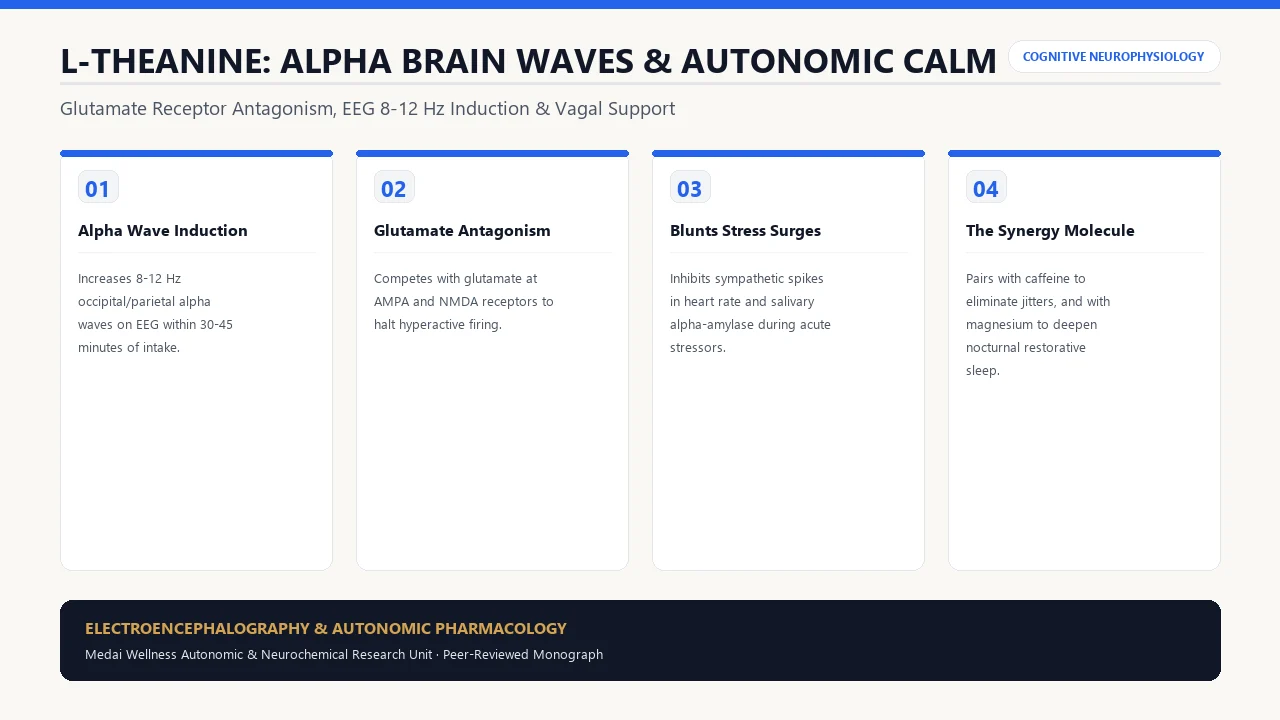
In high-anxiety states, the brain is locked in high-frequency beta wave dominance. Quantitative EEG studies have confirmed that a single 200 mg dose of L-theanine causes a statistically significant increase in alpha band (8–12 Hz) power, beginning approximately 30 minutes post-ingestion and persisting for 3 to 4 hours. This alpha wave burst is concentrated in the parietal and occipital cortices—the neurological hallmark of effortless focus.
3. Molecular Mechanisms: Glutamate, GABA, and Dopamine
L-Theanine crosses the blood-brain barrier via the leucine-preferring system and operates through three distinct molecular pathways:
- Competitive Glutamate Antagonism: Structurally resembling glutamate, L-theanine binds weakly to AMPA, kainate, and NMDA receptors, preventing excess glutamate from binding. This prevents calcium excitotoxicity during stress.
- Inhibition of Glutamine Transporters: It inhibits the astroglial uptake of glutamine, reducing the pool of substrate available for excessive glutamate synthesis.
- Modulation of Monoamines: L-Theanine elevates striatal dopamine and hippocampal serotonin concentrations, supporting mood elevation and cognitive flexibility.
4. Autonomic Buffering: Heart Rate and Salivary Alpha-Amylase
In double-blind, placebo-controlled human trials conducted during acute mental stress tasks (such as mental arithmetic or public speaking challenges):
| Biomarker / Stress Metric | Placebo Group During Stress | L-Theanine (200 mg) Group During Stress |
|---|---|---|
| Heart Rate (HR) | Spiked +18 to +24 bpm above baseline | Blunted to +4 to +7 bpm above baseline |
| Salivary Alpha-Amylase (sAA) | Massive sympathetic surge (+65%) | Significantly suppressed sympathetic secretion |
| Blood Pressure (Mean Arterial) | Elevated systolic & diastolic pressure | Normalized peripheral vascular resistance |
| Subjective Anxiety Score (STAI) | Severe acute tension & agitation | Marked reduction in state anxiety and cognitive distress |
5. Clinical Synergy: Caffeine, Magnesium, and Glycine Stacking
L-Theanine is uniquely versatile and acts synergistically in clinical stacks:
- The Smart Focus Stack (Caffeine + Theanine at 1:2 Ratio): Pairing 100 mg of caffeine with 200 mg of L-theanine eliminates caffeine-induced vasoconstriction, prevents jitters and heart racing, and enhances working memory accuracy on task-switching tests.
- The Nighttime Parasympathetic Stack: Combining 200 mg of L-Theanine with 3g of Glycine and 300 mg of Magnesium Glycinate shuts down pre-sleep mental chatter and lowers core body temperature without next-day grogginess.
6. Comparative Analysis: L-Theanine vs. Prescription Anxiolytics
| Attribute | L-Theanine (200–400 mg) | Benzodiazepines (e.g., Lorazepam) | SSRIs (e.g., Sertraline) |
|---|---|---|---|
| Mechanism | Glutamate receptor antagonism + Alpha wave induction | Positive allosteric modulation of GABAA receptors | Selective inhibition of serotonin reuptake (SERT) |
| Onset of Action | 30–45 minutes | 20–60 minutes | 4–6 weeks |
| Sedation & Motor Impairment | None; promotes relaxed focus | Significant drowsiness, ataxia, cognitive slowing | Variable (fatigue or insomnia) |
| Tolerance & Dependence | Zero tolerance or physical withdrawal liability | High risk of addiction, tolerance, and rebound panic | Physical withdrawal (discontinuation syndrome) |
Frequently Asked Questions
Can L-Theanine make you tired during the day?
No. L-theanine does not induce sleepiness on its own; it increases alpha waves, which reflect calm alertness. If you are extremely sleep-deprived, relaxing your sympathetic drive may allow your underlying exhaustion to surface, but L-theanine is not a sedative hypnotic.
What is the optimal therapeutic dose of L-Theanine for panic attacks?
Clinical trials typically utilize 200 mg for general cognitive relaxation and up to 400 mg for acute situational stress or panic symptoms. Doses are safe taken 1 to 2 times daily.
How quickly does L-theanine take effect?
L-Theanine is rapidly absorbed through the intestinal mucosa, with plasma concentrations rising within 15 minutes and peak brain concentrations and EEG alpha waves manifesting between 30 and 50 minutes post-consumption.