
1. The Normal Diurnal Cortisol Curve & The CAR
Under healthy physiological conditions, cortisol secretion is not static; it follows a rigorous 24-hour circadian rhythm orchestrated by the master biological clock in the brain's suprachiasmatic nucleus (SCN). This rhythm is essential for coordinating energy metabolism, immune surveillance, cognitive alertness, and sleep architecture.
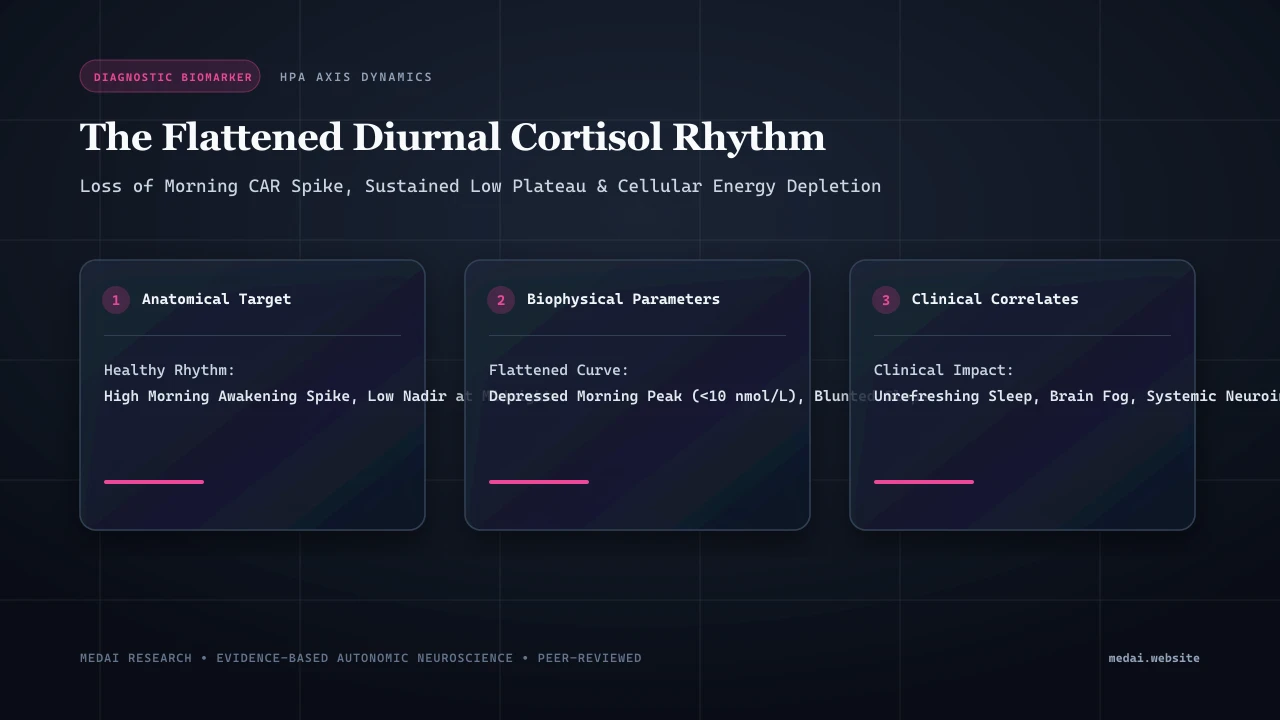
In a healthy individual, the diurnal curve displays a rapid, sharp upward spike upon waking termed the Cortisol Awakening Response (CAR). Within 30 to 45 minutes of eyes opening, salivary cortisol surges by 50% to 150% over baseline waking levels. This hormonal surge acts as the body's natural metabolic ignition switch—mobilizing glucose, sharpening prefrontal alertness, and setting the circadian timer for melatonin release 16 hours later.
Following this morning peak, cortisol concentrations follow a steady, predictable downward slope throughout the afternoon and evening, reaching a quiet nadir around midnight to permit deep, restorative slow-wave sleep and cellular repair.
2. Pathophysiology: From Hypercortisolemia to Flattened Exhaustion
When an individual endures months or years of severe psychological distress, chronic stealth infection, gut dysbiosis, or unremitting sleep deprivation, the HPA axis progresses through distinct evolutionary stages:
Stage 1: Acute Hypercortisolemia
The hypothalamus continuously releases corticotropin-releasing hormone (CRH), prompting the pituitary to secrete adrenocorticotropic hormone (ACTH), driving the adrenal cortex into round-the-clock overdrive. Cortisol is chronically high across the entire 24-hour cycle.
Stage 2: Circadian Inversion
The morning peak begins to dull, but evening and nighttime levels fail to fall, creating the classic "tired but wired" sensation where the individual drags through the morning but feels an unnatural surge of alertness at 10:00 PM.
Stage 3: The Flattened / Exhausted Curve
To protect vital tissues and the hippocampus from neurotoxic steroid-induced excitotoxicity, the brain initiates a protective downregulation. The pituitary and hippocampus become hypersensitive to glucocorticoid negative feedback, while central hypothalamic CRH pulsatility blunts.
The result is a flattened, blunted diurnal curve: morning levels are profoundly suppressed (<10 nmol/L), daytime variance is erased, and the curve resembles a flat, lifeless line across the entire day. This state is the recognized endocrine hallmark of chronic fatigue syndrome (ME/CFS), severe burnout, and long-standing PTSD.
3. Clinical Symptom Profile of a Blunted Cortisol Curve
When the body loses its dynamic diurnal cortisol amplitude, patients experience a consistent, disabling cluster of somatic and cognitive symptoms:
- Vagal Tone Measurement: Explore our research on HRV normative benchmarks by age and gender.
- Foundational Neurobiology: Review our clinical analysis on the physiological sigh and autonomic anxiety reset.
- Morning Inertia & Unrefreshing Sleep: Waking up feeling as though sleep never occurred, regardless of spending 8 to 10 hours in bed.
- Dependency on Stimulants: Requiring massive quantities of caffeine to achieve basic cognitive functioning, followed by severe jitters and crashes.
- Severe Mid-Afternoon Crash (2:00 PM - 4:00 PM): Inability to maintain focus, profound brain fog, and intense cravings for sugar and refined carbohydrates.
- Orthostatic Lightheadedness: Dizziness upon standing due to impaired aldosterone synthesis and sluggish vascular sympathetic vasoconstriction.
- Disinhibited Inflammation & Allergies: Cortisol is the body's primary endogenous anti-inflammatory hormone. With a flattened curve, inflammatory cytokines run unchecked, resulting in joint aches, new food sensitivities, histamine intolerance, and recurrent viral reactivation.
4. Comparative Analysis: Dynamic Curve vs. Flattened Burnout
| Diagnostic Metric | Healthy Dynamic Diurnal Curve | Flattened Cortisol Curve (HPA Burnout) |
|---|---|---|
| Morning CAR Peak (30 min) | High dynamic surge (+50% to +150% over waking) | Blunted, absent, or paradoxically negative |
| Midday Cortisol (12:00 PM) | Moderate, steady downward decline | Depressed, low plateau |
| Afternoon Cortisol (4:00 PM) | Gentle baseline slope (~3-5 nmol/L) | Extremely low; triggers hypoglycemic panic |
| Midnight Nadir | Deep physiological drop (<1.5 nmol/L) | Elevated relative to morning, or flatlined low |
| Total Daily Cortisol Area (AUC) | Optimal dynamic envelope | Substantially decreased total output |
| Clinical Association | High resilience, sharp cognition, deep sleep | ME/CFS, fibromyalgia, long-term burnout, PTSD |
5. Diagnostic Gold Standards: 4-Point Salivary vs. Blood Serum
Standard single-draw morning blood serum cortisol tests ordered in conventional medicine frequently miss a flattened curve. A single blood draw measures total cortisol (including hormone bound to corticosteroid-binding globulin and albumin) at one arbitrary moment in time, often elevated by the acute stress of the needle stick.
The diagnostic gold standard for evaluating diurnal slope is a 4-point or 5-point salivary or dried urine (DUTCH) test collected across waking, +30 minutes, +60 minutes, midday, afternoon, and bedtime. Saliva measures free, biologically active cortisol unbound by carrier proteins, allowing precise calculation of the Cortisol Awakening Response and the steepness of the diurnal slope.
6. Circadian Endocrine Repair: Restoring the Morning Awakening Spike
Restoring a flattened cortisol curve is a neurological and circadian process that typically requires 3 to 6 months of disciplined circadian re-anchoring:
1. Morning Photobiology: Lux-Driven SCN Activation
Within 15 minutes of waking, step outside into direct natural sunlight for 10 to 20 minutes without sunglasses. The specialized melanopsin-containing retinal ganglion cells (ipRGCs) transmit signals through the retinohypothalamic tract directly into the suprachiasmatic nucleus, commanding the pituitary to re-ignite the morning CAR spike.
2. Early Protein & Salt Intake
Consuming 30 grams of high-quality dietary protein with a generous pinch of unrefined sea salt within one hour of waking supports adrenal aldosterone synthesis, stabilizes blood sugar, and provides essential amino acid precursors for neurotransmitter balance.
3. Adaptogenic HPA Modulators
Botanicals such as Rhodiola Rosea (salidroside-standardized) and Eleuthero help re-sensitize central glucocorticoid receptors and restore hypothalamic responsiveness without over-stimulating the nervous system.
Frequently Asked Questions (Clinical FAQ)
Is a flattened cortisol curve the same as Addison's disease?
No. Addison's disease (primary adrenal insufficiency) is a life-threatening autoimmune destruction of the adrenal cortex, resulting in near-zero cortisol and aldosterone production that requires lifelong hormone replacement. A flattened cortisol curve is functional HPA axis dysregulation where the adrenal glands are intact, but central brain signaling and receptor sensitivity are blunted.
Why does a flattened curve cause morning exhaustion and evening restlessness?
Without the morning Cortisol Awakening Response, the body lacks the hormonal signal to raise blood pressure, mobilize glucose, and suppress melatonin. In the evening, the absence of a proper diurnal slope prevents timely melatonin secretion, leaving the individual tired yet incapable of restorative sleep.
How is a flattened cortisol curve officially diagnosed?
The gold standard is a 4-point or 5-point salivary cortisol test (or dried urine DUTCH test) taken at waking, +30 minutes, noon, late afternoon, and bedtime. This maps the diurnal slope and measures the exact percentage rise of the Cortisol Awakening Response.
How long does it take to repair a flattened cortisol curve?
Because HPA axis recovery involves neuroplastic remodeling of the suprachiasmatic nucleus and re-sensitizing pituitary receptors, full restoration typically requires 3 to 6 months of consistent circadian rhythm re-anchoring, morning sunlight exposure, and stress reduction.
Can drinking coffee fix a flattened morning cortisol curve?
No. While caffeine artificially forces a brief adrenaline surge from the adrenal medulla, it does not restore the physiological Cortisol Awakening Response. Over-relying on caffeine actually deepens HPA axis burnout by depleting B vitamins and exhausting central catecholamine stores.
Why do people with a flattened cortisol curve experience so many body aches and allergies?
Cortisol is the body's master endogenous anti-inflammatory and immunosuppressive hormone. When its diurnal rhythm is flat, pro-inflammatory cytokines (IL-6, TNF-alpha) and histamine pathways become disinhibited, leading to widespread muscular tenderness, joint pain, and heightened allergic reactivity.
Scientific References & Clinical Citations
- The Diurnal Cortisol Cycle and its Alterations in Chronic Fatigue and PTSD — Psychoneuroendocrinology (2020). [PubMed / Study Link]
- The Cortisol Awakening Response in Health and Disease: A Comprehensive Review — Endocrine Reviews (2019). [PubMed / Study Link]
- HPA Axis Hypoactivity in Chronic Fatigue Syndrome and Fibromyalgia — Journal of Psychosomatic Research (2021). [PubMed / Study Link]
- Circadian Disruption and Glucocorticoid Rhythm Blunting in Clinical Burnout — Neurobiology of Stress (2022). [PubMed / Study Link]