
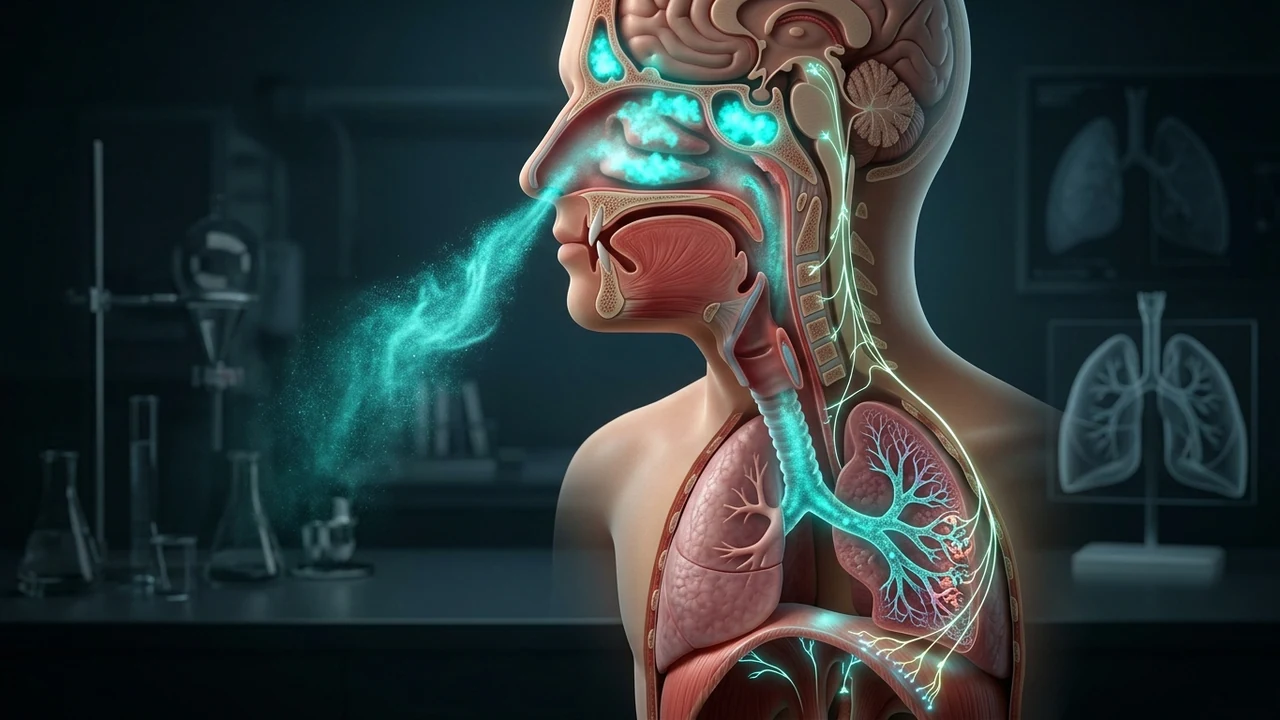
Biomechanics of the Larynx: The Acoustic Transducer
The human larynx is a suspension of cartilages, intrinsic muscles, and specialized mucosal membranes situated at the crossroads of the respiratory tract and digestive system. During quiet tidal breathing, the vocal folds remain abducted (separated), allowing laminar airflow into the lungs. However, during phonation, the thyroarytenoid and lateral cricoarytenoid muscles contract, adducting the vocal folds across the airway.
As expiratory air from the lungs is forced through this constricted glottic slit, the Bernoulli effect and tissue elasticity cause the vocal folds to vibrate rapidly, slicing the continuous airflow into discrete acoustic pressure waves. This phenomenon is known as the mucosal wave. Crucially, the subglottic mucosa and the inner lining of the thyroid and cricoid cartilages are densely innervated by the Internal Branch of the Superior Laryngeal Nerve (iSLN), a dedicated sensory branch of the vagus nerve. The iSLN contains an exceptionally high concentration of low-threshold, rapidly adapting mechanoreceptors that fire in direct proportion to the amplitude of mucosal oscillation.
The "VOO" Phonation: Peter Levine’s Somatic Mechanism
In somatic trauma therapy, the "VOO" sound is recognized for its ability to guide a patient out of acute sympathetic hyperarousal (fight-or-flight) or freeze without triggering cognitive overwhelm. From an acoustic standpoint, the "VOO" sound utilizes a low back rounded vowel ([u] in the International Phonetic Alphabet) combined with a voiced labiodental fricative [v].
This anatomical configuration provides three simultaneous physiological effects:
- Subglottic Pressure Stabilization: The partial occlusion of the lips against the teeth restricts air outflow, stabilizing transglottic pressure and preventing the vocal folds from colliding violently, which avoids vocal fatigue.
- Low-Frequency Resonance (80 - 150 Hz): The deep pitch creates physical vibrations that transmit through the sternum, mediastinum, and pericardium. Because the cardiac plexus of the vagus nerve wraps directly around the aortic arch and pulmonary trunk, these low-frequency acoustic vibrations provide gentle mechanical agitation to thoracic vagal fibers.
- Involuntary Exhalation Prolongation: Because air escapes through the constricted lips at a fraction of normal velocity, a single comfortable exhalation easily extends to 12 to 18 seconds, enforcing a 1:3 or 1:4 inhalation-to-exhalation ratio.
| Phonetic Sound | Vocal Tract State | Acoustic Back-Pressure | Primary Mechanoreceptor Target |
|---|---|---|---|
| Open "AH" | Fully Unoccluded | Negligible | Superficial oral mucosa (minimal vagal impact) |
| "VOO" (Somatic) | Labiodental Fricative + Rounded Vowel | High (Acoustic Reactance) | Superior laryngeal nerve & mediastinal cardiac plexus |
| "HUM" (Nasal) | Complete Labial Occlusion, Open Velopharynx | Very High (Intranasal Resonance) | Sphenoid sinus, ethmoid bone, maxillary nitric oxide |
| Straw Phonation | Artificial Narrow Bore Occlusion | Maximal Controlled Impedance | Intrinsic laryngeal mechanoreceptors, vocal fold unloading |
The Respiratory Sinus Arrhythmia (RSA) Amplification Cascade
The primary biometric consequence of elongated vowel phonation is the dramatic amplification of Respiratory Sinus Arrhythmia (RSA). RSA is the physiological phenomenon whereby heart rate accelerates during inhalation and decelerates during exhalation, mediated entirely by the cardiac branches of the vagus nerve.
During inhalation, pulmonary stretch receptors send inhibitory signals via the vagus nerve to the nucleus ambiguus, temporarily switching off the "vagal brake" so the heart can beat faster to oxygenate incoming blood. During the subsequent elongated "VOO" or "HUM" exhalation, this inhibition is completely lifted. The nucleus ambiguus fires at full capacity, showering the sinoatrial node with acetylcholine and dramatically lengthening interbeat intervals. When exhalations are sustained for 12 seconds, the drop in heart rate can be as large as 15 to 20 beats per minute from peak inhalation to trough exhalation. This rhythmic swing represents maximum autonomic flexibility and parasympathetic tone.
Clinical Prescription: The 5-Minute "VOO" Toning Protocol
Clinicians can prescribe this structured somatic exercise for patients experiencing acute anxiety, panic spikes, or chronic muscle clenching:
- Seated Stabilization: Sit on a firm chair with both feet planted flat on the floor. Allow the shoulders to drop away from the ears, relaxing the jaw muscles so the molars do not touch.
- Quiet Diaphragmatic Breath: Inhale gently through the nose for 3 seconds, feeling the abdomen expand outward like an inflating balloon. Avoid chest lifting.
- Deep "VOO" Phonation: On the exhale, sound a deep foghorn "VOOOOO" pitch. Make the pitch as low as comfortably possible without straining the throat. Feel the vibration rumbling through the sternum, belly, and pelvis.
- Expiratory Hold: Let the sound sustain until the air is comfortably exhausted (10 to 14 seconds). At the end of the sound, pause silently for 1 to 2 seconds before allowing the next breath to arrive naturally.
- Repetitions: Complete 8 to 10 continuous repetitions (approximately 3 to 4 minutes). Observe somatic indicators of nervous system regulation: spontaneous deep sighing, swallowing, or sensation of warmth in the extremities.
To further explore vocal medicine, review our foundational articles on acoustic stimulation of the nervous system and learn more about combining vocal exercises with structural adjustments in our guide to vocal cord exercises and vagal activation.