
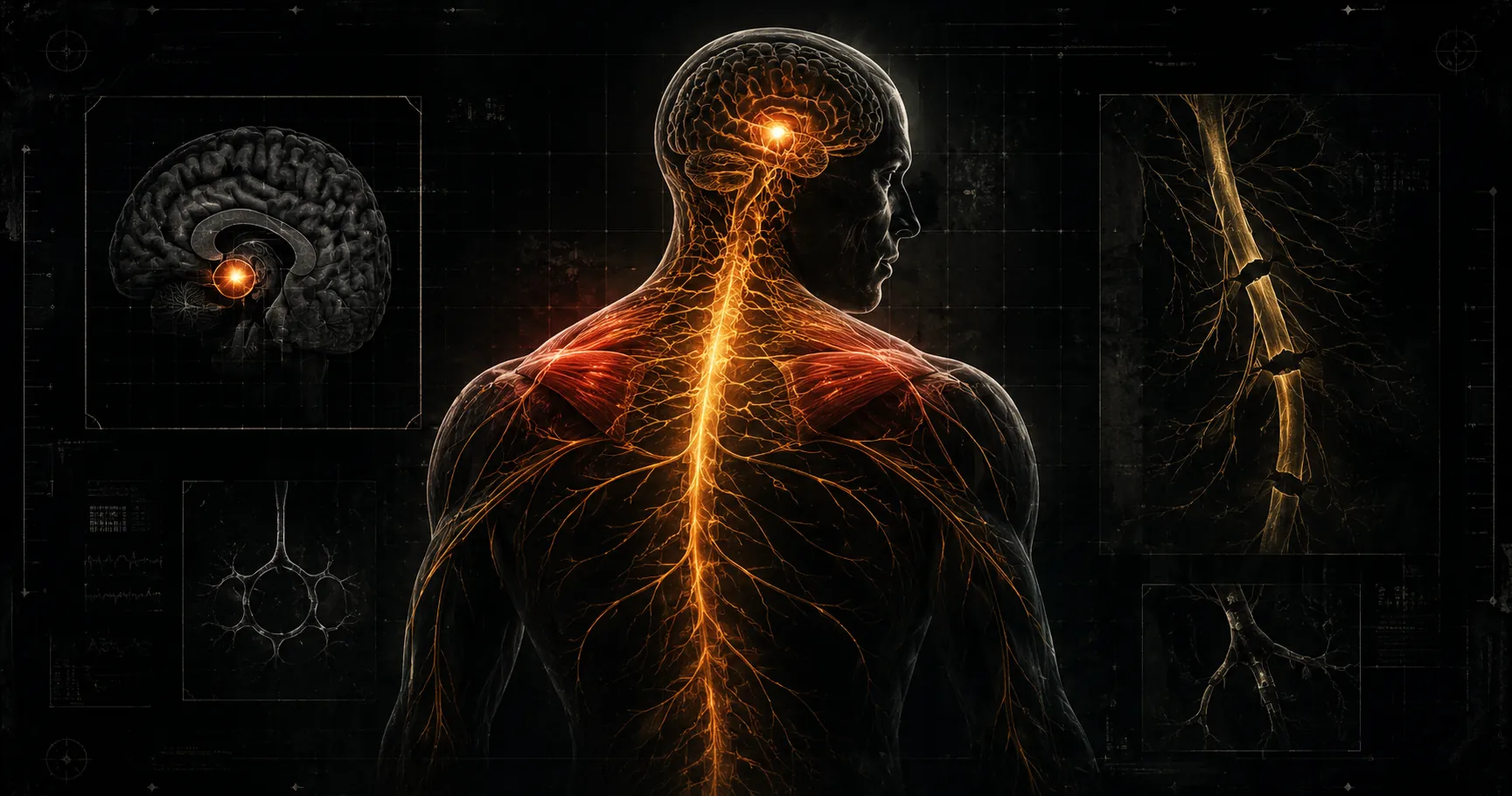
Medical Triage Alert: Prolonged autonomic exhaustion can mask or trigger cardiovascular events, immune suppression, and major depressive disorder. Seek qualified medical care if daily functioning is significantly impaired.
You wake up exhausted. Your shoulders are tight. Your mind is already racing before you've checked a single notification. You snap at people for no reason. Then you lie awake at night wondering why you can't just relax.
If this sounds familiar, you're likely experiencing chronic stress — not the occasional burst of pressure that helps you meet a deadline, but the low-grade, persistent activation of your sympathetic nervous system that never fully turns off.
In this guide, I'll walk you through the full chronic stress symptoms checklist, explain how chronic stress differs from anxiety and burnout, and show you the most effective natural ways to lower chronic stress — including the breathing protocol built on respiratory vagal stimulation.
What Is Chronic Stress, Medically?
Chronic stress is the body's prolonged physiological response to perceived threats that don't resolve. Unlike acute stress — which fires up and fades within minutes — chronic stress keeps the hypothalamic-pituitary-adrenal (HPA) axis active for weeks, months, or even years.
The result: sustained elevation of cortisol and adrenaline, reduced vagal tone, and a nervous system locked into sympathetic overdrive. Over time, this state rewires the brain and damages nearly every system in the body.
Chronic Stress Symptoms Checklist: 12 Signs Your Body Is Stuck in Fight-or-Flight
1. Persistent Fatigue That Sleep Doesn't Fix
When your body is in a constant state of alert, sleep becomes shallow and unrefreshing. You may sleep eight hours and still wake up drained because your nervous system never fully powered down.
2. Muscle Tension and Physical Pain
Chronic stress keeps muscles — especially in the neck, shoulders, jaw, and lower back — in a state of partial contraction. Over time, this leads to tension headaches, TMJ disorders, and chronic back pain.
3. Digestive Problems (IBS, Heartburn, Bloating)
The gut is densely innervated by the vagus nerve. Chronic stress disrupts peristalsis, reduces blood flow to the digestive tract, and alters the gut microbiome — a direct pathway to irritable bowel syndrome and acid reflux.
4. Racing Heart and Chest Tightness
Sustained sympathetic activation keeps your heart rate elevated and reduces heart rate variability. You may feel palpitations, a pounding sensation in your chest, or tightness even when there's no immediate danger.
5. Brain Fog and Poor Concentration
Elevated cortisol impairs hippocampal function and suppresses neurogenesis. This shows up as difficulty focusing, forgetfulness, slow processing speed, and a feeling of mental cloudiness.
6. Irritability and Emotional Reactivity
When the amygdala is sensitized by chronic stress, the prefrontal cortex loses its ability to regulate emotional responses. Small frustrations trigger disproportionate reactions.
7. Weakened Immune System
Cortisol suppresses immune function. You may get sick more often, take longer to recover from colds, or notice chronic low-grade inflammation in the form of skin breakouts, joint pain, or allergies.
8. Changes in Appetite and Weight
Chronic stress alters hunger hormones — ghrelin and leptin — often leading to increased cravings for sugar and fat, especially in the evening. This can cause unexplained weight gain, particularly around the abdomen.
9. Insomnia or Fragmented Sleep
A hyperactive HPA axis interferes with the sleep-wake cycle. You may have trouble falling asleep, wake up frequently during the night, or find yourself wide awake at 3 AM with a racing mind.
10. Reduced Libido and Sexual Function
Stress suppresses reproductive hormones. Low libido, erectile dysfunction, and menstrual cycle irregularities are common signs of prolonged stress exposure.
11. Dizziness and Tingling Sensations
Chronic stress can alter breathing patterns (shallow chest breathing), leading to reduced oxygen exchange, lightheadedness, and tingling in the hands or face.
12. Emotional Numbness or Detachment
When stress becomes overwhelming, the nervous system can shift into dorsal vagal shutdown — the freeze response. This manifests as emotional flatness, dissociation, and a sense of watching your life from behind glass.
Chronic Stress vs. Anxiety vs. Burnout: What's the Difference?
These three terms are often used interchangeably, but they describe distinct conditions:
- Chronic stress is a physiological state of prolonged HPA axis activation. It has measurable physical markers: elevated cortisol, low HRV, high blood pressure. It is the biological foundation.
- Anxiety is the psychological experience of worry, dread, or fear — often without a clear trigger. Chronic stress fuels anxiety by keeping the threat-detection system hypersensitive.
- Burnout is a state of emotional, physical, and mental exhaustion caused by excessive and prolonged stress. It's characterized by cynicism, reduced performance, and a sense of depleted energy.
You can have chronic stress without anxiety, and burnout without chronic stress symptoms — but in practice, they often overlap. Understanding the difference helps you choose the right intervention.
How Chronic Stress Rewires the Brain
Chronic stress doesn't just make you feel bad — it physically changes your brain structure:
- Amygdala enlargement: The brain's threat center grows larger and becomes more reactive.
- Hippocampal shrinkage: The memory and emotional regulation center loses volume, impairing learning and mood stability.
- Prefrontal cortex thinning: The logical decision-making region reduces in activity, making it harder to regulate impulses and emotions.
- Reduced vagal tone: The vagus nerve — the brake pedal of the nervous system — becomes less effective, making it harder to return to calm after stress.
These changes are reversible. The brain retains neuroplasticity throughout life, and the right interventions can restore healthy function.
Stress doesn't break you because you're weak. It breaks you because your nervous system has been running full throttle for so long it has forgotten how to coast. The override is mechanical — a slow exhale, repeated until the body remembers safety.
Natural Ways to Lower Chronic Stress Without Medication
Research published in Frontiers in Human Neuroscience (2018) and Scientific Reports — Nature (2021) confirms that certain interventions directly increase vagal tone and down-regulate the stress response:
- Respiratory vagal stimulation (rVNS): Slow, extended exhales mechanically activate the vagus nerve, shifting the body from sympathetic to parasympathetic dominance.
- Heart rate variability biofeedback: Training yourself to breathe at resonance frequency (~6 breaths per minute) maximizes HRV and resets autonomic balance.
- Cold exposure: The mammalian dive reflex (submerging the face in cold water) triggers vagal activation and reduces sympathetic tone.
- Moderate aerobic exercise: Regular movement at moderate intensity increases vagal tone and improves HRV over time.
- Sleep hygiene: Consistent sleep-wake cycles help the HPA axis recover and reduce baseline cortisol.
- Social connection: Positive social engagement activates the ventral vagal pathway (the social engagement system) and counteracts the stress response.
The sleep-support formula protocol combines these mechanisms into a structured system — 8 guided audio sessions that use precise breathing ratios to mechanically override the stress response, plus a 19-page dossier explaining the science.