
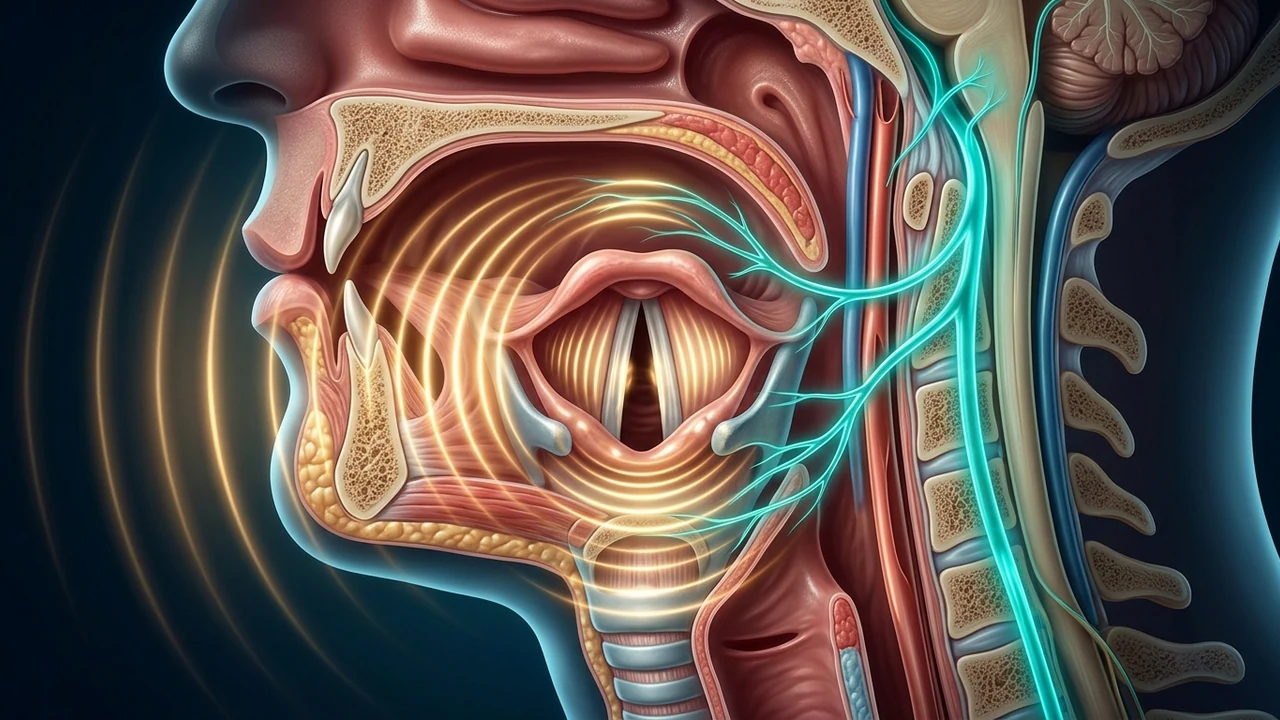
The Anatomical Pathway: From Vocal Cords to Brainstem Nuclei
The vagus nerve (Cranial Nerve X) provides the primary parasympathetic and sensory innervation for the pharynx, larynx, heart, lungs, and the gastrointestinal tract. Crucially, vocal production is inextricably linked with vagal anatomy through two major peripheral branches:
- The Superior Laryngeal Nerve (SLN): The internal branch pierces the thyrohyoid membrane to supply sensory innervation to the laryngeal mucosa down to the vocal cords. It is densely packed with Ruffini-like and Pacinian-like mechanoreceptors that fire in direct response to acoustic vibrations and fluid pressure changes.
- The Recurrent Laryngeal Nerve (RLN): This long, looping branch provides motor innervation to all intrinsic laryngeal muscles except the cricothyroid. It maintains vocal fold adduction and tension during sustained phonation.
When you articulate the sustained "O-M" phonation, the vocal folds oscillate together, generating acoustic pressure waves that reflect back into the subglottic space and thyroid cartilage. These mechanosensitive afferents transmit high-frequency electrical impulses via Cranial Nerve X directly into the Nucleus Tractus Solitarius (NTS) within the medulla oblongata. The NTS functions as the brain's central autonomic switchboard. Once excited by laryngeal vibratory input, the NTS engages the Nucleus Ambiguus, which immediately increases cardiopulmonary vagal outflow, decelerating the sinoatrial node and lengthening cardiac interbeat intervals (RR intervals).
Acoustic Resonance: 432Hz vs 440Hz and Somatic Coupling
Acoustics is not merely sound heard through the tympanic membrane; it is a physical force characterized by pressure differentials, displacement of tissue, and osseous conduction. In musical and acoustic literature, considerable debate exists regarding standard pitch calibration (440Hz concert pitch vs 432Hz natural harmonic tuning). From a neurobiological perspective, what matters is not numerology, but mechanical impedance matching between the fundamental pitch and human anatomical structures.
The human cranium, thoracic cage, and paranasal sinuses act as acoustic Helmholtz resonators. When vocal frequencies match the resonant frequency of these cavities—typically falling between 100Hz and 450Hz depending on individual anatomy—the amplitude of somatic tissue vibration increases dramatically without requiring increased vocal exertion. At around 432Hz (or its lower subharmonics at 216Hz and 108Hz, typical male and female chanting baselines), bone conduction through the sphenoid, ethmoid, and cervical vertebrae delivers direct mechanical oscillation to the carotid sinus and the jugular foramen, through which the vagus nerve exits the skull base.
| Phonation Mode | Dominant Frequency Band | Primary Anatomical Target | Autonomic Outcome |
|---|---|---|---|
| Sustained 'AAA' | 600 - 800 Hz | Oral Cavity & Hard Palate | Moderate sympathetic activation, open airway |
| Elongated 'OOO' | 300 - 450 Hz | Pharyngeal Wall & Larynx | Baroreflex stimulation, NTS afferent drive |
| Closed 'MMM' (Hum) | 120 - 250 Hz | Nasal Sinuses, Ethmoid Bone, Cribriform | 15-fold Nitric Oxide spike, maximal parasympathetic tone |
| Complete 'A-U-M' | Dynamic Sweep (120 - 700 Hz) | Full Cranio-Thoracic Circuit | Maximal Respiratory Sinus Arrhythmia (RSA) synchronization |
The Breathing Mechanics of Chanting: 0.1Hz Resonance Frequency
In addition to laryngeal vibration, chanting functions as an uncompromising physiological regulator of respiration. An individual cannot chant continuously while inhaling; vocalization is strictly expiratory. When practicing standard monastic chanting or yogic mantras, exhalations are naturally prolonged to 10 to 12 seconds, while inhalations occur rapidly in 2 to 3 seconds. This establishes a respiratory cycle of roughly 5 to 6 breaths per minute (0.1 Hz).
A breathing frequency of 0.1Hz represents the resonant frequency of the human cardiovascular baroreflex. At 0.1Hz, fluctuations in blood pressure, heart rate, and respiratory air volume synchronize into complete hemodynamic coherence. During the extended exhalation phase, intrathoracic pressure rises, venous return to the right atrium drops slightly, and the nucleus ambiguus releases acetylcholine onto M2 muscarinic receptors at the cardiac sinoatrial node, slowing the heart. As explored in our clinical deep-dive on humming and vagus nerve physiology, pairing extended phonation with nasal humming produces a 15-fold surge in endogenous nitric oxide gas from the maxillary sinuses, promoting systemic vasodilation and down-regulating peripheral vascular resistance.
Clinical Protocol: Executing Neuro-Acoustic OM Toning
For patients presenting with autonomic dysregulation, hyperarousal, or blunted heart rate variability, clinical bio-acoustic toning provides an accessible somatic intervention. The protocol should be executed as follows:
- Postural Alignment: Sit upright with an axial elongation of the cervical spine. This straightens the carotid sheath, ensuring the vagus nerve and glossopharyngeal nerve are not subjected to compression at the atlas (C1) and axis (C2) levels.
- Diaphragmatic Inflow: Take a quiet, nasal inhalation over 3 seconds, expanding the lower lateral ribs without elevating the clavicles or upper trapezius.
- Three-Stage Vocalization (12 seconds):
- Stage 1 ('A'): 3 seconds. Open mouth wide, focusing acoustic energy in the back of the throat.
- Stage 2 ('U'): 4 seconds. Round the lips into an 'O' shape, directing the vibration downward into the sternum and chest wall.
- Stage 3 ('M'): 5 seconds. Close the lips firmly, allowing the teeth to remain slightly parted. Direct all vibratory hum upward into the nasal sinuses, sphenoid bone, and crown.
- Repetition & Dosage: Repeat for 12 consecutive cycles (approximately 3 minutes). For advanced protocols, review our guide to vocal cord exercises and vagal activation to combine pitch modulation with somatic vagal conditioning.
Cardiopulmonary Biomarkers: What the Metrics Reveal
When evaluated via continuous lead-II electrocardiogram (ECG) and photoplethysmography (PPG), the autonomic shifts produced by chanting are immediate and quantifiable:
- RMSSD (Root Mean Square of Successive Differences): Typically increases by 25% to 40% within 180 seconds of continuous resonance chanting, reflecting augmented vagal motor output.
- High-Frequency (HF) Power (0.15 - 0.40 Hz): Shows pronounced consolidation at the exact respiratory frequency, demonstrating pure parasympathetic mediation via the cardiac vagus.
- Resting Pulse Rate: Drops by 4 to 9 beats per minute post-session as the cholinergic anti-inflammatory pathway attenuates sympathetic adrenergic drive.
For patients tracking autonomic recovery with wearable biometrics, these shifts can be cross-referenced with our comprehensive tutorial on respiratory sinus arrhythmia as a vagal tone biomarker.