
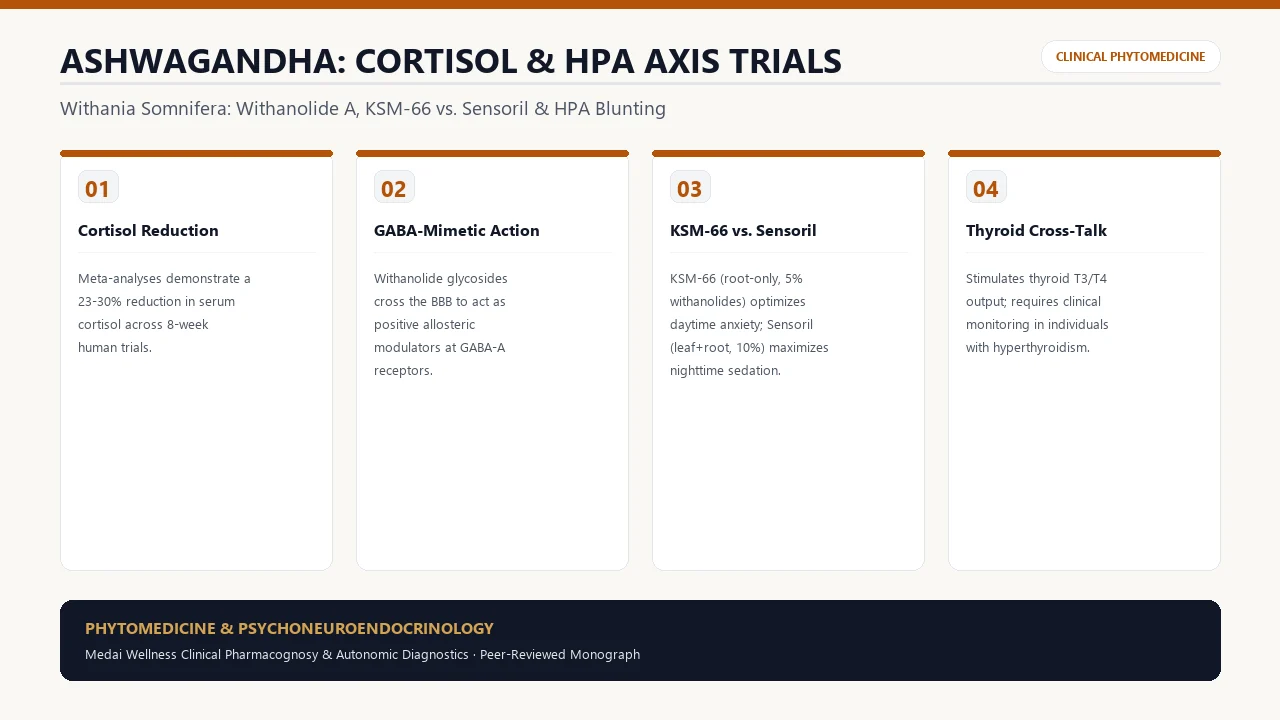
1. Botanical Overview: The King of Adaptogens
For over 3,000 years, the roots of Withania somnifera (traditionally called Ashwagandha in Sanskrit, translating to "smell of the horse" representing vitality and physical vigor) have formed the cornerstone of Ayurvedic rasayana rejuvenation therapy.
In modern psychoneuroendocrinology, ashwagandha has transitioned from traditional folklore into an rigorously validated adaptogen—a botanical substance that increases non-specific resistance to biological, physical, and emotional stressors without perturbing normal physiological parameters.
2. Active Phytochemistry: Withanolides and Withaferin A
The therapeutic efficacy of ashwagandha depends strictly on its concentration of bioactive steroidal lactones known as withanolides:
- Vagal Tone Measurement: Explore our research on HRV normative benchmarks by age and gender.
- Foundational Neurobiology: Review our clinical analysis on the physiological sigh and autonomic anxiety reset.
- Withanolide A and Withanolide D: Possess strong neuroprotective properties, stimulating neurite outgrowth, dendritic arborization, and synaptogenesis in hippocampal neurons.
- Withanoside IV and VI: Prevent stress-induced synaptic loss and attenuate microglial neuroinflammation.
- Withaferin A: A potent anti-inflammatory compound that inhibits NF-\(\kappa\)B, though excessive concentrations from raw leaf extracts can cause cytotoxicity. High-quality standardized extracts carefully control withaferin A ratios.
3. Systematic Review of Double-Blind Human Trials
The clinical reputation of ashwagandha is anchored in rigorous placebo-controlled evidence:
| Clinical Study & Reference | Sample & Dosage | Key Biomarker Outcomes |
|---|---|---|
| Chandrasekhar et al. (2012) Indian J Psychol Med |
64 chronically stressed adults; 300 mg KSM-66 twice daily vs. placebo (60 days). | 27.9% reduction in serum cortisol (p < 0.0001); 44.0% reduction on the Perceived Stress Scale (PSS). |
| Lopresti et al. (2019) Medicine (Baltimore) |
60 adults with mild anxiety; 240 mg standardized extract daily (60 days). | Statistically significant reduction in morning cortisol and DHEA-S; significant elevation in testosterone (men). |
| Salve et al. (2019) Cureus |
Randomized, double-blind trial evaluating sleep quality and anxiety scores. | Shortened sleep onset latency; significant improvement in sleep efficiency and mental alertness on waking. |
4. KSM-66 vs. Sensoril: Which Formulation Is Superior?
The two most prominent patented extracts on the market exhibit distinct biochemical profiles:
| Characteristic | KSM-66 Ashwagandha | Sensoril Ashwagandha |
|---|---|---|
| Plant Part Used | 100% Root extract (traditional water-milk extraction) | Root AND Leaf blend (aqueous extraction) |
| Standardized Withanolide Content | 5% withanolides by HPLC | 10% withanolides by HPLC (more concentrated) |
| Clinical Profile | Adaptogenic, physical performance, daytime anxiety relief | Deeply sedating, rapid cortisol suppression, nighttime sleep |
| Typical Dosage | 300 mg to 600 mg daily | 125 mg to 250 mg daily |
5. Central GABA-Mimetic and HPA Axis Mechanisms
Ashwagandha lowers stress through two complementary neurological pathways:
- Direct HPA Axis Blunting: Bioactive withanolides cross the blood-brain barrier and bind to hypothalamic glucocorticoid receptors, downregulating the transcription and pulsatile secretion of Corticotropin-Releasing Hormone (CRH). Without CRH stimulation, the pituitary secretes less ACTH, blunting adrenal cortisol output.
- GABA-A Receptor Modulation: Electrophysiological patch-clamp recordings prove that withanolides act as positive allosteric modulators at \( ext{GABA}_A\) receptors, augmenting chloride currents and dampening autonomic hyperarousal in a manner similar to low-dose endogenous neurosteroids.
6. Clinical Safety, Thyroid Interaction, and Cycling
To use ashwagandha responsibly:
- Thyroid Stimulation: Ashwagandha stimulates the thyroid gland, elevating free T3 and T4 levels. While beneficial for subclinical hypothyroidism, individuals with Hashimoto's hyperthyroidism or Graves' disease should avoid it.
- Autoimmune Precaution: Because it stimulates innate immune activity, individuals with systemic lupus or rheumatoid arthritis should exercise caution.
- The 8-Week Cycling Rule: To prevent down-regulation of endogenous adaptogenic response, take ashwagandha for 8 to 12 weeks, followed by a 2-week washout period.
Frequently Asked Questions
How quickly does ashwagandha begin lowering cortisol?
While subtle GABA-mimetic calming can be felt within 2 to 3 hours of an initial dose, significant systemic reductions in circulating serum cortisol and adrenal remodeling require 4 to 8 weeks of daily consistent administration.
Can ashwagandha cause emotional numbness (anhedonia)?
In a small subset of individuals (particularly when taken at high doses without cycling), excessive cortisol suppression and 5-HT1A serotonin receptor desensitization can produce an emotional flatness or anhedonia. If this occurs, immediately reduce dose or discontinue.
Is it better to take ashwagandha in the morning or before bed?
If taking KSM-66 for daytime focus and stress resilience, take 300 mg with breakfast. If taking Sensoril for insomnia and nocturnal adrenal surges, take 125–250 mg 45 minutes before sleep.